THE ACCURACY TEST OF TECHNICAL ANALYSIS OF MOVING AVERAGE, BOLLINGER BANDS, AND RELATIVE STRENGTH INDEX ON STOCK PRICES OF COMPANIES LISTED IN INDEX LQ45
DOI:
https://doi.org/10.22441/indikator.v6i2.14806Kata Kunci:
Technical Analyst, Moving Average, Bollinger Bands, Relative Strength Index, Stock Price MovementAbstrak
This study aims to test and provide empirical evidence of the accuracy of the technical analysis indicators Moving Average, Bollinger Bands, and Relative Strength Index in predicting the direction of stock price movements. This research focuses on stocks that represent the Indonesian stock Market, namely the LQ45 stock index for the period February 2021 - July 2021. Data were collected through the tradingview.com platform. To test the research hypothesis, the statistical differences between the predictions and the reality of stock price movement were tested using Mann-Whitney non-parametric test. The results of this study found that there was no difference between the predictions of the direction of stock price movements produced by the three indicators and the actual prices, which means that the three indicators are accurate. From the results of the analysis and comparison of the performance of the three indicators from the number of signals, the average rate of return, and the sample observations, it can be concluded that the Relative Strength Index indicator has a more optimal accuracy performance compared to the other two indicators. indicator. The results of this study can be used as a reference for capital market investors in choosing technical analysis methods that can help make more appropriate investment decisions.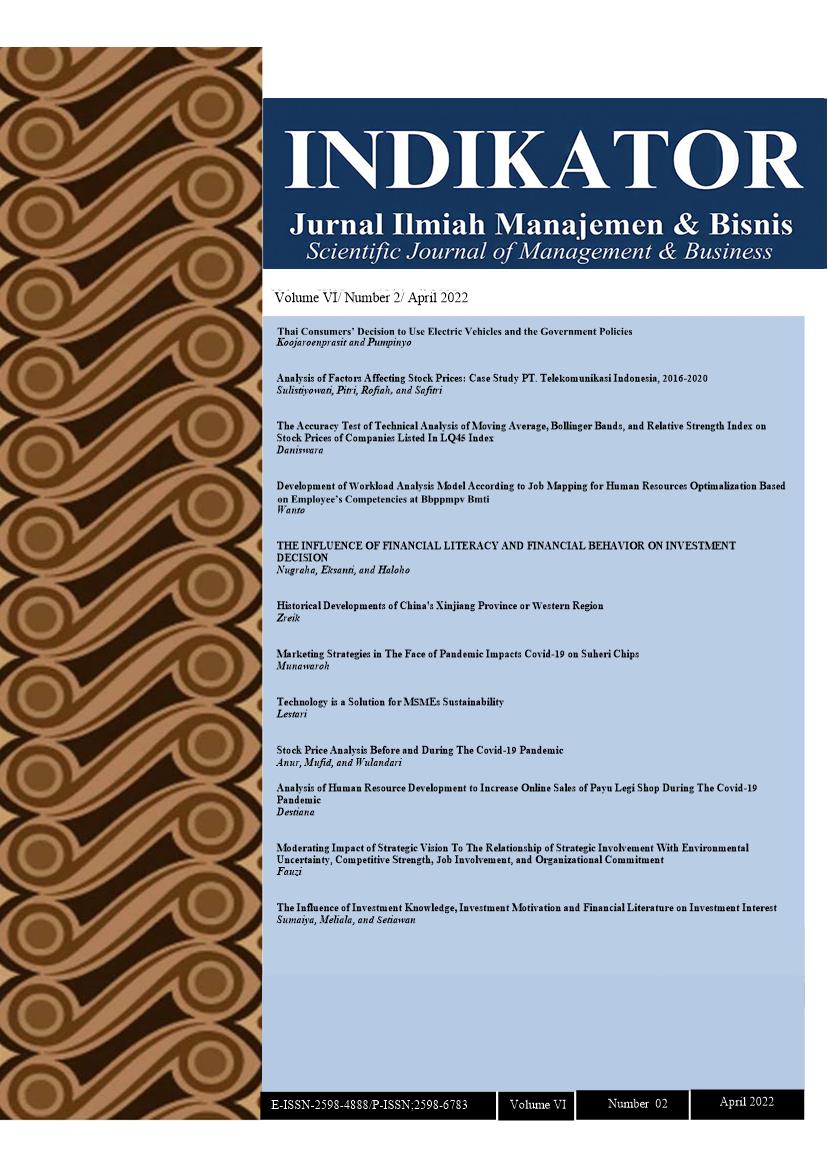
Unduhan
Diterbitkan
Cara Mengutip
Terbitan
Bagian
Lisensi
The copyright to this article is transferred to Universitas Mercu Buana (UMB) if and when the article is accepted for publication. The undersigned hereby transfers any and all rights in and to the paper including without limitation all copyrights to UMB. The undersigned hereby represents and warrants that the paper is original and that he/she is the author of the paper, except for material that is clearly identified as to its original source, with permission notices from the copyright owners where required. The undersigned represents that he/she has the power and authority to make and execute this assignment.
We declare that:
1. This paper has not been published in the same form elsewhere.
2. It will not be submitted anywhere else for publication prior to acceptance/rejection by this Journal.
3. A copyright permission is obtained for materials published elsewhere and which require this permission for reproduction.
Furthermore, I/We hereby transfer the unlimited rights of publication of the above mentioned paper in whole to UMB. The copyright transfer covers the exclusive right to reproduce and distribute the article, including reprints, translations, photographic reproductions, microform, electronic form (offline, online) or any other reproductions of similar nature.
The corresponding author signs for and accepts responsibility for releasing this material on behalf of any and all co-authors. This agreement is to be signed by at least one of the authors who have obtained the assent of the co-author(s) where applicable. After submission of this agreement signed by the corresponding author, changes of authorship or in the order of the authors listed will not be accepted.
Retained Rights/Terms and Conditions
1. Authors retain all proprietary rights in any process, procedure, or article of manufacture described in the Work.
2. Authors may reproduce or authorize others to reproduce the Work or derivative works for the authors personal use or for company use, provided that the source and the UMB copyright notice are indicated, the copies are not used in any way that implies UMB endorsement of a product or service of any employer, and the copies themselves are not offered for sale.
3. Although authors are permitted to re-use all or portions of the Work in other works, this does not include granting third-party requests for reprinting, republishing, or other types of re-use.
This work is also licensed under a Creative Commons Attribution-NonCommercial 4.0 International License.









