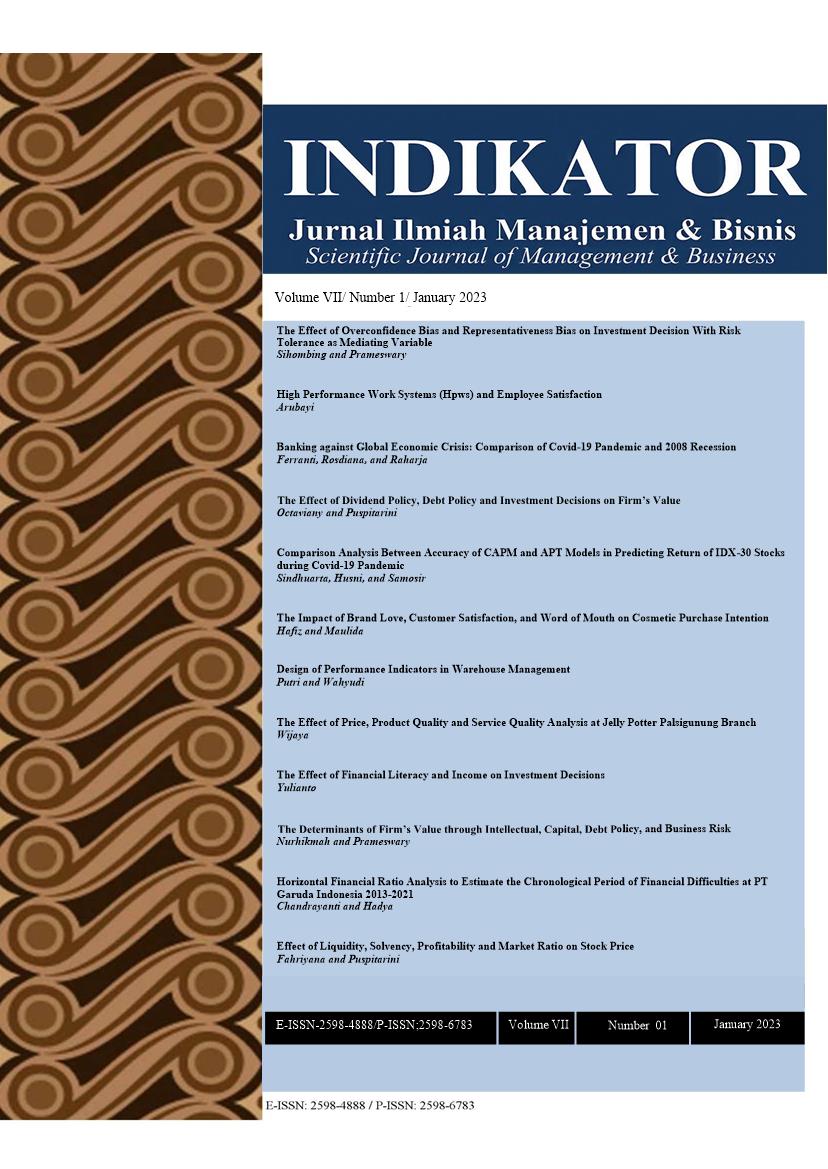
The Impact of Brand Love, Customer Satisfaction, and Word of Mouth on Cosmetic Purchase Intention
DOI:
https://doi.org/10.22441/indikator.v7i1.17107Kata Kunci:
Brand love, Customer Satisfaction, Word of Mouth, Purchase Intention, Brand Trust, Brand Image, Brand Experience, Self-Congruence,Abstrak
This study was conducted to explore The Impact of Brand Love, Customer Satisfaction and Word of Mouth on Luxcrime Cosmetics Purchase Intention. The contribution of this research is expected to be able to add information at the theoretical/scientific level of marketing management and also provide an increase in Service Excellent in the cosmetic industry sector. Primary data in this study were collected through questionnaires with a total of 260 respondents who live in Jabodetabek and have purchased Luxcrime brand cosmetic products and used this product more than once. The data analysis technique used by researchers in this study is partial least squares structural equation modeling. The results of this study indicate that six of the seven proposed hypotheses are accepted, while Brand Image cannot affect Brand Love. To make brand marketing more effective, marketers need to be aware of the emotional component of the company. In addition, achieving the highest level of brand love for a cosmetic brand can be an innovation for long-term success. For further research, researchers can expand research both from the demographics of research locations in Indonesia.
Unduhan
Diterbitkan
Cara Mengutip
Terbitan
Bagian
Lisensi
The copyright to this article is transferred to Universitas Mercu Buana (UMB) if and when the article is accepted for publication. The undersigned hereby transfers any and all rights in and to the paper including without limitation all copyrights to UMB. The undersigned hereby represents and warrants that the paper is original and that he/she is the author of the paper, except for material that is clearly identified as to its original source, with permission notices from the copyright owners where required. The undersigned represents that he/she has the power and authority to make and execute this assignment.
We declare that:
1. This paper has not been published in the same form elsewhere.
2. It will not be submitted anywhere else for publication prior to acceptance/rejection by this Journal.
3. A copyright permission is obtained for materials published elsewhere and which require this permission for reproduction.
Furthermore, I/We hereby transfer the unlimited rights of publication of the above mentioned paper in whole to UMB. The copyright transfer covers the exclusive right to reproduce and distribute the article, including reprints, translations, photographic reproductions, microform, electronic form (offline, online) or any other reproductions of similar nature.
The corresponding author signs for and accepts responsibility for releasing this material on behalf of any and all co-authors. This agreement is to be signed by at least one of the authors who have obtained the assent of the co-author(s) where applicable. After submission of this agreement signed by the corresponding author, changes of authorship or in the order of the authors listed will not be accepted.
Retained Rights/Terms and Conditions
1. Authors retain all proprietary rights in any process, procedure, or article of manufacture described in the Work.
2. Authors may reproduce or authorize others to reproduce the Work or derivative works for the authors personal use or for company use, provided that the source and the UMB copyright notice are indicated, the copies are not used in any way that implies UMB endorsement of a product or service of any employer, and the copies themselves are not offered for sale.
3. Although authors are permitted to re-use all or portions of the Work in other works, this does not include granting third-party requests for reprinting, republishing, or other types of re-use.
This work is also licensed under a Creative Commons Attribution-NonCommercial 4.0 International License.









