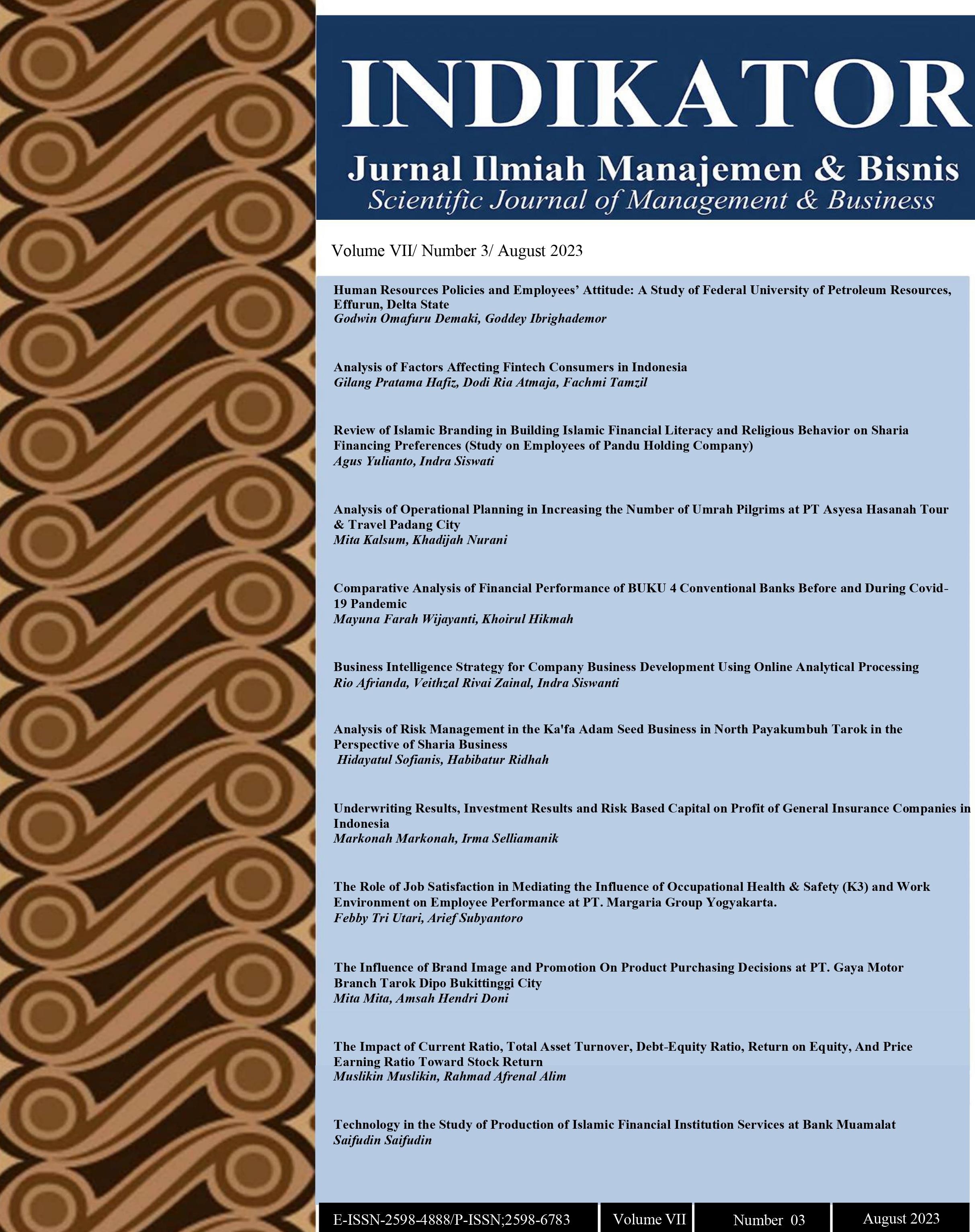
Technology in the Study of Production of Islamic Financial Institution Services at Bank Muamalat
DOI:
https://doi.org/10.22441/indikator.v7i3.19926Abstract
Financial technology is innovation related to financial services and technology, in which there are new applications, processes or models that aim to make it easier for society. The birth of this innovation made people's ability to be able to relate, especially in terms of transactions that were originally traditional to become modern or often called online. This study aims to determine the strengths, weaknesses, opportunities and threats of financial technology for banks in Indonesia at Bank Muamalat.
This type of research is descriptive qualitative research with the SWOT analysis method. Data collection was carried out using the method of literature study and documentation. The data source used is a secondary data source from the official website of Bank Muamalat obtained from information technology management reports published in 2020. The data analysis technique used is data reduction, data presentation and drawing conclusions.
Based on the research conducted, it is known that there are 4 analyzes, namely the strengths of financial technology, weaknesses in financial technology, opportunities in financial technology and threats to financial technology at Bank Muamalat. By looking at these four factors, there is a strategy especially for Bank Muamalat to increase market share and income.References
Adolfo Paolin et al. 2016. “Amniotic Membranes in Ophthalmology: Long Term Data on Transplantation Outcomes.” Cell and Tissue Banking volume: 51–58.
Alessandro R. Marcon, Blake Murdoch, and Timothy Caulfield. 2021. “Peddling Promise? An Analysis of Private Umbilical Cord Blood Banking Company Websites in Canada.” Cell and Tissue Banking: 609–622.
Alexandros A. Papantoniou. 2022. “Regtech: Steering the Regulatory Spaceship in the Right Direction?” Journal of Banking and Financial Technology: 1–16.
Alina Tatarenko. 2006. “European Regulations and Their Impact on Tissue Banking.” Cell and Tissue Banking: 231–235.
Charalampos Basdekis, Apostolos Christopoulos, Ioannis Katsampoxakis, and Aikaterini Vlachou. 2022. “FinTech’s Rapid Growth and Its Effect on the Banking Sector.” Journal of Banking and Financial Technology volume: 159–176.
Ilias Ioannou, and Guven Demirel. 2022. “Blockchain and Supply Chain Finance: A Critical Literature Review at the Intersection of Operations, Finance and Law.” Journal of Banking and Financial Technology volume: 83–107.
J. Mohr et al. 2016. “Disinfection of Human Musculoskeletal Allografts in Tissue Banking: A Systematic Review.” Cell and Tissue Banking volume: 573–584.
M. Germain et al. 2016. “Disinfection of Human Cardiac Valve Allografts in Tissue Banking: Systematic Review Report.” Cell and Tissue Banking: 593–601.
Martin Yuille et al. 2010. “The UK DNA Banking Network: A ‘Fair Access’ Biobank.” Cell and Tissue Banking: 241–251.
R. Villalba et al. 2004. “Evaluation and Utility of New CE Marked Containers (CELLFLEX- MacoPharma) for Bone Bank.” Cell and Tissue Banking: 267–269.
Sovan Mitra, and Andreas Karathanasopoulos. 2020. “FinTech Revolution: The Impact of Management Information Systems upon Relative Firm Value and Risk.” Journal of Banking and Financial Technology: 175–187.
Tien-Yu Hsu. 2021. “Machine Learning Applied to Stock Index Performance Enhancement.” Journal of Banking and Financial Technology: 21–33.
Published
How to Cite
Issue
Section
License
The copyright to this article is transferred to Universitas Mercu Buana (UMB) if and when the article is accepted for publication. The undersigned hereby transfers any and all rights in and to the paper including without limitation all copyrights to UMB. The undersigned hereby represents and warrants that the paper is original and that he/she is the author of the paper, except for material that is clearly identified as to its original source, with permission notices from the copyright owners where required. The undersigned represents that he/she has the power and authority to make and execute this assignment.
We declare that:
1. This paper has not been published in the same form elsewhere.
2. It will not be submitted anywhere else for publication prior to acceptance/rejection by this Journal.
3. A copyright permission is obtained for materials published elsewhere and which require this permission for reproduction.
Furthermore, I/We hereby transfer the unlimited rights of publication of the above mentioned paper in whole to UMB. The copyright transfer covers the exclusive right to reproduce and distribute the article, including reprints, translations, photographic reproductions, microform, electronic form (offline, online) or any other reproductions of similar nature.
The corresponding author signs for and accepts responsibility for releasing this material on behalf of any and all co-authors. This agreement is to be signed by at least one of the authors who have obtained the assent of the co-author(s) where applicable. After submission of this agreement signed by the corresponding author, changes of authorship or in the order of the authors listed will not be accepted.
Retained Rights/Terms and Conditions
1. Authors retain all proprietary rights in any process, procedure, or article of manufacture described in the Work.
2. Authors may reproduce or authorize others to reproduce the Work or derivative works for the authors personal use or for company use, provided that the source and the UMB copyright notice are indicated, the copies are not used in any way that implies UMB endorsement of a product or service of any employer, and the copies themselves are not offered for sale.
3. Although authors are permitted to re-use all or portions of the Work in other works, this does not include granting third-party requests for reprinting, republishing, or other types of re-use.
This work is also licensed under a Creative Commons Attribution-NonCommercial 4.0 International License.









