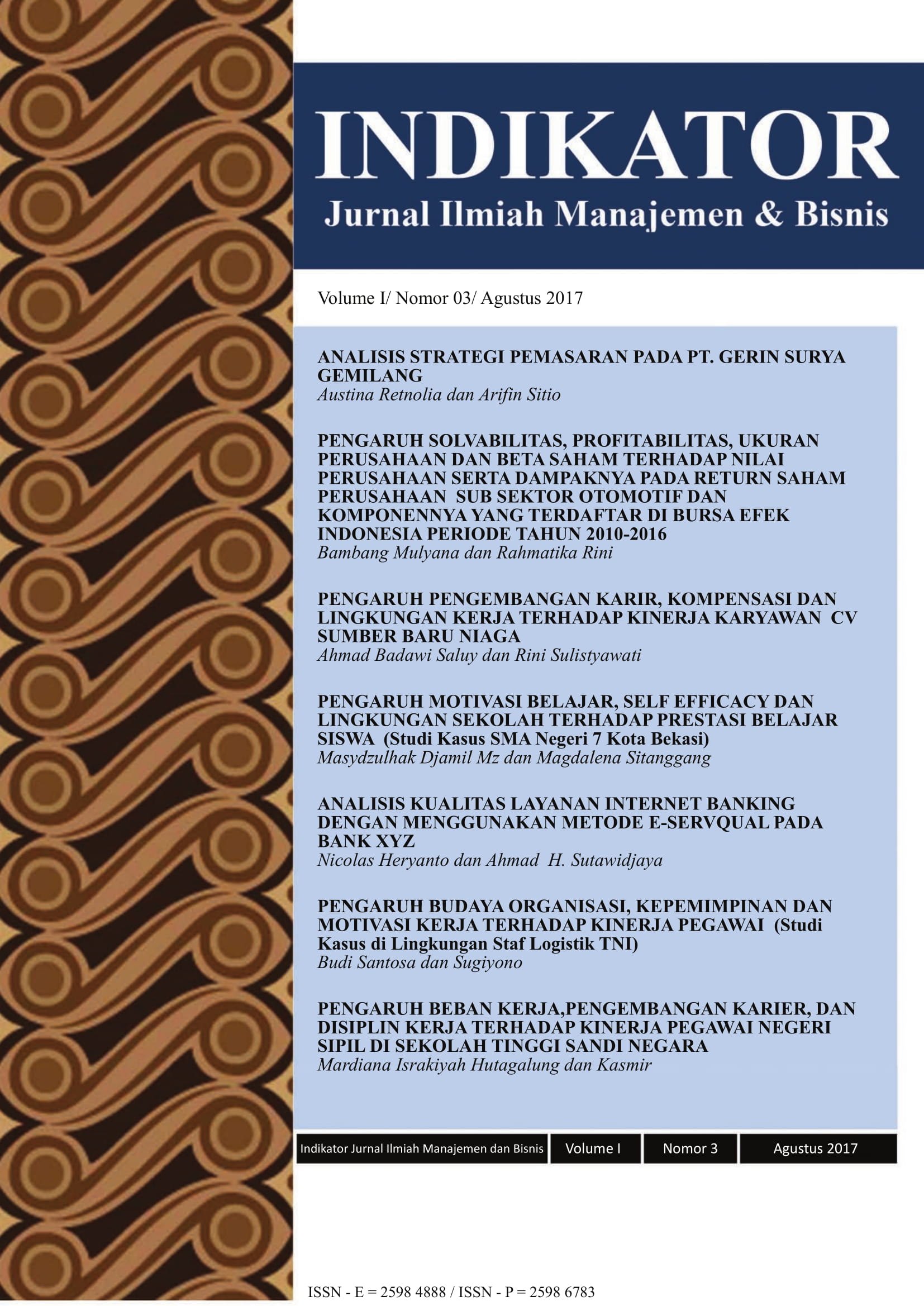
PENGARUH PENGEMBANGAN KARIR; KOMPENSASI DAN LINGKUNGAN KERJA TERHADAP KINERJA KARYAWAN CV SUMBER BARU NIAGA
DOI:
https://doi.org/10.22441/indikator.v1i3.2327Keywords:
employee development, compensation, work environment and employee performanceAbstract
This research aims to analyze the influence of the employees development; compensation and working environment on performance against partial and simultaneously at CV Sumber Baru Niaga. Research design is a descriptive quantitative research using a sample of 100 respondents as samples at the same time the population or sample is called saturated sampling. Model test using SPSS version 18.0.0.0. Test validity and reliability using Pearson Product Moment with significance level 0.05 and 0.01 multicollinearity test; with a threshold of tolerance of 0.10; test using the test of normality Kolmogorov-Smirnov. The conclusion that results obtained concludes the employee development and work environment has no significant influence on performance employees; hence the compensation and benefit has a significant influence on performance of employees. Simultaneously employee development; compensation; and work environment have a significant influence on performance of employees.
References
Robbins; Stephen P. dan Judge; Timothy A. 2015. Perilaku Organisasi. Jakarta : PT. Salemba Empat.
Septianto; D. 2010. “Pengaruh Lingkungan Kerja dan Stres Kerja Terhadap Kinerja Karyawan Studi Pada PT. Pataya Raya Utama”. Tesis. Universitas Diponegoro; hal. 11.
Sunyoto; D. 2012. Teori; Kuesioner; dan Analisa Data Sumber Daya Manusia (Praktek Penelitian); cetakan pertama. Yogyakarta: CAPS (Centre for Academic Publishing Service).
Sutrisno; Edy. 2010. Manajemen Sumber Daya Manusia. Jakarta: PT Prenada Media Group.
Yahman; Bahrul. 2009. Pengaruh Kompensasi dan Motivasi Kerja Terhadap Komitmen Organisasi di Organisasi Pendidikan Islam X; Vol. 8 No. 2; Agustus 2009. Fakultas Ekonomi & Ilmu Sosial UIN Jakarta. Jakarta.
Atma Negara; Ni Made Candra Megita. 2014. Pengaruh Pengembangan Karir Terhadap Kinerja Pegawai Pada Pt. Pos Indonesia (Persero) Kabupaten Jembrana Tahun 2014. Vol: 4 No: 1 Tahun: 2014.
Arnold; CA. 2007. The Strategic Importance Of Motivational Rewards For Lower-Level Employees In The Manufacturing And Retailing Industries SA. Journal of Industrial Psychology. Volume 33 (3) 15-23.
Abd Hamid; Nur Zainie. 2012. The Relationship Between Workplace Environment and Job Performance in Selected Government Offices in Shah Alam.international Review of Management and Business Research Vol 4 issue 3.
Benson; G. S. 2006. Employee development; commitment and intention to turnover: a test of ‘employability’ policies in action. Human Resource Management Journal; volume 16: 173–192.
Bacotic; Danica. 2013. Relationship between Working Conditions and Job Satisfaction. The Case of Croatian Shipbuilding Company International Journal of Business and Social Science Vol. 4 No. 2. February 2013.
Chong; E. and Ma; X. 2010. The Influence of Individual Factors; Supervision and Work Environment on Creative Self-Efficacy. Creativity and Innovation Management. Volume 19: 23 Corporate Ownership & Control / Volume 8; Issue 3; 2011.
Eppson; Catherine T; Smith; Wayne W; Stone; Ronald S. 2009. CEO Compensation And Firm Performance: Is There Any Relationship. Journal of Business & Economics Research. Littleton volume 7 issue 11 : 81-93.
Downloads
Published
How to Cite
Issue
Section
License
The copyright to this article is transferred to Universitas Mercu Buana (UMB) if and when the article is accepted for publication. The undersigned hereby transfers any and all rights in and to the paper including without limitation all copyrights to UMB. The undersigned hereby represents and warrants that the paper is original and that he/she is the author of the paper, except for material that is clearly identified as to its original source, with permission notices from the copyright owners where required. The undersigned represents that he/she has the power and authority to make and execute this assignment.
We declare that:
1. This paper has not been published in the same form elsewhere.
2. It will not be submitted anywhere else for publication prior to acceptance/rejection by this Journal.
3. A copyright permission is obtained for materials published elsewhere and which require this permission for reproduction.
Furthermore, I/We hereby transfer the unlimited rights of publication of the above mentioned paper in whole to UMB. The copyright transfer covers the exclusive right to reproduce and distribute the article, including reprints, translations, photographic reproductions, microform, electronic form (offline, online) or any other reproductions of similar nature.
The corresponding author signs for and accepts responsibility for releasing this material on behalf of any and all co-authors. This agreement is to be signed by at least one of the authors who have obtained the assent of the co-author(s) where applicable. After submission of this agreement signed by the corresponding author, changes of authorship or in the order of the authors listed will not be accepted.
Retained Rights/Terms and Conditions
1. Authors retain all proprietary rights in any process, procedure, or article of manufacture described in the Work.
2. Authors may reproduce or authorize others to reproduce the Work or derivative works for the authors personal use or for company use, provided that the source and the UMB copyright notice are indicated, the copies are not used in any way that implies UMB endorsement of a product or service of any employer, and the copies themselves are not offered for sale.
3. Although authors are permitted to re-use all or portions of the Work in other works, this does not include granting third-party requests for reprinting, republishing, or other types of re-use.
This work is also licensed under a Creative Commons Attribution-NonCommercial 4.0 International License.









