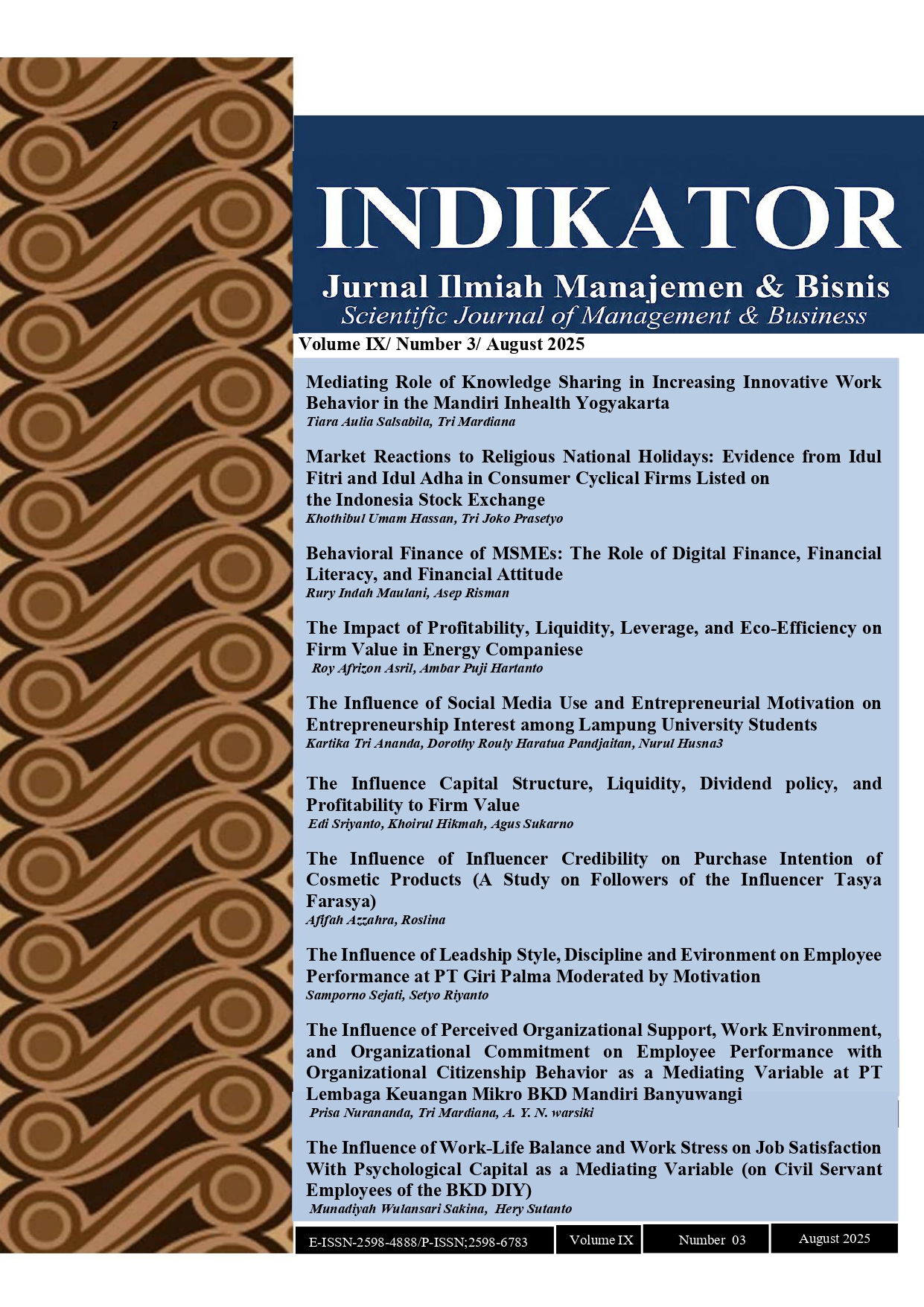
The Influence of Work-Life Balance and Work Stress on Job Satisfaction With Psychological Capital as a Mediating Variable (on Civil Servant Employees of the BKD DIY)
DOI:
https://doi.org/10.22441/indikator.v9i3.32490Keywords:
Work-Life Balance, Work Stress, Job Satisfaction, Psychological CapitalAbstract
Maintaining job satisfaction among civil servants is essential for ensuring the effectiveness and efficiency of public service delivery. In this context, factors such as work-life balance, work stress, and psychological capital play a crucial role. This study investigates the influence of work-life balance and work stress on job satisfaction, with psychological capital serving as a mediating variable among civil servants at the Regional Personnel Agency (BKD) of the Special Region of Yogyakarta (DIY). The population in this study consists of all BKD DIY employees, and the sampling technique employed is exhaustive sampling, resulting in a total of 85 respondents. Data were collected through the distribution of offline, hard-copy questionnaires and analyzed using Structural Equation Modeling–Partial Least Squares (SEM-PLS) with SmartPLS 4 software. The results indicate that work-life balance has a significant positive effect on job satisfaction, while work stress has a significant negative effect. In addition, psychological capital significantly mediates the relationship between work-life balance and job satisfaction, as well as the relationship between work stress and job satisfaction. These findings highlight the importance of strengthening psychological capital to enhance job satisfaction among civil servants.
References
Avey, J. B., Reichard, R. J., Luthans, F., & Mhatre, K. H. (2011). Meta-analysis of the impact of positive psychological capital on employee attitudes, behaviors, and performance. Human Resource Development Quarterly, 22(2), 127–152. https://doi.org/10.1002/hrdq.20070
Bergheim, K. M. J., Nielsen, M. B., Mearns, K. J., & Eid, J. (2015). The relationship between psychological capital, job satisfaction, and safety climate among maritime workers. Safety Science, 74, 27–36. https://doi.org/10.1016/j.ssci.2014.11.020
Hu, H. (2025). The impact of perceived stress on job satisfaction: The mediating role of burnout and moderating influence of psychological capital. BMC Nursing, 24(1), 112–125.
Kariri, H. D. (2023). The impact of psychological capital on job satisfaction and stress management in community nursing. SAGE Open, 13(2), 1–10.
Kurniawan, R., & Ardi, R. (2020). The effect of work stress on job satisfaction and organizational commitment. Jurnal Manajemen dan Kewirausahaan, 22(2), 91–99. https://doi.org/10.9744/jmk.22.2.91-99
Niswaty, R., Darma, R., Salam, R., & Umar, S. (2021). Authentic leadership, PsyCap, and work engagement: Evidence from public service organizations in Indonesia. PMC Public Health Research, 8(1), 234–243.
Saputri, I., Putra, A., & Rahayu, E. (2022). The effect of work-life balance, work stress, and work motivation through psychological capital on BNN millennial employees in Riau Islands. Jurnal Psikologi dan Organisasi, 11(2), 77–88.
Zega, E. A., & Zona, M. A. (2024). The influence of work-life balance on psychological well-being among Gen Z employees in Indonesian startups. International Journal of Emerging Markets Research, 19(1), 55–69.
Zhang, M., Wang, J., Li, Y., & Chen, H. (2023). The mediating role of organizational identification in the relationship between psychological capital and job satisfaction. Frontiers in Psychology, 14, 1188497. https://doi.org/10.3389/fpsyg.2023.1188497
Downloads
Published
How to Cite
Issue
Section
License
The copyright to this article is transferred to Universitas Mercu Buana (UMB) if and when the article is accepted for publication. The undersigned hereby transfers any and all rights in and to the paper including without limitation all copyrights to UMB. The undersigned hereby represents and warrants that the paper is original and that he/she is the author of the paper, except for material that is clearly identified as to its original source, with permission notices from the copyright owners where required. The undersigned represents that he/she has the power and authority to make and execute this assignment.
We declare that:
1. This paper has not been published in the same form elsewhere.
2. It will not be submitted anywhere else for publication prior to acceptance/rejection by this Journal.
3. A copyright permission is obtained for materials published elsewhere and which require this permission for reproduction.
Furthermore, I/We hereby transfer the unlimited rights of publication of the above mentioned paper in whole to UMB. The copyright transfer covers the exclusive right to reproduce and distribute the article, including reprints, translations, photographic reproductions, microform, electronic form (offline, online) or any other reproductions of similar nature.
The corresponding author signs for and accepts responsibility for releasing this material on behalf of any and all co-authors. This agreement is to be signed by at least one of the authors who have obtained the assent of the co-author(s) where applicable. After submission of this agreement signed by the corresponding author, changes of authorship or in the order of the authors listed will not be accepted.
Retained Rights/Terms and Conditions
1. Authors retain all proprietary rights in any process, procedure, or article of manufacture described in the Work.
2. Authors may reproduce or authorize others to reproduce the Work or derivative works for the authors personal use or for company use, provided that the source and the UMB copyright notice are indicated, the copies are not used in any way that implies UMB endorsement of a product or service of any employer, and the copies themselves are not offered for sale.
3. Although authors are permitted to re-use all or portions of the Work in other works, this does not include granting third-party requests for reprinting, republishing, or other types of re-use.
This work is also licensed under a Creative Commons Attribution-NonCommercial 4.0 International License.









