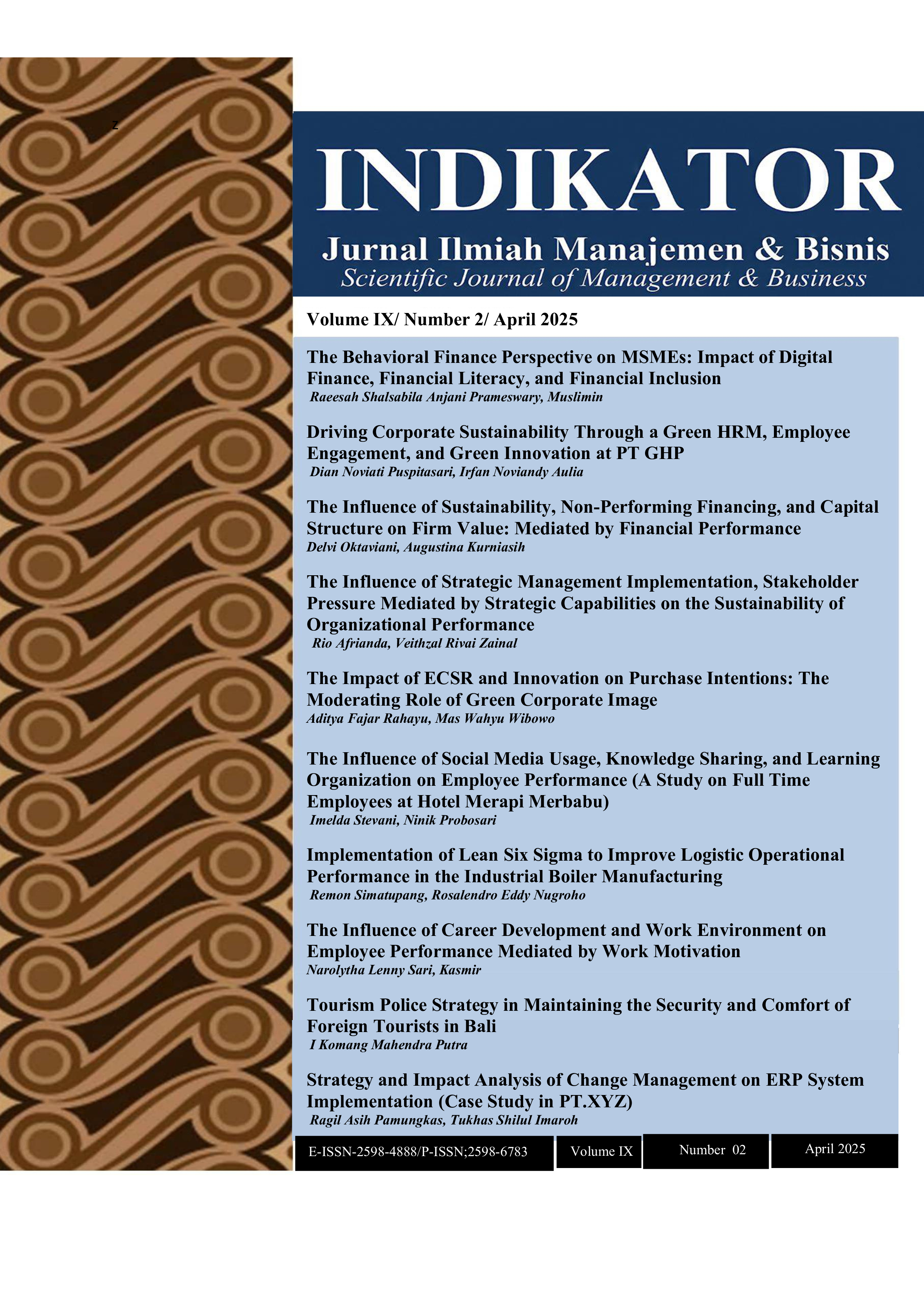
Driving Corporate Sustainability Through A Green HRM, Employee Engagement, and Green Innovation at PT GHP
DOI:
https://doi.org/10.22441/indikator.v9i2.32922Keywords:
Green Human Resources Management, Employee Engagement, Green Innovation, Corporate SustainabilityAbstract
Achieving sustainable economic growth while reducing environmental damage presents a significant challenge in the era of globalization and technological advancements. As primary contributors to greenhouse gas emissions, industries hold a pivotal position in advancing global initiatives aimed at meeting Sustainable Development Goals (SDGs). This study investigates the influence of Green Human Resource Management (GHRM) and Employee Engagement on Corporate Sustainability, with Green Innovation serving as a mediating variable on PT GHP. In this study, the researcher used a quantitative research type. The research model was analyzed using partial least squares structural equation modeling (PLS-SEM) with the Smart-PLS software, based on a sample of 56 respondents. The findings of this study reveal that GHRM and Employee Engagement have a positive and significant influence on Corporate Sustainability and Green Innovation. Furthermore, Green Innovation mediates the relationship between GHRM and Corporate Sustainability, while its mediating role on Employee Engagement is not statistically significant.
References
Amin. K., & Riyanto. S. (2022). Strategi Employee Engagement dalam Meningkatkan Motivasi Kerja Karyawan di PT. X. JOSR: Journal of Social Research. http://ijsr.internationaljournallabs.com/index.php/ijsr.
Ardiansyah, T. L. S. I., Hui, M., Sentoso, A., & Ikrom, Z. (2024). Analisa Corporate Social Responsibility Dan Green Human Resources Management Pada “Gojek”. Musytari: Neraca Manajemen, Akuntansi, dan Ekonomi, 3(4), 54-64.
Bahmani, S., Farmanesh, P., & Khademolomoom, A. H. (2023). Effects of green human resource management on innovation performance through green innovation: Evidence from northern Cyprus on small island universities. Sustainability, 15(5).
Deyas, C, E., & Sidjabat, M, R. (2022). Pengaruh Corporate Sustainability Reporting Terhadap Profitabilitas Perusahaan Non-Keuangan di Indonesia Pada Periode 2015 – 2019. Jurnal Manajemen dan Usahawan Indonesia. Vol.45 No.2 77-93. https://scholarhub.ui.ac.id/jmui/vol45/iss2/6
Dr. N. Deepalakshmi, et al. (2024) Employee Engagement And Organizational Performance: A Human Resource Perspective, Educational Administration: Theory and Practice, 30(4), 5941-5948, Doi: 10.53555/kuey.v30i4.2323.
Ewaldo, D., Tjan, C., Selli, S., & Kalalo, P. A. (2023). Analisa Corporate Social Responsibility (Csr) Dan Green Human Resource Management (Ghrm) Pada Pt Unilever Indonesia. Neraca: Jurnal Ekonomi, Manajemen dan Akuntansi, 1(5), 638-646.
Gallup. (2017). State of the Global Workplace. In Employee Engagement Insights for Business Leaders Worldwide. Gallup Press.
Ghardallou, W. (2022). Corporate Sustainability and Firm Performance: The Moderating Role of CEO Education and Tenure. Sustainability (Switzerland), 14(6). https://doi.org/10.3390/su14063513.
Ghozali, Imam dan Hengky Latan (2015). Partial Least Squares Konsep Teknik dan Aplikasi dengan Program Smart PLS 3.0. Semarang: Universitas Diponegoro Semarang.
Hair. F. Jr, Joseph., Hult, G. Thomas M., Ringle, Christian M., Sarstedt, Marko., Danks, Nicholas P., and Ray, Soumya. (2021). Partial Least Squares Structural Modeling (PLS-SEM) Using R. Springer Nature, Switzerland.
Hamid, R.S. dan Anwar, S.M. (2019). Structural Equation Modeling (SEM) Berbasis Varian: Konsep Dasar dan Aplikasi dengan ProgramSmartPLS3.2.8 dalam Riset Bisnis. Jakarta: PT Inkubator Penulis Indonesia.
Hussein, A.S. 2015. Penelitian Bisnis dan Manajemen Menggunakan Partial Least Square (PLS) dengan smartPLS 3.0. Fakultas Ekonomi dan Bisnis Universitas Brawijaya.
Kanan, M., Taha, B., Saleh, Y., Alsayed, M., Assaf, R., Hassen, M. B., Alshaibani, E., Bakir, A., & Tunsi, W. (2023). Green Innovation as a Mediator between Green Human Resource Management Practices and Sustainable Performance in Palestinian Manufacturing Industries. MDPI, Sustainability 2023, 15, 1077. https:// doi.org/10.3390/su15021077.
Lestari, S., & Nawangsari, L. C. (2022). The Influence of Employee Engagement to Support Corporate Sustainability at PT Wiza. JRSSEM. Vol. 2, No. 1, 83–99. DOI:10.36418/jrssem.v2i1.243.
Liao, Yu., Qiu, X., Wu, A., Sun, Q., Shen, H., & Li, P., (2022). Assessing The Impact Of Green Innovation On Corporate Sustainable Development. Frontiers in Energy Research. doi: 10.3389/fenrg.2021.800848.
Mambrasar, G. B., (2024). Indonesia Perlahan Tapi Pasti Mencapai Target SDGs Tahun 2030. CNBC Indonesia.
Novitasari, M. (2022). Jurnal Sustainable Jurnal Sustainable. Jurnal Sustainable, 01(1), 84–103.
Nugroho, M. A., & Tiarapuspa, T. (2023). Pengaruh Green Culture, Green Transformational Leadership, Green Human Resource Management Terhadap Green Organizational Citizenship Behavior. ETNIK: Jurnal Ekonomi dan Teknik, 2(4), 350-359.
Pinem, D., & Aulia, S. (2022). The Effect of Corporate Sustainability Performance on the Values of Companies Listed in the Sri Kehati Index. Formosa Journal of Sustainable Research, 2(3), 713-734.
Sharma, P. K., & Kumra, R. (2020). Relationship between workplace spirituality, organizational justice, and mental health: Mediation role of employee engagement. Journal of Advances in Management Research, 17(5), 627–650. https://doi.org/10.1108/JAMR-01-2020-0007
Sugiyono. (2019). Metode Penelitian Pendidikan (Pendekatan Kuantitatif, Kualitatif, dan R&D). Bandung : Alfabeta.
Utami, A. P., & Emilia, N. (2024). Pengaruh Green Human Resource Management, Green Innovation, Perceived Organizational Support dan Risk-Taking Corporate Sustainability. PUBLIK: Jurnal Manajemen Sumber Daya Manusia, Adminsitrasi dan Pelayanan Publik. Vol. 11 No.1. 314-330.
Zhao, W., & Huang, L. (2022). The impact of green transformational leadership, green HRM, green innovation and organizational support on the sustainable business performance: evidence from China. Economic Research-Ekonomska Istraživanja. Vol. 35, No. 1, 6121–6141. https://doi.org/10.1080/1331677X.2022.2047086.
Downloads
Additional Files
Published
How to Cite
Issue
Section
License
The copyright to this article is transferred to Universitas Mercu Buana (UMB) if and when the article is accepted for publication. The undersigned hereby transfers any and all rights in and to the paper including without limitation all copyrights to UMB. The undersigned hereby represents and warrants that the paper is original and that he/she is the author of the paper, except for material that is clearly identified as to its original source, with permission notices from the copyright owners where required. The undersigned represents that he/she has the power and authority to make and execute this assignment.
We declare that:
1. This paper has not been published in the same form elsewhere.
2. It will not be submitted anywhere else for publication prior to acceptance/rejection by this Journal.
3. A copyright permission is obtained for materials published elsewhere and which require this permission for reproduction.
Furthermore, I/We hereby transfer the unlimited rights of publication of the above mentioned paper in whole to UMB. The copyright transfer covers the exclusive right to reproduce and distribute the article, including reprints, translations, photographic reproductions, microform, electronic form (offline, online) or any other reproductions of similar nature.
The corresponding author signs for and accepts responsibility for releasing this material on behalf of any and all co-authors. This agreement is to be signed by at least one of the authors who have obtained the assent of the co-author(s) where applicable. After submission of this agreement signed by the corresponding author, changes of authorship or in the order of the authors listed will not be accepted.
Retained Rights/Terms and Conditions
1. Authors retain all proprietary rights in any process, procedure, or article of manufacture described in the Work.
2. Authors may reproduce or authorize others to reproduce the Work or derivative works for the authors personal use or for company use, provided that the source and the UMB copyright notice are indicated, the copies are not used in any way that implies UMB endorsement of a product or service of any employer, and the copies themselves are not offered for sale.
3. Although authors are permitted to re-use all or portions of the Work in other works, this does not include granting third-party requests for reprinting, republishing, or other types of re-use.
This work is also licensed under a Creative Commons Attribution-NonCommercial 4.0 International License.









