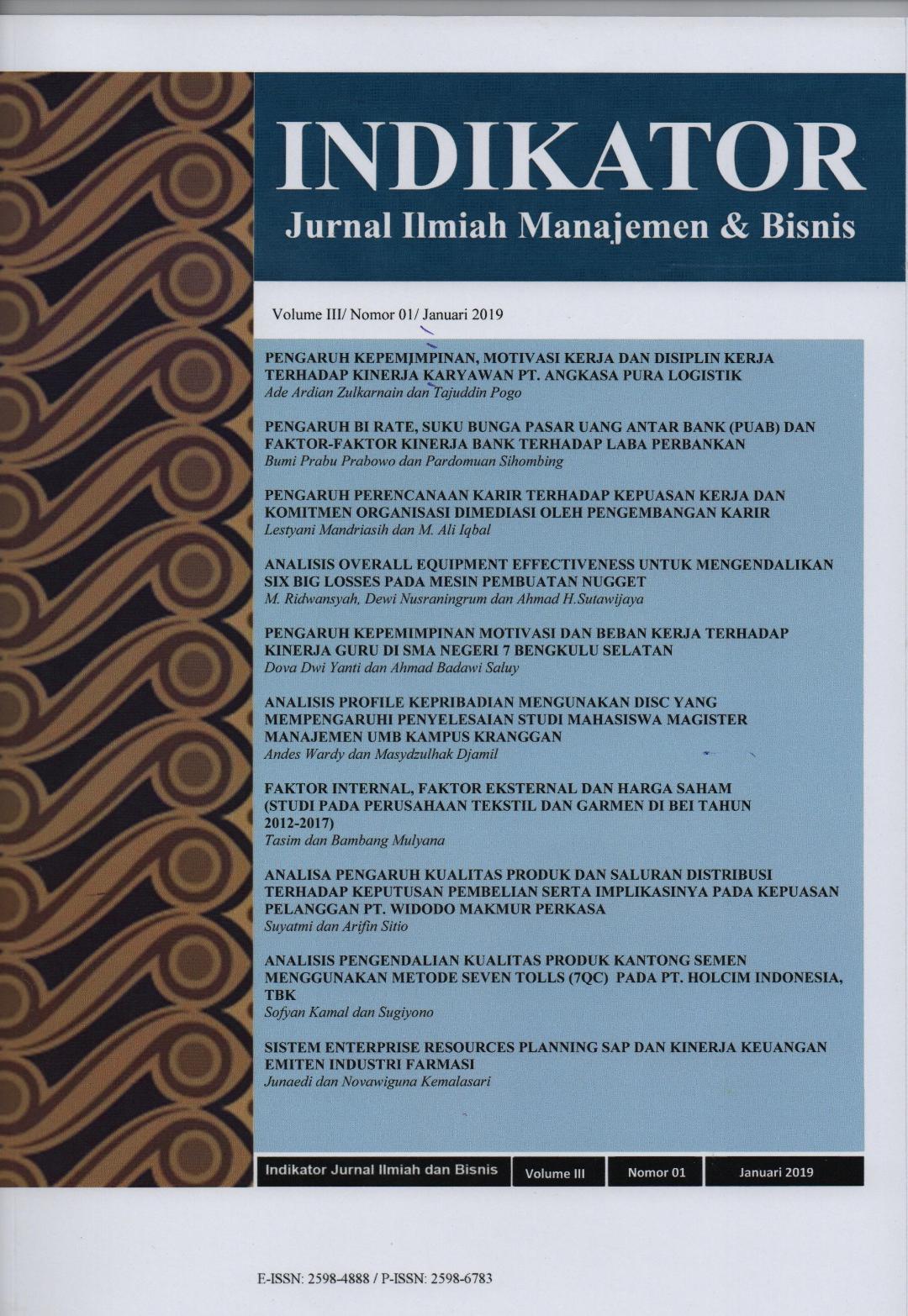
SISTEM ENTERPRISE RESOURCES PLANNING SAP DAN KINERJA KEUANGAN EMITEN INDUSTRI FARMASI
DOI:
https://doi.org/10.22441/indikator.v3i1.5173Keywords:
resource planning, SAP, return on assets, return on equity, return on sales, assets turnover, net profit margin, basic earning power, sales ratio, net profit ratioAbstract
This study aims to analyze the financial performance pre and post enterprise resource planning SAP systems implemented. The chosen variables in this study are ROA, ROE, ROS, ATO, NPM, BEP, sales ratio, and net profit ratio compared during 5 years before and after enterprise resource planning SAP systems implemented. The samples in this study was taken using purposive sampling method. After setting multiple criteria, 4 companies selected as samples. The data analyzed by descriptive analysis method and paired sample t test. This test using IBM SPSS Statistic 21 Program. The result of study shows that there is no differences in ROA, ROE, ROS, ATO, NPM, BEP, sales ratio, and net profit ratio during 5 years before and after enterprise resource planning SAP systems implemented.References
Columbus, Louis. (2014, May 12). Gartner's ERP Market Share Update Shows The Future of Cloud ERP is Now. Forbes Online Magazine. Retrieved from http://www.forbes.com/sites/louiscolumbus/2014/05/12/gartners-erp-market-share-update-shows-the-future-of-cloud-erp-is-now
Fahmi, Irham. 2014. Analisis Kinerja Keuangan Panduan Bagi Akademisi, Manajer, dan Investor untuk Menilai dan Menganalisis Bisnis dari Aspek Keuangan. Cetakan Ketiga. Alfabeta, Bandung.
Harahap, Sofyan. 2015. Analisis Kritis Atas Laporan Keuangan. Cetakan Keduabelas. Rajagrafindo Persada, Jakarta.
McClave, J.T., Benson, P.G., & Sincich, T. 2011. Statistik untuk Bisnis dan Ekonomi. Edisi Kesebelas. Erlangga. Jakarta.
Suntoyo, Danang. 2014. Sistem Informasi Manajemen Perspektif Organisasi. Center of Academic Publishing Service, Jakarta.
Suryalena. (2013). “Enterprise Resource Planning (ERP) Sebagai Tulang Punggung Bisnis Masa Kini”. Jurnal Aplikasi Bisnis Universitas Riau. Vol.3. No.2 Tahun 2013
Trihendradi, Cornelius. 2010. Step by Step SPSS 18 Analisis Data Statistik. Penerbit ANDI. Yogyakarta
Wagner, B. dan Ellen, M. 2013. Concepts in Enterprise Resource Planning. 4th Edition. Cengage Learning.
Widiyanti, Shandra. 2013. Kesuksesan dan Kegagalan Implementasi Enterprise Resource Planning (ERP) Pada Perusahaan dan Contoh Studi Kasus. Tesis Magister Manajemen & Bisnis. Institut Pertanian Bogor.
Wijaya, S.F., dan Suparto, D. 2009. ERP (Enterprise Resource Planning) dan Solusi Bisnis. Graha Ilmu, Yogyakarta.
Winarno, Wahyu. (2011).”Arti Penting Visi Bisnis dalam Implementasi Sistem ERP”. Jurnal Ekonomi, Akuntansi, dan Manajemen Universitas Jember, Vol.10 No.1 Tahun 2011.
Downloads
Published
How to Cite
Issue
Section
License
The copyright to this article is transferred to Universitas Mercu Buana (UMB) if and when the article is accepted for publication. The undersigned hereby transfers any and all rights in and to the paper including without limitation all copyrights to UMB. The undersigned hereby represents and warrants that the paper is original and that he/she is the author of the paper, except for material that is clearly identified as to its original source, with permission notices from the copyright owners where required. The undersigned represents that he/she has the power and authority to make and execute this assignment.
We declare that:
1. This paper has not been published in the same form elsewhere.
2. It will not be submitted anywhere else for publication prior to acceptance/rejection by this Journal.
3. A copyright permission is obtained for materials published elsewhere and which require this permission for reproduction.
Furthermore, I/We hereby transfer the unlimited rights of publication of the above mentioned paper in whole to UMB. The copyright transfer covers the exclusive right to reproduce and distribute the article, including reprints, translations, photographic reproductions, microform, electronic form (offline, online) or any other reproductions of similar nature.
The corresponding author signs for and accepts responsibility for releasing this material on behalf of any and all co-authors. This agreement is to be signed by at least one of the authors who have obtained the assent of the co-author(s) where applicable. After submission of this agreement signed by the corresponding author, changes of authorship or in the order of the authors listed will not be accepted.
Retained Rights/Terms and Conditions
1. Authors retain all proprietary rights in any process, procedure, or article of manufacture described in the Work.
2. Authors may reproduce or authorize others to reproduce the Work or derivative works for the authors personal use or for company use, provided that the source and the UMB copyright notice are indicated, the copies are not used in any way that implies UMB endorsement of a product or service of any employer, and the copies themselves are not offered for sale.
3. Although authors are permitted to re-use all or portions of the Work in other works, this does not include granting third-party requests for reprinting, republishing, or other types of re-use.
This work is also licensed under a Creative Commons Attribution-NonCommercial 4.0 International License.









