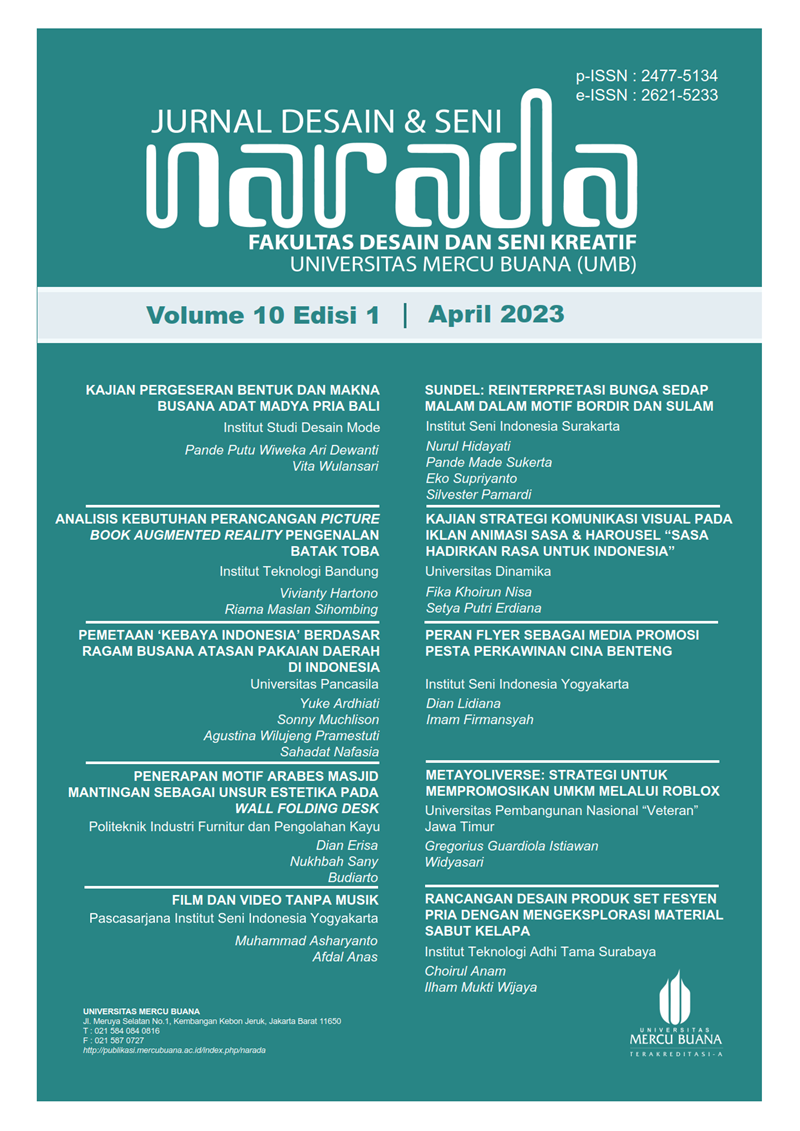
SUNDEL: REINTERPRETASI BUNGA SEDAP MALAM DALAM MOTIF BORDIR DAN SULAM
DOI:
https://doi.org/10.22441/narada.2023.v10.i1.006Keywords:
Bunga Sedap Malam, embroidery motif, ready to wear, reinterpretationAbstract
The making of embroidery and needlework motifs on art-wear that inspired from Sedap Malam (Sedap Malam) is the attempt to create an exclusive embroidery and needlework motifs as the identity of Pasuruan Regency, East Java. The creation of this motifs is the response from the need to develop, enrich, and design an embroidery and needlework motifs belongs to Pasuruan that would boost the sustainability of embroidery and needlework industry that is lately decreasing. Therefore, an experiment method in the form of innovative re-production is required to create an art-work with re-interpretation concept. The method in art creation used in this study is artistic research where the artist undergo several practices or creating process in the field study with emic approach, In this case, the process are developing the local potential in Pasuruan Regency (Sedap Malam) and identify what and how meaning inside it. The creation sages consist of data collection from various resources like field data and direct observation on Sedap Malam, literary study, and extensive interview with Tourism and Culture Department of Pasuruan Regency. The next stage is experimenting tuberose motif using reinterpretation concept. The motifs created during the experiment are stillation of Sedap Malam as the main motif, as well as complementary motifs generated from flora in the surrounding such as pandan leaves and rose balsam flower as the flower commodity in Pasuruan Regency. The inspiration in using Sedap Malam in creating embroidery and needlework motif on ready to wear results to ready to wear design with Sedap Malam motif that is made using embroidery and needlework technique, where Sedap Malam is presented as the main motif in the ready to wear.
Downloads
References
Bircan, I., & Gencler, F. (2015). Analysis of Innovation Based Human Resources for Sutainable Development. Journal of Procedia Social and Behavioral Sciences 195, 1348-1354.
Djelantik, A. (1999). Estetika. Bandung: Masyarakat Seni Pertunjukkan Indonesia.
Feldman, E. B. (1967). Arts As Image and Idea. New Jersey: Prentice-Hall, Englewood Cliffs.
Gustami, S. (2004). Proses Peciptaan Seni Kriya”Untaian Metodologis. Yogyakarta: Program Penciptaan Seni Pascasarjana ISI Yogyakarta.
Hidayati, N. (2019). Women in Fashion: Preference and Existence of Handmade Fashion Products. International Journal of Innovation, Creativity and Change 8(1), 221-237.
Hidayati, N., Kiranantika, A., & Pujirahayu, S. E. (2019). The Identification of female workers in Handcraft Embroidery Industry Based on The Factors Shaping Their Work Behavior. Advances in Sosial Science, Education and Humanities Research, Volume 242 2nd ICOVET. Proceedings of the 2nd International Conference on Vocational Education and Training (ICOVET 2018). Amsterdam: Atlantis Press.
Kartika, D. S. (2016). Kreasi Artistik: Perjumpaan Tradisi Dan Modern Dalam Paradigma Kekaryaan Seni. Surakarta: Citra Sains.
Lestari, A. D. (2021). Tinjauan Pemanfaatan Limbah Kulit Jagung pada Produk Fashion. Narada Jurnal Desain dan Seni, 8(1), 31-44.
Lestari, N. S. (2013). Motif Bunga Dalam Kain Batik, Motif Cantik Yang Memikul Nilai Kekuatan Sakral Dalam Kehidupan Manusia. Prosiding The 5th International Conference on Indonesian Studies: “Ethnicity and Globalization" (p. 117). Yogyakarta: Fakultas Ilmu Pengetahuan Budaya Universitas Indonesia.
Odabasi, S. (2015). A Design Method On Wearable Art. Between Worlds Innovation and Design in Textiles and Costume. Turkey: Published in International Textiles & Costume Congress (ITCC).
Paramadhyaksa, I. N. (2016). Filosofi Dan Penerapan Konsepsi Bunga Padma Dalam Perwujudan Arsitektur Tradisional Bali. Jurnal Langkau Betang, 3(1), 28-42.
Prahardini, P. (2006). Teknologi Produksi Bunga Sedap Malam. Jurnal Info Teknologi Pertanian No: 52, 1-8.
Soedarso , S. (2006). Trilogi Seni: Penciptaan, Eksistensi, dan Kegunaan Seni. Yogyakarta: Institut Seni Indonesia.
Sugiharto, B. (2009). Untuk apa seni? Bandung: Matahari.
Sumardjo, J. (2006). Estetika Paradoks. Bandung: Sunan Ambu Press.
Suzana K, L. (2006). Problematika Seni. Bandung: Sunan Ambu Press.
Downloads
Published
How to Cite
Issue
Section
License
A writer who will publish their article in the NARADA Journal of Design and Art agrees to the following conditions:
- The author owns the copyright and grants the rights to NARADA Journal of Design and Art as the party entrusted with publishing the article for the first time simultaneously licensed under the "Creative Commons Attribution-ShareAlike 4.0" License. This makes it possible for other people to share the work with a form of acknowledgment of authorship of the work and initial publication in this journal according to the authorship of the article provided.
- Authors may enter into separate additional contractual agreements for non-exclusive distribution of the published journal version of the work (e.g., posting it to an institutional repository or publishing it in a book) with acknowledgment of initial publication in the NARADA Journal of Design and Art.
- Authors are permitted and asked to post their work online (for example, institutional repositories or on personal websites) after the article publication process. This avoids double publication or multiple submissions which will affect the similarity of writing of the published work.
- In order to maintain the value of originality and similarity of articles sent or submitted. Authors are asked to temporarily remove or hide the original article from other online systems until they receive the results and decisions from the NARADA Journal of Design and Art regarding the decision to publish the article.
- The author, in this case the contributing author (Contributor Author), will be sent a form or letter stating the validity of the scientific work, signed on an IDR 10,000 stamp. Then the author will be asked to send the email to [email protected].
Pemberitahuan Hak Cipta
Seorang penulis yang akan menerbitkan artikelnya dalam NARADA Jurnal Desain dan Seni setuju dengan ketentuan berikut:
- Penulis memiliki hak cipta dan memberikan hak kepada pihak NARADA Jurnal Desain dan Seni sebagai pihak yang diberikan kepercayaan untuk mempublikasi artikelnya pertama kali secara bersamaan dilisensikan di bawah Lisensi "Creative Commons Attribution-ShareAlike 4.0". Hal ini memungkinkan kepada orang lain untuk membagi karya dengan bentuk pengakuan kepengarangan karya dan publikasi awal dalam jurnal ini sesuai dengan penulisan artikel yang diberikan.
- Penulis dapat membuat perjanjian kontrak tambahan yang terpisah untuk distribusi non-eksklusif versi jurnal yang diterbitkan dari karya tersebut (misalnya, mempostingnya ke repositori institusional atau menerbitkannya dalam sebuah buku) dengan pengakuan publikasi awal dalam NARADA Jurnal Desain dan Seni.
- Penulis diizinkan dan diminta untuk mempostingkan karyanya secara online (semisal, repositori institusional atau di situs web pribadi) setelah proses penerbitan artikel, Hal ini menghindari adanya double publikasi atau pengajuan jamak yang akan berpengaruh kepada adanya kesamaan penulisan dari karya yang diterbitkan.
- Demi menjaga nilai orisinalitas dan nilai kesamaan dari artikel yang dikirim atau diajukan. Penulis diminta untuk menghilangkan atau menyembunyikan secara sementara artikel orisinil dari sistem online lain yang sampai mendapatkan hasil nilai dan ketetapan dari pihak NARADA Jurnal Desain dan Seni mengenai keputusan publikasi dari artikel.
- Penulis dalam hal ini penulis kontributor (Contributor Author) akan dikirimkan form atau surat pernyataan keabsahan karya ilmiah, yang ditanda tangani di atas materai 10000. Dan selanjutnya penulis diminta untuk mengirimkan ke email [email protected].









