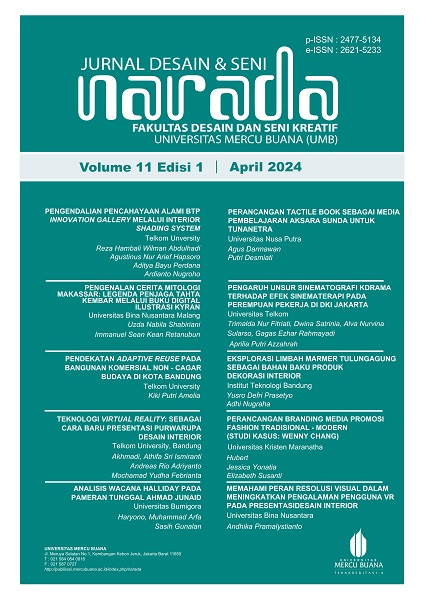
PERANCANGAN BRANDING MEDIA PROMOSI FASHION TRADISIONAL-MODERN (Studi Kasus : Wenny Chang)
DOI:
https://doi.org/10.22441/narada.2024.v11.i1.009Keywords:
Traditional Fabric, Promotional Media, Fashion Designer, Traditional-ModernAbstract
The development of the fashion industry in Indonesia has provided interesting opportunities for designers to combine modern designs with traditional elements that can help preserve local culture. This research aims to design a promotion strategy for Wenny Chang, a fashion designer who is well-known for her work in major cities in Indonesia. Wenny Chang's distinctive feature is her use of traditional Indonesian fabrics harmoniously combined with other materials, with a modern touch. Each of Wenny Chang's works has a unique and beautiful traditional-modern characteristic. This research will use a qualitative approach with a case study method to study every small detail of Wenny Chang's work, resulting in integrated data. The research will also produce a promotional media design strategy tailored to the needs and characteristics of Wenny Chang and potential consumer preferences. The results of Wenny Chang's promotional media designs include: brand identity, business suite, souvenirs, fashion photography, and fashion videography. This research aims to contribute to the domestic fashion industry practitioners in strengthening their brand through the selection of appropriate promotional media, expanding markets, and increasing public appreciation for traditional Indonesian fabrics.
References
Adîr, V., Adîr, G., & Pascu, N. E. (2014). How to Design a Logo. Procedia - Social and Behavioral Sciences, 122, 140–144.
Chaudhary, R. K. (2018). Psychological Theory In Typography. Anubooks, Vol. 9(1), 1-7.
Hall, A. (2022, September 18). How do you use fashion to communicate your identity. University Times. Diambil dari: https://csulauniversitytimes.com/how-do-you-use-fashion-to-communicate-your-identity/
Jack C. Taylor Library. (2023). What Is Fashion Branding? Fashion Merchandising: Branding. USA: Fontbonne University.
Kestenbaum, R. (2022). Attracting Customers To New Fashion Brands Is Harder Than Ever. USA: Forbes.
Kohli, C., & Suri, R. (2002). Creating effective logos: Insights from theory and practice. Business Horizons, 45(3), 58–64.
Kupka, M. (2015). The Fashion Film Effect: Interview With Marketa Uhlirova. http://modebewegtbild.de/2015/11/09/the-fashion-film-effect-marketa-uhlirova-im-
Snow, B. E., & Froehlich, H. B. (1920). The Theory and Practice of Color (3 ed.). http://www.archive.org/details/cu31924002932634
Weingerl, P., & Javoršek, D. (2018). Theory of Colour Harmony and Its Application. Tehnicki Vjesnik, Vol. 25(4), 1243–1248.
Wijaya, Z. T. (2013). Penyusunan dan Implementasi Strategi Branding Produk Kuliner dalam Membentuk Brand Knowledge sebagai Oleh-Oleh Khas Kabupaten Madiun. Yogyakarta: UAJY.
Yadav, P., Chakrabarti, D., & Bisoyi, D. (2014). Typography as a statement of Design. https://www.researchgate.net/publication/316683307
Downloads
Published
How to Cite
Issue
Section
License
A writer who will publish their article in the NARADA Journal of Design and Art agrees to the following conditions:
- The author owns the copyright and grants the rights to NARADA Journal of Design and Art as the party entrusted with publishing the article for the first time simultaneously licensed under the "Creative Commons Attribution-ShareAlike 4.0" License. This makes it possible for other people to share the work with a form of acknowledgment of authorship of the work and initial publication in this journal according to the authorship of the article provided.
- Authors may enter into separate additional contractual agreements for non-exclusive distribution of the published journal version of the work (e.g., posting it to an institutional repository or publishing it in a book) with acknowledgment of initial publication in the NARADA Journal of Design and Art.
- Authors are permitted and asked to post their work online (for example, institutional repositories or on personal websites) after the article publication process. This avoids double publication or multiple submissions which will affect the similarity of writing of the published work.
- In order to maintain the value of originality and similarity of articles sent or submitted. Authors are asked to temporarily remove or hide the original article from other online systems until they receive the results and decisions from the NARADA Journal of Design and Art regarding the decision to publish the article.
- The author, in this case the contributing author (Contributor Author), will be sent a form or letter stating the validity of the scientific work, signed on an IDR 10,000 stamp. Then the author will be asked to send the email to [email protected].
Pemberitahuan Hak Cipta
Seorang penulis yang akan menerbitkan artikelnya dalam NARADA Jurnal Desain dan Seni setuju dengan ketentuan berikut:
- Penulis memiliki hak cipta dan memberikan hak kepada pihak NARADA Jurnal Desain dan Seni sebagai pihak yang diberikan kepercayaan untuk mempublikasi artikelnya pertama kali secara bersamaan dilisensikan di bawah Lisensi "Creative Commons Attribution-ShareAlike 4.0". Hal ini memungkinkan kepada orang lain untuk membagi karya dengan bentuk pengakuan kepengarangan karya dan publikasi awal dalam jurnal ini sesuai dengan penulisan artikel yang diberikan.
- Penulis dapat membuat perjanjian kontrak tambahan yang terpisah untuk distribusi non-eksklusif versi jurnal yang diterbitkan dari karya tersebut (misalnya, mempostingnya ke repositori institusional atau menerbitkannya dalam sebuah buku) dengan pengakuan publikasi awal dalam NARADA Jurnal Desain dan Seni.
- Penulis diizinkan dan diminta untuk mempostingkan karyanya secara online (semisal, repositori institusional atau di situs web pribadi) setelah proses penerbitan artikel, Hal ini menghindari adanya double publikasi atau pengajuan jamak yang akan berpengaruh kepada adanya kesamaan penulisan dari karya yang diterbitkan.
- Demi menjaga nilai orisinalitas dan nilai kesamaan dari artikel yang dikirim atau diajukan. Penulis diminta untuk menghilangkan atau menyembunyikan secara sementara artikel orisinil dari sistem online lain yang sampai mendapatkan hasil nilai dan ketetapan dari pihak NARADA Jurnal Desain dan Seni mengenai keputusan publikasi dari artikel.
- Penulis dalam hal ini penulis kontributor (Contributor Author) akan dikirimkan form atau surat pernyataan keabsahan karya ilmiah, yang ditanda tangani di atas materai 10000. Dan selanjutnya penulis diminta untuk mengirimkan ke email [email protected].
