
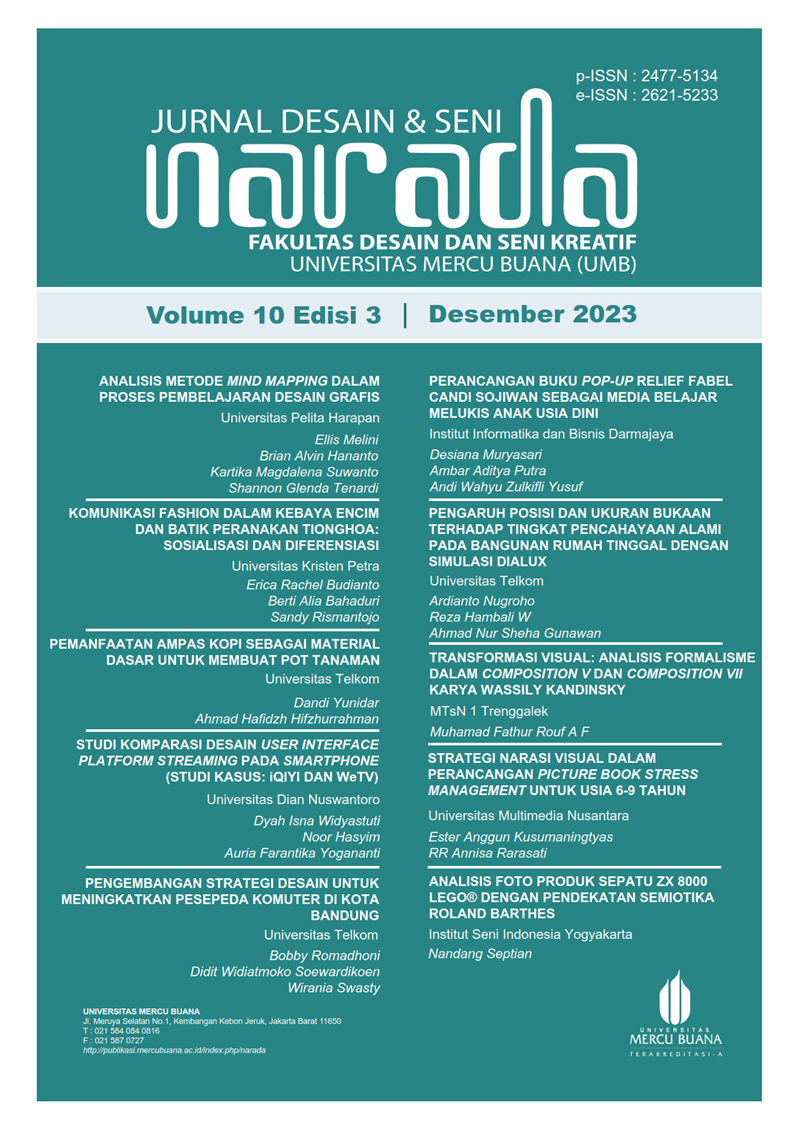
ANALISIS METODE MIND MAPPING DALAM PROSES PEMBELAJARAN DESAIN GRAFIS
DOI:
https://doi.org/10.22441/narada.2023/v10.i3.001Keywords:
Graphic design, Divergent thinking, Mind map, Design process, Concept visualization.Abstract
This study is about the application of the mind mapping method done by a group of design students in the context of graphic design learning. Mind mapping is one of the thinking tools commonly used in the creative thinking process. The goal of this study is to analyze how the participants use this thinking tool and reflect upon its utility as a method applied during the divergent phase in the series of design process. The method used here is a case study, using mixed approaches of qualitative-descriptive and quantitative explanations to measure the qualitative aspects. Results show that the participants can do the mind mapping method, which essentially pertains to its functions, though not rigidly following the formal techniques taught by Buzan. Through comparing the mind maps produced by them with the grades they got for the exploration criteria of their design results, it’s yet to be concluded that the mind map quality can determine the quality of the resulting design.
Downloads
References
Adodo, S. O. (2013). Effect of Mind-Mapping as a Self-Regulated Learning Strategy on Students’ Achievement in Basic Science and Technology. Mediterranean Journal of Social Sciences, 4, 163–172.
DOI:https://doi.org/10.5901/mjss.2013.v4n6p163
Amabile, T. M. (2011). The Social Psychology of Creativity (Softcover reprint of the original 1st ed. 1983 edition). Springer.
American Psychological Association. (n.d.). Creativity. Retrieved July 29, 2023, from www.apa.org/topics/creativity
Avdagic, E., May, F., McClean, T., Shackleton, F., Wade, C., & Healy, K. (2021). Mind Mapping as a Pragmatic Solution for Evaluation: A Critical Reflection through Two Case Studies. Practical Assessment, Research, and Evaluation, 26(1).
DOI:https://doi.org/10.7275/sqqw-ht68
Buzan, T. (2018). How to Mind Map: Make the Most of Your Mind and Learn to Create, Organize and Plan (US Only Ed edition). Thorsons Pub.
Cañas, A., & Novak, J. (2008). Facilitating the Adoption of Concept Mapping Using CmapTools to Enhance Meaningful Learning. Knowledge Cartography: Software Tools and Mapping Techniques.
Chen, J. (2008). The using of mind map in concept design. 2008 9th International Conference on Computer-Aided Industrial Design and Conceptual Design, 1034–1037.
DOI:https://doi.org/10.1109/CAIDCD.2008.4730739
Davies, M. (2011). Concept mapping, mind mapping and argument mapping: What are the differences and do they matter? Higher Education, 62(3), 279–301.
DOI:https://doi.org/10.1007/s10734-010-9387-6
Dong, Y., Zhu, S., & Li, W. (2021). Promoting Sustainable Creativity: An Empirical Study on the Application of Mind Mapping Tools in Graphic Design Education. Sustainability, 13(10), Article 10.
DOI:https://doi.org/10.3390/su13105373
DPMA. (n.d.). DPMA Trademarks—Mind Maps. Retrieved July 30, 2023, from https://register.dpma.de/DPMAregister/marke/register/2015931/DE
Eppler, M. (2006). A Comparison between Concept Maps, Mind Maps, Conceptual Diagrams, and Visual Metaphors as Complementary Tools for Knowledge Construction and Sharing. Http://Www.Alexandria.Unisg.Ch/Publikationen/54807, 5.
DOI:https://doi.org/10.1057/palgrave.ivs.9500131
Jiang, Y., & Liu, W. (2015). Application of Mind Mapping in Poster Design Classroom Teaching and Practice Guiding. International Journal of Sociology Study, 3(1), 49–52.
Justia Trademarks. (n.d.). MIND MAPS Trademark—Registration Number 1595757—Serial Number 73823774. Retrieved July 30, 2023, from http://trademarks.justia.com/738/23/mind-73823774.html
Kokotovich, V. (2008). Problem analysis and thinking tools: An empirical study of non-hierarchical mind mapping. Design Studies, 29(1), 49–69.
DOI:https://doi.org/10.1016/j.destud.2007.09.001
Lambert, V. A., & Lambert, C. E. (2012). Qualitative Descriptive Research: An Acceptable Design. Pacific Rim International Journal of Nursing Research, 16(4), 255–256.
Martin, B., & Hanington, B. (2012). Universal Methods of Design: 100 Ways to Research Complex Problems, Develop Innovative Ideas, and Design Effective Solutions (Digital ed). Rockport Publishers.
Miranti, M. G., & Wilujeng, B. Y. (2017). Creative Thinking Skills Enhancement Using Mind Mapping. 39–42.
DOI:https://doi.org/10.2991/iconhomecs-17.2018.9
Saldana, J. (2015). The Coding Manual for Qualitative Researchers (3rd edition). SAGE Publications Ltd.
Siwczuk, E. (2005). Mind Maps Ñ A Creative Thinking Tool In Information Technology. https://www.semanticscholar.org/paper/MIND-MAPS-%C3%B1-A-CREATIVE-THINKING-TOOL-IN-INFORMATION-Siwczuk/3c906561107197385d024c40d4cb25ac44b803ca
Tee, T., Azman, M. N. A., & Mohamed, S. (2014). Buzan Mind Mapping: An Efficient Technique for Note-Taking.
UK Intelectual Property Office. (n.d.). Trade mark: Mind Maps. Retrieved July 30, 2023, from https://trademarks.ipo.gov.uk/ipo-tmcase/page/Results/1/UK00001424476?legacySearch=False
Downloads
Published
How to Cite
Issue
Section
License
A writer who will publish their article in the NARADA Journal of Design and Art agrees to the following conditions:
- The author owns the copyright and grants the rights to NARADA Journal of Design and Art as the party entrusted with publishing the article for the first time simultaneously licensed under the "Creative Commons Attribution-ShareAlike 4.0" License. This makes it possible for other people to share the work with a form of acknowledgment of authorship of the work and initial publication in this journal according to the authorship of the article provided.
- Authors may enter into separate additional contractual agreements for non-exclusive distribution of the published journal version of the work (e.g., posting it to an institutional repository or publishing it in a book) with acknowledgment of initial publication in the NARADA Journal of Design and Art.
- Authors are permitted and asked to post their work online (for example, institutional repositories or on personal websites) after the article publication process. This avoids double publication or multiple submissions which will affect the similarity of writing of the published work.
- In order to maintain the value of originality and similarity of articles sent or submitted. Authors are asked to temporarily remove or hide the original article from other online systems until they receive the results and decisions from the NARADA Journal of Design and Art regarding the decision to publish the article.
- The author, in this case the contributing author (Contributor Author), will be sent a form or letter stating the validity of the scientific work, signed on an IDR 10,000 stamp. Then the author will be asked to send the email to [email protected].
Pemberitahuan Hak Cipta
Seorang penulis yang akan menerbitkan artikelnya dalam NARADA Jurnal Desain dan Seni setuju dengan ketentuan berikut:
- Penulis memiliki hak cipta dan memberikan hak kepada pihak NARADA Jurnal Desain dan Seni sebagai pihak yang diberikan kepercayaan untuk mempublikasi artikelnya pertama kali secara bersamaan dilisensikan di bawah Lisensi "Creative Commons Attribution-ShareAlike 4.0". Hal ini memungkinkan kepada orang lain untuk membagi karya dengan bentuk pengakuan kepengarangan karya dan publikasi awal dalam jurnal ini sesuai dengan penulisan artikel yang diberikan.
- Penulis dapat membuat perjanjian kontrak tambahan yang terpisah untuk distribusi non-eksklusif versi jurnal yang diterbitkan dari karya tersebut (misalnya, mempostingnya ke repositori institusional atau menerbitkannya dalam sebuah buku) dengan pengakuan publikasi awal dalam NARADA Jurnal Desain dan Seni.
- Penulis diizinkan dan diminta untuk mempostingkan karyanya secara online (semisal, repositori institusional atau di situs web pribadi) setelah proses penerbitan artikel, Hal ini menghindari adanya double publikasi atau pengajuan jamak yang akan berpengaruh kepada adanya kesamaan penulisan dari karya yang diterbitkan.
- Demi menjaga nilai orisinalitas dan nilai kesamaan dari artikel yang dikirim atau diajukan. Penulis diminta untuk menghilangkan atau menyembunyikan secara sementara artikel orisinil dari sistem online lain yang sampai mendapatkan hasil nilai dan ketetapan dari pihak NARADA Jurnal Desain dan Seni mengenai keputusan publikasi dari artikel.
- Penulis dalam hal ini penulis kontributor (Contributor Author) akan dikirimkan form atau surat pernyataan keabsahan karya ilmiah, yang ditanda tangani di atas materai 10000. Dan selanjutnya penulis diminta untuk mengirimkan ke email [email protected].









