
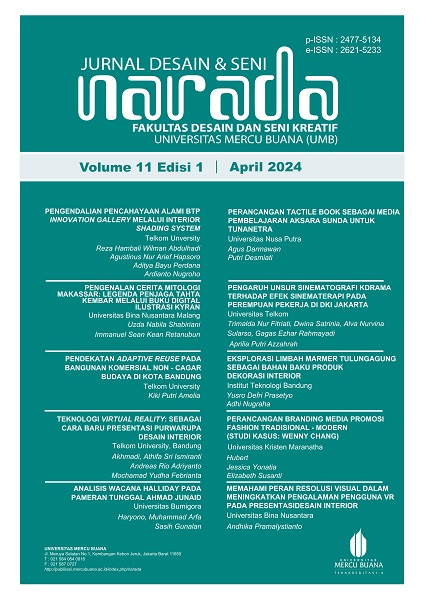
MEMAHAMI PERAN KUALITAS VISUAL DALAM MENINGKATKAN PENGALAMAN PENGGUNA VR PADA PRESENTASI DESAIN INTERIOR
DOI:
https://doi.org/10.22441/narada.2024.v11.i1.010Keywords:
Resolution, Virtual Reality, VisualAbstract
With the development of digital technology, Virtual Reality (VR) has become an innovative tool in interior design presentation and exploration. VR allows users to interact with the space immersively, providing a more realistic experience compared to two-dimensional representations. One of the main factors that affects the quality of the user experience in VR is visual resolution. Higher resolution can increase the level of realism, clarifying material details, lighting, and textures, and reducing distracting visual effects, such as pixelation or blur. In the context of interior design, an optimal visual experience is essential to help designers and clients understand the scale, composition, and atmosphere of a space before the realization stage. Therefore, this study aims to explore the extent to which visual resolution in VR can affect user perception and interaction, and how optimizing display quality can improve the effectiveness of VR as an interior design presentation tool. The research method includes data collection through questionnaires, observations, and experiments on interior design users. The results of the study show that the use of high resolution directly increases respondents' interest and the effectiveness of using VR as a visualization tool in interior design. This shows the great potential of VR technology in enhancing the virtual interaction experience, as well as providing important directions in the selection of visualization media in the future. With high resolution, VR is able to provide a more realistic and immersive visual experience for users, which in turn can improve the understanding and appreciation of interior design. These findings provide a foundation for further development in the application of VR technology in the design industry, as well as emphasizing the importance of considering the visual resolution factor in its use. Thus, this study not only provides new insights, but also offers practical contributions to the development of VR in the context of interior design.
References
Aungst, S., Barton, R., & Wilson, D. (2003). The virtual integrated design method. Quality Engineering, 15(4), 565-579.
Guevara, D., de Laski-Smith, D., & Ashur, S. (2022). Interior Design Students’ Perception Of Virtual Reality. SN Social Sciences, 2.
Guo, L. (2023). Simulation evaluation of virtual reality in interior design effect display and practice mode innovation. Soft Computing, 27, 8371-8380.
Joy, E., R, A., & Raja, C. (2022). Digital 3D modeling for preconstruction real-time visualization of home interior design through virtual reality. Construction Innovation, Vol. 24(2), 643 - 653.
Kaleja, P., & Kozlovská, M. (2017). Virtual Reality as Innovative Approach to the Interior Designing. Selected Scientific Papers - Journal of Civil Engineering, 12(1), 109 - 116.
M., V. (2024). How Virtual Reality is Changing the World of Interior Design. San Antonio: Vevtion Technologies.
Mudliyar, P., Ingale, Y., Bhalerao, S., & Jagtap, O. (2014). Virtual Reality for Interior Design. International Journal of Research in Advent Technology, 2(3), 260-263.
Özgen, D. S., Afacan, Y., & Sürer, E. (2021). Usability of virtual reality for basic design education: a comparative study with paper-based design. International Journal of Technology and Design Education, 31(2), 357-377.
Pramalystianto, A. (2023). Study of Image Resolution in Virtual Reality Panorama Technology 360 In Comfort of Interior Visualization. International Journal of Architecture and Urbanism, 7(2), 244-250.
Society Interiors Design (2024). Virtual Reality (VR) in Interior Design: How VR is Revolutionizing Design Processes. Indiana: Society Interiors & Design Magnate Publishing Pvt Ltd.
Wasilewski, S., Grobe, L. O., Wienold, J., & Andersen, M. (2022). Efficient Simulation for Visual Comfort Evaluations. Energy and Buildings, 267.
Xu, J., Li, M., Cao, K., Zhou, F., Lv, B., Lu, Z., Cui, Z., & Zhang, K. (2022). A VR Experimental Study on the Influence of Chinese Hotel Interior Color Design on Customers’ Emotional Experience. Buildings, 12(7).
Downloads
Published
How to Cite
Issue
Section
License
A writer who will publish their article in the NARADA Journal of Design and Art agrees to the following conditions:
- The author owns the copyright and grants the rights to NARADA Journal of Design and Art as the party entrusted with publishing the article for the first time simultaneously licensed under the "Creative Commons Attribution-ShareAlike 4.0" License. This makes it possible for other people to share the work with a form of acknowledgment of authorship of the work and initial publication in this journal according to the authorship of the article provided.
- Authors may enter into separate additional contractual agreements for non-exclusive distribution of the published journal version of the work (e.g., posting it to an institutional repository or publishing it in a book) with acknowledgment of initial publication in the NARADA Journal of Design and Art.
- Authors are permitted and asked to post their work online (for example, institutional repositories or on personal websites) after the article publication process. This avoids double publication or multiple submissions which will affect the similarity of writing of the published work.
- In order to maintain the value of originality and similarity of articles sent or submitted. Authors are asked to temporarily remove or hide the original article from other online systems until they receive the results and decisions from the NARADA Journal of Design and Art regarding the decision to publish the article.
- The author, in this case the contributing author (Contributor Author), will be sent a form or letter stating the validity of the scientific work, signed on an IDR 10,000 stamp. Then the author will be asked to send the email to [email protected].
Pemberitahuan Hak Cipta
Seorang penulis yang akan menerbitkan artikelnya dalam NARADA Jurnal Desain dan Seni setuju dengan ketentuan berikut:
- Penulis memiliki hak cipta dan memberikan hak kepada pihak NARADA Jurnal Desain dan Seni sebagai pihak yang diberikan kepercayaan untuk mempublikasi artikelnya pertama kali secara bersamaan dilisensikan di bawah Lisensi "Creative Commons Attribution-ShareAlike 4.0". Hal ini memungkinkan kepada orang lain untuk membagi karya dengan bentuk pengakuan kepengarangan karya dan publikasi awal dalam jurnal ini sesuai dengan penulisan artikel yang diberikan.
- Penulis dapat membuat perjanjian kontrak tambahan yang terpisah untuk distribusi non-eksklusif versi jurnal yang diterbitkan dari karya tersebut (misalnya, mempostingnya ke repositori institusional atau menerbitkannya dalam sebuah buku) dengan pengakuan publikasi awal dalam NARADA Jurnal Desain dan Seni.
- Penulis diizinkan dan diminta untuk mempostingkan karyanya secara online (semisal, repositori institusional atau di situs web pribadi) setelah proses penerbitan artikel, Hal ini menghindari adanya double publikasi atau pengajuan jamak yang akan berpengaruh kepada adanya kesamaan penulisan dari karya yang diterbitkan.
- Demi menjaga nilai orisinalitas dan nilai kesamaan dari artikel yang dikirim atau diajukan. Penulis diminta untuk menghilangkan atau menyembunyikan secara sementara artikel orisinil dari sistem online lain yang sampai mendapatkan hasil nilai dan ketetapan dari pihak NARADA Jurnal Desain dan Seni mengenai keputusan publikasi dari artikel.
- Penulis dalam hal ini penulis kontributor (Contributor Author) akan dikirimkan form atau surat pernyataan keabsahan karya ilmiah, yang ditanda tangani di atas materai 10000. Dan selanjutnya penulis diminta untuk mengirimkan ke email [email protected].
