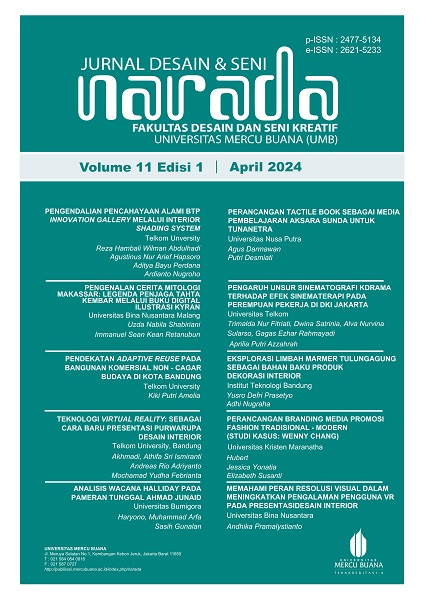
PENDEKATAN ADAPTIVE REUSE PADA BANGUNAN KOMERSIAL NON-CAGAR BUDAYA DI KOTA BANDUNG
DOI:
https://doi.org/10.22441/narada.2024.v11.i1.003Keywords:
Adaptive reuse, Commercial Area, Space TransformationAbstract
Adaptive reuse, defined as the practice of repurposing old buildings by converting them to serve new functions, has become an increasingly common phenomenon in commercial building in Bandung. In the city of Bandung, the local government has established specific guidelines for the classification of cultural heritage buildings, meaning that not all old buildings are recognized as heritage assets. The phenomenon found in commercial buildings nowadays is the reuse of old buildings, with transformation of transforming them into new functions. One common approach is seen in heritage buildings, termed adaptive reuse, where transformations maintain conservation values and principles. Field observations show many non-heritage buildings applying some principles of adaptive reuse in their implementations. Adaptive reuse principles, aligned with decision considerations in implementation, are in line with the principles of transforming forms. Qualitative methods with case studies and data triangulation prove several points in adaptive reuse principles used in transforming old buildings into new ones that are not heritage buildings. Although historical value is not the main focus of these decisions, they refers more towards other aspects such as social, economic, and aesthetic values, which can be additional points in design that are not found in new building designs.
References
Bullen, P. A. (2007). Adaptive reuse and sustainability of commercial buildings. 25(1/2), 20–31. https://doi.org/10.1108/02632770710716911
Bullen, P., & Love, P. (2011). A new future for the past: a model for adaptive reuse decision-making. 1(1), 32–34. https://doi.org/10.1108/20441241111143768
Ching, D. K. (2014). Architecture: Form, space, and order.
Creswell, J. W. (2002). Research Design: Qualitative, Quantitative, and Mixed Methods Approaches. Second Edition, Sage Publications, International Education and Professional Pubisher.
Hartono, H. D. (2011). 100 Bangunan Cagar Budaya. CSS Publisher.
Hartono, H. D., & Rahmadya, V. A. (2021). ADAPTIVE REUSE ON BIOSKOP DIAN AS A CULTURAL HERITAGE BUILDING GROUP A IN BANDUNG CITY. Jurnal RISA (Riset Arsitektur), 5(4), 367–383.
ICOMOS. (1999). The Burra Charter: The Australia ICOMOS Charter for Places of Cultural Significance.
Lanz, F., & Pendlebury, J. (2022). Adaptive Reuse: a critical review. The Journalof Architecture, 27(2–3), 441–462. https://doi.org/10.1080/13602365.2022.2105381
Luthfiah. (2010). Perubahan Bentuk dan Fungsi Hunian pada Rumah Susun Pasca Penghunian. Jurnal “Ruang,” 2(2), 34–44.
Maharlika, F., & Rifa’i, A. (2023). ADAPTIVE REUSE PADA BANGUNAN RESTORAN ROEMAH NENEK. Jurnal Narada, 10(2), 215–225.
ODASA Design Guidance Note: Adaptive Re-Use, (2014).
Peraturan Daerah Kota Bandung Nomor 7 Tahun 2018 Tentang Pengelolaan Cagar Budaya, 44 (2018).
Purnomo, A. D., Amelia, K. P., Kynanti, N. M., & Toni, F. (n.d.). IMPLEMENTASI ADAPTIF PADA DALEM WURYANINGRATAN. Jurnal Arsitektur ARCADE, 2022, 231–238.
Siahaan, J. (2010). Ruang Publik: Antara Harapan dan Kenyataan. Buletin Tata Ruang,.
Soewarno, N. (2020). POLA PERGESERAN FUNGSI HUNIAN PADA BANGUNAN RUMAH TOKO kasus: transformasi bangunan di kawasan Pasar Baru-Bandung. Jurnal Arsitektur Zonasi, 3(2), 113–124. https://doi.org//10.17509/jaz.v3i2.25374
Sudaryono. (2017). METODOLOGI PENELITIAN Kuantitatif, Kualitatif dan Mix Method (Edisi Kedu). RAJAWALI PERS.
Downloads
Published
How to Cite
Issue
Section
License
A writer who will publish their article in the NARADA Journal of Design and Art agrees to the following conditions:
- The author owns the copyright and grants the rights to NARADA Journal of Design and Art as the party entrusted with publishing the article for the first time simultaneously licensed under the "Creative Commons Attribution-ShareAlike 4.0" License. This makes it possible for other people to share the work with a form of acknowledgment of authorship of the work and initial publication in this journal according to the authorship of the article provided.
- Authors may enter into separate additional contractual agreements for non-exclusive distribution of the published journal version of the work (e.g., posting it to an institutional repository or publishing it in a book) with acknowledgment of initial publication in the NARADA Journal of Design and Art.
- Authors are permitted and asked to post their work online (for example, institutional repositories or on personal websites) after the article publication process. This avoids double publication or multiple submissions which will affect the similarity of writing of the published work.
- In order to maintain the value of originality and similarity of articles sent or submitted. Authors are asked to temporarily remove or hide the original article from other online systems until they receive the results and decisions from the NARADA Journal of Design and Art regarding the decision to publish the article.
- The author, in this case the contributing author (Contributor Author), will be sent a form or letter stating the validity of the scientific work, signed on an IDR 10,000 stamp. Then the author will be asked to send the email to [email protected].
Pemberitahuan Hak Cipta
Seorang penulis yang akan menerbitkan artikelnya dalam NARADA Jurnal Desain dan Seni setuju dengan ketentuan berikut:
- Penulis memiliki hak cipta dan memberikan hak kepada pihak NARADA Jurnal Desain dan Seni sebagai pihak yang diberikan kepercayaan untuk mempublikasi artikelnya pertama kali secara bersamaan dilisensikan di bawah Lisensi "Creative Commons Attribution-ShareAlike 4.0". Hal ini memungkinkan kepada orang lain untuk membagi karya dengan bentuk pengakuan kepengarangan karya dan publikasi awal dalam jurnal ini sesuai dengan penulisan artikel yang diberikan.
- Penulis dapat membuat perjanjian kontrak tambahan yang terpisah untuk distribusi non-eksklusif versi jurnal yang diterbitkan dari karya tersebut (misalnya, mempostingnya ke repositori institusional atau menerbitkannya dalam sebuah buku) dengan pengakuan publikasi awal dalam NARADA Jurnal Desain dan Seni.
- Penulis diizinkan dan diminta untuk mempostingkan karyanya secara online (semisal, repositori institusional atau di situs web pribadi) setelah proses penerbitan artikel, Hal ini menghindari adanya double publikasi atau pengajuan jamak yang akan berpengaruh kepada adanya kesamaan penulisan dari karya yang diterbitkan.
- Demi menjaga nilai orisinalitas dan nilai kesamaan dari artikel yang dikirim atau diajukan. Penulis diminta untuk menghilangkan atau menyembunyikan secara sementara artikel orisinil dari sistem online lain yang sampai mendapatkan hasil nilai dan ketetapan dari pihak NARADA Jurnal Desain dan Seni mengenai keputusan publikasi dari artikel.
- Penulis dalam hal ini penulis kontributor (Contributor Author) akan dikirimkan form atau surat pernyataan keabsahan karya ilmiah, yang ditanda tangani di atas materai 10000. Dan selanjutnya penulis diminta untuk mengirimkan ke email [email protected].
