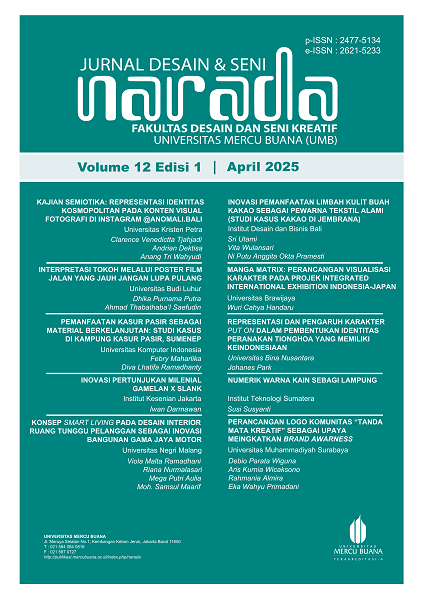
REPRESENTASI DAN PENGARUH KARAKTER PUT ON DALAM PEMBENTUKAN IDENTITAS PERANAKAN TIONGHOA YANG MEMILIKI NILAI KEINDONESIAAN
Keywords:
Peranakan Culture, Character Design, Identity, Comic, Visual NarativeAbstract
"Put On" is the name of both a character and the title of a comic that was once popular in Indonesia. Put On was published around 1931 by Kho Wan Gie in the newspaper. The Put On comic showcases many aspects of the Chinese-Indonesian (Peranakan) culture residing in Jakarta. The Chinese--Indonesian cultures depicted in the comic includes language, daily habits, family structure, and the food consumed. In the Put On comic, the character Put On is shown to be mischievous, naive, and childish despite being portrayed as a large middle-aged man. This research was conducted using qualitative methods in the form of multimodal analysis and narrative inquiry. The observation through multimodal analysis was done to see the graphic narrative elements in the comic, while narrative inquiry was carried out to elaborate on the experience of reading Put On. The aspects observed in the reading experience included character design (drawing style, physical appearance, and clothing style), language (body language and speech), and visualization of social situations. The results of the study reveal that while the design and traits of Put On as the main character do not clearly exhibit a Chinese-Indonesian identity, it is the interaction with other characters who use distinctive language and the social environment they inhabit that makes the Put On comic able to represent Chinese-Indonesian culture.
References
Bonneff, M. (1976). Komik Indonesia. Kepustakaan Populer Gramedia.
Burke, P. J., & Stets, J. E. (2023). Identity Theory (2nd ed.). Oxford University Press.
Jeong Hee, K. (2016). Understanding Narrative Inquiri. Sage.
Kho Wan Gie. (2015). Put On edisi Pantjawarna. Suara Harapan Bangsa, Pustaka Klasik.
MacWilliams, M. (2008). Japanese Visual Culture: Exploration in the World of Manga and Anime. M.E. Sharpe.
McCloud, S. (1993). Understanding Comics: The Invisible Art. Harper Collins Press.
Onghokham. (2017). Riwayat TiongHoa Peranakan di Jawa (3rd ed.). Komunitas Bambu.
R. Kress, G. (2010). Multimodality: A Social Semiotic Approach to Contemporary Communication. Routledge.
Refaie, E. El. (2013). Transnational Identity as Shape- Shifting: metaphor and Cultural Resonance in Gene Luen Yang’s American Born Chinese. In Transnational Perspective on Graphic Narrative (1st ed.). Bloomsbury Academic.
Zahar, I. (2020). Visual Character and Context of Put On (1931-1965) : First Indonesian Comic. International Journal of Comic Art, 17(1).
Downloads
Published
How to Cite
Issue
Section
License
A writer who will publish their article in the NARADA Journal of Design and Art agrees to the following conditions:
- The author owns the copyright and grants the rights to NARADA Journal of Design and Art as the party entrusted with publishing the article for the first time simultaneously licensed under the "Creative Commons Attribution-ShareAlike 4.0" License. This makes it possible for other people to share the work with a form of acknowledgment of authorship of the work and initial publication in this journal according to the authorship of the article provided.
- Authors may enter into separate additional contractual agreements for non-exclusive distribution of the published journal version of the work (e.g., posting it to an institutional repository or publishing it in a book) with acknowledgment of initial publication in the NARADA Journal of Design and Art.
- Authors are permitted and asked to post their work online (for example, institutional repositories or on personal websites) after the article publication process. This avoids double publication or multiple submissions which will affect the similarity of writing of the published work.
- In order to maintain the value of originality and similarity of articles sent or submitted. Authors are asked to temporarily remove or hide the original article from other online systems until they receive the results and decisions from the NARADA Journal of Design and Art regarding the decision to publish the article.
- The author, in this case the contributing author (Contributor Author), will be sent a form or letter stating the validity of the scientific work, signed on an IDR 10,000 stamp. Then the author will be asked to send the email to [email protected].
Pemberitahuan Hak Cipta
Seorang penulis yang akan menerbitkan artikelnya dalam NARADA Jurnal Desain dan Seni setuju dengan ketentuan berikut:
- Penulis memiliki hak cipta dan memberikan hak kepada pihak NARADA Jurnal Desain dan Seni sebagai pihak yang diberikan kepercayaan untuk mempublikasi artikelnya pertama kali secara bersamaan dilisensikan di bawah Lisensi "Creative Commons Attribution-ShareAlike 4.0". Hal ini memungkinkan kepada orang lain untuk membagi karya dengan bentuk pengakuan kepengarangan karya dan publikasi awal dalam jurnal ini sesuai dengan penulisan artikel yang diberikan.
- Penulis dapat membuat perjanjian kontrak tambahan yang terpisah untuk distribusi non-eksklusif versi jurnal yang diterbitkan dari karya tersebut (misalnya, mempostingnya ke repositori institusional atau menerbitkannya dalam sebuah buku) dengan pengakuan publikasi awal dalam NARADA Jurnal Desain dan Seni.
- Penulis diizinkan dan diminta untuk mempostingkan karyanya secara online (semisal, repositori institusional atau di situs web pribadi) setelah proses penerbitan artikel, Hal ini menghindari adanya double publikasi atau pengajuan jamak yang akan berpengaruh kepada adanya kesamaan penulisan dari karya yang diterbitkan.
- Demi menjaga nilai orisinalitas dan nilai kesamaan dari artikel yang dikirim atau diajukan. Penulis diminta untuk menghilangkan atau menyembunyikan secara sementara artikel orisinil dari sistem online lain yang sampai mendapatkan hasil nilai dan ketetapan dari pihak NARADA Jurnal Desain dan Seni mengenai keputusan publikasi dari artikel.
- Penulis dalam hal ini penulis kontributor (Contributor Author) akan dikirimkan form atau surat pernyataan keabsahan karya ilmiah, yang ditanda tangani di atas materai 10000. Dan selanjutnya penulis diminta untuk mengirimkan ke email [email protected].
