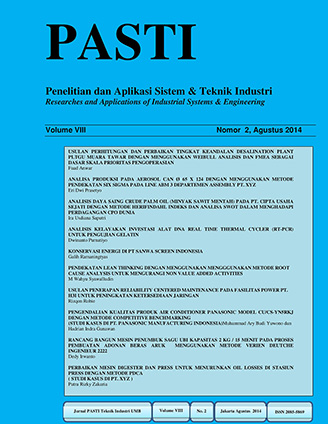
PERBAIKAN MESIN DIGESTER DAN PRESS UNTUK MENURUNKAN OIL LOSSES DI STASIUN PRESS DENGAN METODE PDCA ( STUDI KASUS DI PT. XYZ )
Abstrak
PT. XYZ merupakan salah satu perusahaan yang mengolah kelapa sawit menjadi CPO. Persaingan yang ketat memaksa pihak manajemen membuat suatu konsep rencana untuk menghadapinya, hal ini menyebabkan perusahaan berusaha untuk menghasilkan CPO yang lebih baik untuk memberikan kepuasan kepada konsumen. Penelitian ini dilakukan di stasiun press pada proses pengempaan yang merupakan proses utama yang memisahkan minyak dengan ampas. Tingginya kehilangan minyak yang terdapat pada proses pengempaan ini merupakan salah satu penyebab kurangnya mutu CPO yang dihasilkan. Penulis menggunakan konsep kaizen atau perbaikan terus-menerus pada mesin digester dan press untuk mengurangi kehilangan minyak di stasiun press. Dalam pelaksanaan kegiatan perbaikan, konsep kaizen memutar roda deming (siklus PDCA) dan melakukan delapan langkah pemecahan masalah. Delapan langkah pemecahan masalah ini dimulai dengan identifikasi masalah, target, analisa kondisi, analisa penyebab, rencana perbaikan, pelaksanaan perbaikan, evaluasi hasil, dan standarisasi. Dari analisa kondisi dan penyebab didapat beberapa faktor yang akan diperbaiki adalah melakukan penggantian long dan short arm, bottom plate, temperatur gauge, press cage, dan screw press, serta dilakukannya settingan ampere dan tekanan hidrolik motor. Berdasarkan analisa didapat persentase rata-rata kehilangan minyak yang dapat diminimalisasi selama penelitian dari 7.37% menjadi 6.31%. untuk mempertahankan hasil yang telah dicapai, maka dilakukan pengontrolan pada semua komponen mesin digester dan press agar proses berjalan dengan lancer.
Kata Kunci : Oil losses, Kaizen, PDCA-8 langkah pemecahan masalah
Unduhan
Unduhan
Diterbitkan
Cara Mengutip
Terbitan
Bagian
Lisensi
The copyright to this article is transferred to Universitas Mercu Buana (UMB) if and when the article is accepted for publication. The undersigned hereby transfers any and all rights in and to the paper including without limitation all copyrights to UMB. The undersigned hereby represents and warrants that the paper is original and that he/she is the author of the paper, except for material that is clearly identified as to its original source, with permission notices from the copyright owners where required. The undersigned represents that he/she has the power and authority to make and execute this assignment.
We declare that:
1. This paper has not been published in the same form elsewhere.
2. It will not be submitted anywhere else for publication prior to acceptance/rejection by this Journal.
3. A copyright permission is obtained for materials published elsewhere and which require this permission for reproduction.
Furthermore, I/We hereby transfer the unlimited rights of publication of the above mentioned paper in whole to UMB. The copyright transfer covers the exclusive right to reproduce and distribute the article, including reprints, translations, photographic reproductions, microform, electronic form (offline, online) or any other reproductions of similar nature.
The corresponding author signs for and accepts responsibility for releasing this material on behalf of any and all co-authors. This agreement is to be signed by at least one of the authors who have obtained the assent of the co-author(s) where applicable. After submission of this agreement signed by the corresponding author, changes of authorship or in the order of the authors listed will not be accepted.
Retained Rights/Terms and Conditions
1. Authors retain all proprietary rights in any process, procedure, or article of manufacture described in the Work.
2. Authors may reproduce or authorize others to reproduce the Work or derivative works for the authors personal use or for company use, provided that the source and the UMB copyright notice are indicated, the copies are not used in any way that implies UMB endorsement of a product or service of any employer, and the copies themselves are not offered for sale.
3. Although authors are permitted to re-use all or portions of the Work in other works, this does not include granting third-party requests for reprinting, republishing, or other types of re-use.





