Development of Teak Wood Powder–Epoxy Composite for Motorcycle CVT Weight Rollers Application
DOI:
https://doi.org/10.22441/ijimeam.v8i1.33422Kata Kunci:
composite, motorcycle part, teak wood, hot press, tensile testAbstrak
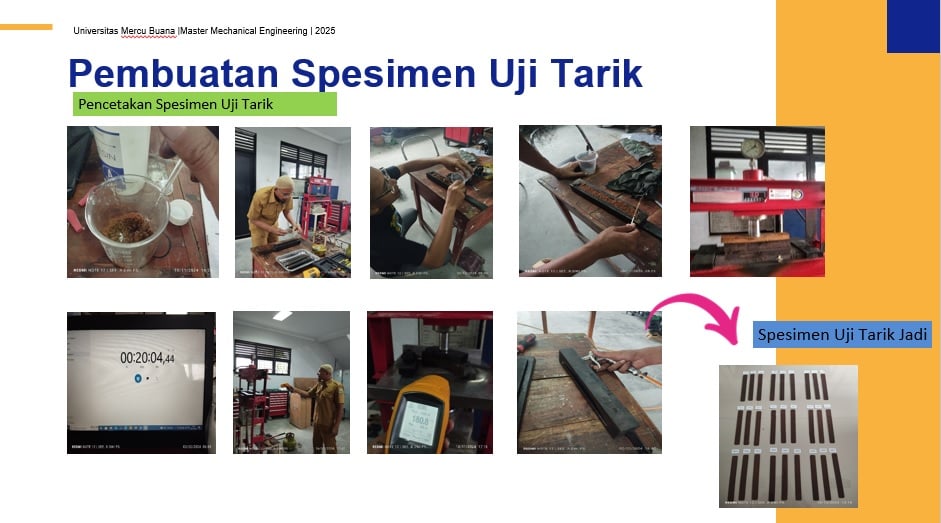
The development of sustainable materials for automotive components has become increasingly important due to environmental concerns associated with conventional synthetic materials. This study investigates the feasibility of teak wood powder (Tectona grandis L.F.) reinforced epoxy composites as an eco-friendly alternative to polytetrafluoroethylene (PTFE) for Continuously Variable Transmission (CVT) weight rollers. The composite was fabricated using a hot-press method with varying composition ratios (60:40, 70:30, and 80:20) and processing temperatures (160 °C, 170 °C, and 180 °C) under a constant pressure of 20 bar. Mechanical performance was evaluated through tensile testing in accordance with ASTM D3039. The results demonstrate that both composition and processing temperature significantly influence tensile strength. The optimal condition—60% teak wood powder and 40% epoxy resin processed at 180 °C—yielded the highest average tensile strength of approximately 25 MPa, surpassing the typical value of conventional PTFE-based rollers (~23 MPa). The improvement is attributed to enhanced matrix–filler bonding and better resin flow at elevated temperatures, resulting in more effective load transfer and reduced void formation. Conversely, higher filler content led to reduced performance due to insufficient matrix continuity and increased interfacial defects. This study provides a significant contribution by demonstrating that teak wood waste can be effectively utilized as a reinforcement material in structural automotive applications. The findings highlight a viable pathway toward cost-effective, sustainable composite design while maintaining competitive mechanical performance. Further investigation on tribological behavior and long-term durability is recommended to support real-world implementation.Unduhan
Referensi
J. A. S. Indar Putra and Y. Kaelani, “Studi eksperimental dan analisa laju keausan roller pada sistem continuously variable transmission (CVT) dengan gerakan reciprocating,” Jurnal Teknik ITS, vol. 5, no. 2, Feb. 2017, doi: 10.12962/j23373539.v5i2.20807.
E. M. Octavian and S. Priyanto, “Pengaruh putaran terhadap ketahanan aus pada round roller dan sliding roller continuously variable trans-mission ESP 150 cc,” Teknobiz: Jurnal Ilmiah Program Studi Magister Teknik Mesin, vol. 10, no. 3, pp. 1–8, Nov. 2020, doi: 10.35814/teknobiz.v10i3.1756.
A. B. Prasojo and Y. Kaelani, “Analisa beban kerja dan gaya dinamis pada round roller dan sliding roller untuk sistem CVT (continuously varia-ble transmission) sepeda motor matic,” Jurnal Teknik ITS, vol. 5, no. 2, Nov. 2016, doi: 10.12962/j23373539.v5i2.20781.
Y. Nofendri and E. Christian, “Pengaruh berat roller terhadap performa mesin Yamaha Mio Soul 110 cc yang menggunakan jenis transmisi otomatis (CVT),” Jurnal Kajian Teknik Mesin, vol. 5, no. 1, pp. 58–65, Apr. 2020, doi: 10.52447/jktm.v5i1.3991.
I. Ilmy and I. N. Sutantra, “Pengaruh variasi konstanta pegas dan massa roller CVT terhadap performa Honda Vario 150 cc,” Jurnal Teknik ITS, vol. 7, no. 1, Mar. 2018, doi: 10.12962/j23373539.v7i1.29829.
B. N. Sandeep, K. Buddha, J. A. Raj, K. C. B. Naidu, and M. Manjunatha, “Preparation and characterization using Tectona grandis natural fiber for the green composite polymer matrix,” Materials Today: Proceedings, vol. 47, pp. 3703–3710, 2021, doi: 10.1016/j.matpr.2021.01.754.
S. B. N. Reddy, K. Buddha, K. C. B. Naidu, and D. B. Basha, “Development and evaluation of a polymer composite material reinforced by Tec-tona grandis fiber, with static analysis,” Polymers (Basel), vol. 17, no. 5, p. 634, Feb. 2025, doi: 10.3390/polym17050634.
A. Ramdhani, R. D. Anjani, and I. Dirja, “Pengaruh paduan serbuk bambu dan matriks polyethylene terhadap sifat mekanik WPC,” Jurnal Pen-didikan Teknik Mesin Undiksha, vol. 11, no. 2, pp. 238–252, Sep. 2023, doi: 10.23887/jptm.v11i2.66005.
M. A. Budiawan, S. A. Umar, and N. Fuadah, “Pengujian papan komposit limbah serbuk gergaji kayu jati putih (Gmelina arborea Roxb) dan se-rat pelepah pisang,” Storage: Jurnal Ilmiah Teknik dan Ilmu Komputer, vol. 2, no. 2, pp. 39–42, May 2023, doi: 10.55123/storage.v2i2.1900.
R. Desiasni, R. Chandra, and F. Widyawati, “Pengaruh volume limbah serbuk kayu jati (Tectona grandis) terhadap daya serap air pada kom-posit partikel dengan matriks epoksi,” Jurnal Tambora, vol. 5, no. 2, pp. 74–78, Jul. 2021, doi: 10.36761/jt.v5i2.1128.
R. D. Handoko, F. Setiawan, and Sehono, “Pengaruh fraksi serbuk kayu jati terhadap kekuatan komposit partikel dengan pengujian impact,” Teknika STTKD: Jurnal Teknik, Elektronik, Engine, vol. 8, no. 2, pp. 322–329, Dec. 2022, doi: 10.56521/teknika.v8i2.738.
K. Kosjoko, “Serbuk kayu jati (Tectona grandis L.f) sebagai bahan penguat komposit brake pad sepeda motor bermatriks epoxy,” J-Proteksion, vol. 6, no. 1, pp. 16–19, Aug. 2021, doi: 10.32528/jp.v6i1.4979.
M. H. Alamsyah and G. Gundara, “Analisis sifat mekanik komposit bahan kampas rem dengan penguat serbuk kayu jati dan serbuk kuningan,” R.E.M. (Rekayasa Energi Manufaktur) Jurnal, vol. 5, no. 1, pp. 9–13, Jan. 2021, doi: 10.21070/r.e.m.v5i1.870.
F. Yudhanto, S. A. Dhewanto, and S. W. Yakti, “Karakterisasi bahan kampas rem sepeda motor dari komposit serbuk kayu jati,” Quantum Teknika: Jurnal Teknik Mesin Terapan, vol. 1, no. 1, 2019, doi: 10.18196/jqt.010104.
R. D. P. Susilo, K. Tarigan, A. F. Sudarma, A. N. Oktaviani, D. S. Khaerudini, and M. Fitri, “Study of the Newton–Raphson method in analyzing the depth of fluid flow in the wastewater canal U RPS TKRO SMKN 1 Ciruas using the MATLAB application,” Jurnal Teknik Mesin, vol. 13, no. 2, p. 102, Jun. 2024, doi: 10.22441/jtm.v13i2.27624.
A. B. Prasojo and Y. Kaelani, “Analisa beban kerja dan gaya dinamis pada round roller dan sliding roller untuk sistem CVT (continuously varia-ble transmission) sepeda motor matic,” Jurnal Teknik ITS, vol. 5, no. 2, Nov. 2016, doi: 10.12962/j23373539.v5i2.20781.
A. D. Zaidan, A. E. Latief, and N. D. Anggraeni, “Analisa karakterisasi material produk slide piece CVT berbahan komposit berpenguat serat nanas dengan fraksi volume 10%,” Jurnal Rekayasa Energi dan Mekanika, vol. 3, no. 1, p. 77, Jun. 2023, doi: 10.26760/JREM.v3i1.77.
S. P. Reddy, K. Buddha, and K. C. B. Naidu, “Development and evaluation of a polymer composite material reinforced by Tectona grandis fiber, with static analysis,” Polymers, vol. 17, no. 5, p. 634, 2025, doi: 10.3390/polym17050634.
N. Petchwattana, W. Channuan, and P. Naknaen, “3D printing filaments prepared from modified Poly(Lactic Acid)/Teak Wood flour compo-sites: An investigation on the particle size effects and silane coupling agent compatibilisation,” Journal of Physical Science, vol. 30, no. 2, pp. 169–188, 2019, doi: 10.21315/jps2019.30.2.10.
S. Salifu and P. A. Olubambi, “Thermomechanical properties prediction of wood-flour reinforced polymer composites using representative volume element (RVE),” MATEC Web of Conferences, vol. 370, p. 03002, 2022, doi: 10.1051/matecconf/202237003002.
P. R. Surya, B. Ashok Kumar, and S. Magibalan, “Enhancing mechanical properties of hybrid natural fiber reinforced epoxy composites with Acacia mangium fiber and Teak Wood powder,” E3S Web of Conferences, vol. 559, p. 02011, 2024, doi: 10.1051/e3sconf/202455902011.
Unduhan
File Tambahan
Diterbitkan
Cara Mengutip
Terbitan
Bagian
Lisensi
Authors who publish in IJIMEAM retain the following rights:- Author retains the copyright and grants the journal the right of first publication of the work simultaneously licensed under the Creative Commons Attribution-ShareAlike 4.0 License that allows others to share the work with an acknowledgment of the work's authorship and initial publication in this journal.
- Author is able to enter into separate, additional contractual arrangements for the non-exclusive distribution of the journal's published version of the work (e.g., post it to an institutional repository or publish it in a book) with the acknowledgment of its initial publication in this journal.
- Author is permitted and encouraged to post his/her work online (e.g., in institutional repositories or on their website) prior to and during the submission process, as it can lead to productive exchanges, as well as earlier and greater citation of the published work (See What is Open Access).
Read more about the Creative Commons Attribution-ShareAlike 4.0 Licence here: https://creativecommons.org/licenses/by-sa/4.0/.









