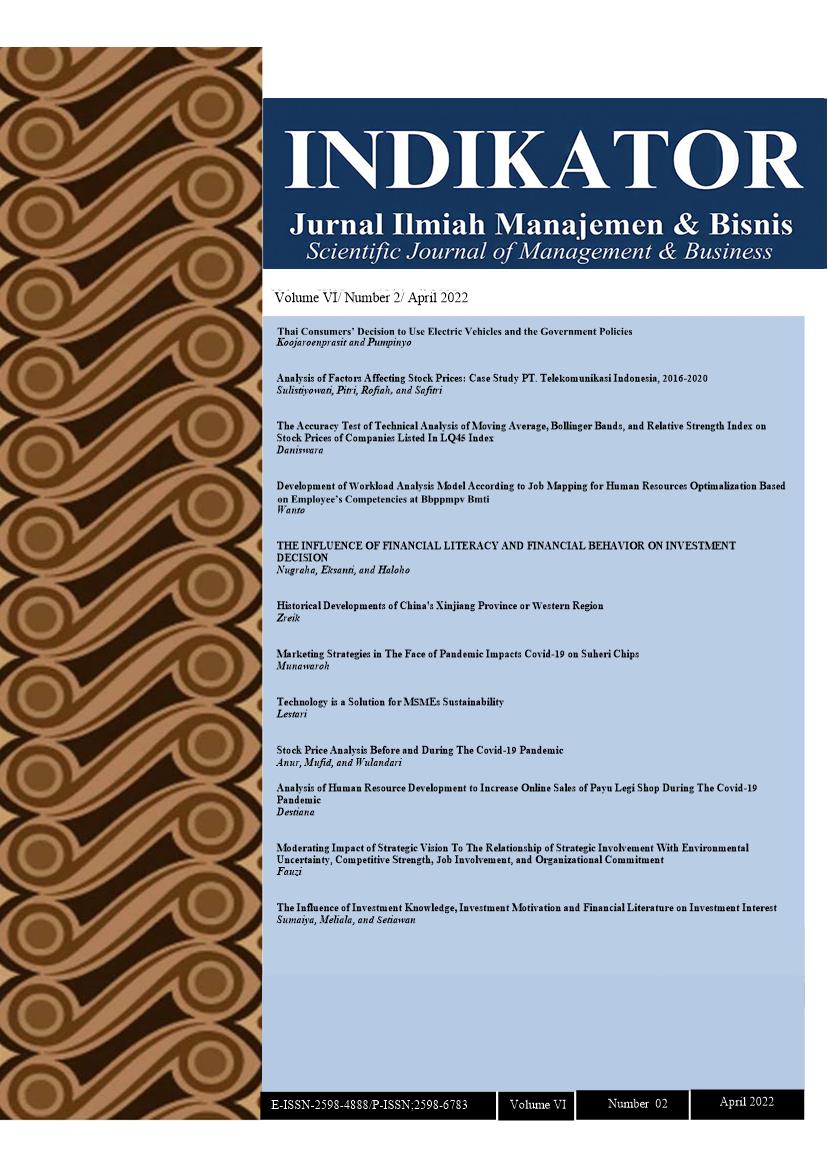
Thai Consumers’ Decision to Use Electric Vehicles and the Government Policies
DOI:
https://doi.org/10.22441/indikator.v6i2.14805Keywords:
government policies, EVAbstract
Abstract
This paper aimed to analyze the importance of government policies and the decision to use Electric Vehicles (EV) for Thai consumer. The paper comparing those who use Electric Vehicles to those tend to use soon. Primary data was obtained from questionnaire. The sample size was 415 comprising 224 of those who use EV and 191 of those tend to use EV soon. Methodology employed the t statistics for hypotheses testing between these two groups. The government policies in this study included import tariff reduction, special privileged for EV users and subsidy and or rebate for EV buyers. Among these government policies, both EV users and intended EV users concerned the most importance in the reduction of import tariff and for the hypothesis test showed that these two-sample group emphasized not significantly different in these policies. The policy makers should implement the reduction on import tariff as soon as possible.
Keywords: government policies, EV
Published
How to Cite
Issue
Section
License
The copyright to this article is transferred to Universitas Mercu Buana (UMB) if and when the article is accepted for publication. The undersigned hereby transfers any and all rights in and to the paper including without limitation all copyrights to UMB. The undersigned hereby represents and warrants that the paper is original and that he/she is the author of the paper, except for material that is clearly identified as to its original source, with permission notices from the copyright owners where required. The undersigned represents that he/she has the power and authority to make and execute this assignment.
We declare that:
1. This paper has not been published in the same form elsewhere.
2. It will not be submitted anywhere else for publication prior to acceptance/rejection by this Journal.
3. A copyright permission is obtained for materials published elsewhere and which require this permission for reproduction.
Furthermore, I/We hereby transfer the unlimited rights of publication of the above mentioned paper in whole to UMB. The copyright transfer covers the exclusive right to reproduce and distribute the article, including reprints, translations, photographic reproductions, microform, electronic form (offline, online) or any other reproductions of similar nature.
The corresponding author signs for and accepts responsibility for releasing this material on behalf of any and all co-authors. This agreement is to be signed by at least one of the authors who have obtained the assent of the co-author(s) where applicable. After submission of this agreement signed by the corresponding author, changes of authorship or in the order of the authors listed will not be accepted.
Retained Rights/Terms and Conditions
1. Authors retain all proprietary rights in any process, procedure, or article of manufacture described in the Work.
2. Authors may reproduce or authorize others to reproduce the Work or derivative works for the authors personal use or for company use, provided that the source and the UMB copyright notice are indicated, the copies are not used in any way that implies UMB endorsement of a product or service of any employer, and the copies themselves are not offered for sale.
3. Although authors are permitted to re-use all or portions of the Work in other works, this does not include granting third-party requests for reprinting, republishing, or other types of re-use.
This work is also licensed under a Creative Commons Attribution-NonCommercial 4.0 International License.









