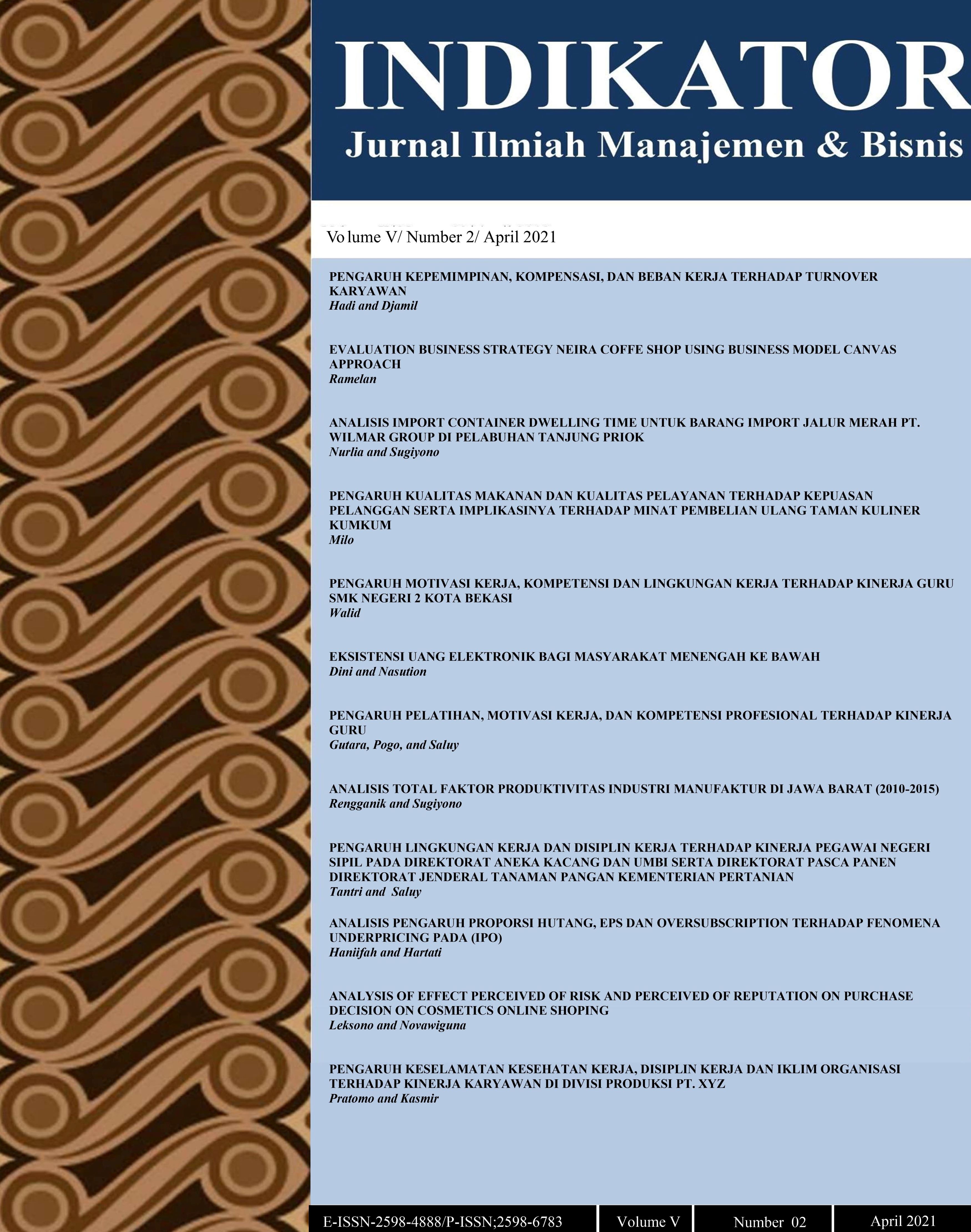
EKSISTENSI UANG ELEKTRONIK BAGI MASYARAKAT MENENGAH KE BAWAH
DOI:
https://doi.org/10.22441/indikator.v5i2.9995Keywords:
masyarakat menengah ke bawah, transaksi non-tunai, teknologi finansial, uang elektronikAbstract
Abstrak
Dengan dicanangkannya program Gerakan Nasional Non-Tunai (GNNT) oleh Bank Indonesia, menumbuhkan kesadaran masyarakat tentang keberadaan uang elektronik sebagai transformasi dari uang tunai. Diiringi dengan perkembangan pesat teknologi dan informasi, perusahaan startup yang memproduksi uang elektronik, Data Bank Indonesia menunjukkan terjadi pelonjakan volume transaksi uang elektronik pada akhir 2018 yakni sebesar 209,8% menjadi 2,9 miliar transaksi dibandingkan 2017 sebesar 943,3 juta transaksi. Namun pada peningkatan penggunaan uang elektronik sebagai metode pembayaran bagi masyarakat Indonesia, masih banyak dari masyarakat menengah ke bawah untuk menerima dan menjalani program Gerakan Nasional Non Tunai. Artikel jurnal ini bertujuan untuk mengetahui keberadaan uang elektronik bagi masyarakat menengah ke bawah, hambatan apa yang diterima uang elektronik dalam membumikan GNNT seperti tujuan Bank Indonesia, dan saran yang dapat digunakan pemerintah untuk mencapai cashless society. Artikel jurnal ini menggunakan metode kualitatif dengan data sekunder melalui data penelitian yang sudah ada sebelumnya.
Abstract
With the launch of the National Non-Cash Movement (GNNT) program by Bank Indonesia, it has raised public awareness about the existence of electronic money as a transformation of cash. Accompanied by the rapid development of technology and information, startup companies that produce electronic money, Data from Bank Indonesia showed an increase in the volume of electronic money transactions at the end of 2018 which was 209.8% to 2.9 billion transactions compared to 2017 which amounted to 943.3 million transactions. However, in increasing the use of electronic money as a method of payment for the people of Indonesia, there are still many from the lower middle class to accept and undergo the National Non-Cash Movement program. This journal article aims to find out the existence of electronic money for the middle to lower classes, what obstacles electronic money has received in grounding GNNT as the goal of Bank Indonesia, and suggestions that the government can play to achieve a cashless society. This journal article uses a qualitative method with secondary data through pre-existing research data.
Published
How to Cite
Issue
Section
License
The copyright to this article is transferred to Universitas Mercu Buana (UMB) if and when the article is accepted for publication. The undersigned hereby transfers any and all rights in and to the paper including without limitation all copyrights to UMB. The undersigned hereby represents and warrants that the paper is original and that he/she is the author of the paper, except for material that is clearly identified as to its original source, with permission notices from the copyright owners where required. The undersigned represents that he/she has the power and authority to make and execute this assignment.
We declare that:
1. This paper has not been published in the same form elsewhere.
2. It will not be submitted anywhere else for publication prior to acceptance/rejection by this Journal.
3. A copyright permission is obtained for materials published elsewhere and which require this permission for reproduction.
Furthermore, I/We hereby transfer the unlimited rights of publication of the above mentioned paper in whole to UMB. The copyright transfer covers the exclusive right to reproduce and distribute the article, including reprints, translations, photographic reproductions, microform, electronic form (offline, online) or any other reproductions of similar nature.
The corresponding author signs for and accepts responsibility for releasing this material on behalf of any and all co-authors. This agreement is to be signed by at least one of the authors who have obtained the assent of the co-author(s) where applicable. After submission of this agreement signed by the corresponding author, changes of authorship or in the order of the authors listed will not be accepted.
Retained Rights/Terms and Conditions
1. Authors retain all proprietary rights in any process, procedure, or article of manufacture described in the Work.
2. Authors may reproduce or authorize others to reproduce the Work or derivative works for the authors personal use or for company use, provided that the source and the UMB copyright notice are indicated, the copies are not used in any way that implies UMB endorsement of a product or service of any employer, and the copies themselves are not offered for sale.
3. Although authors are permitted to re-use all or portions of the Work in other works, this does not include granting third-party requests for reprinting, republishing, or other types of re-use.
This work is also licensed under a Creative Commons Attribution-NonCommercial 4.0 International License.









