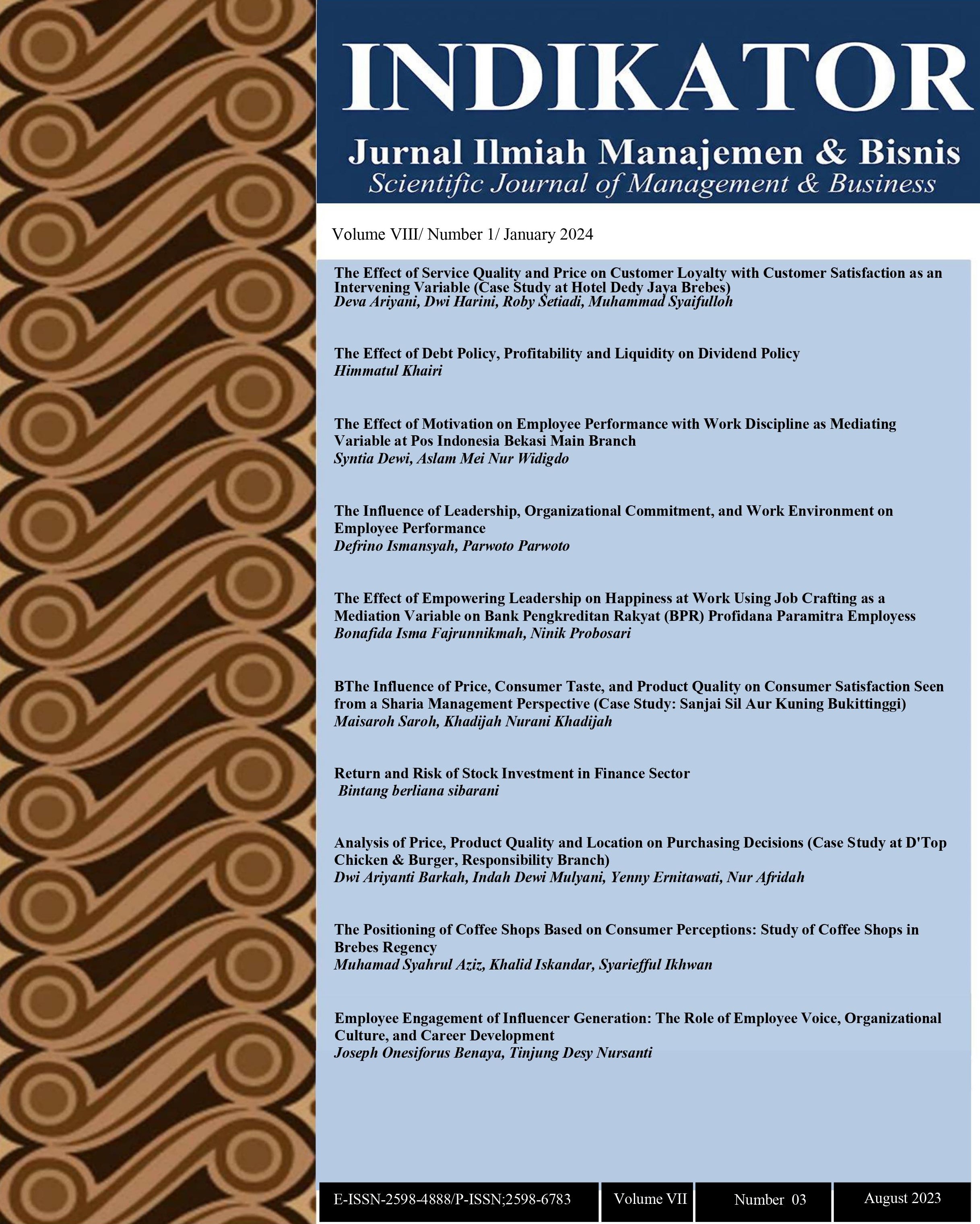
Employee Engagement of Influencer Generation: The Role of Employee Voice, Organizational Culture, and Career Development
DOI:
https://doi.org/10.22441/indikator.v8i1.24793Keywords:
employee voice, organizational culture, career development, employee engagement, influencer generationAbstract
It is the goal of this research to figure out the extent to which elements such as employee voice, organizational culture, and career development have an impact on employee engagement among Influencer Generation, or generation Z as it is more commonly referred to. In this study, a quantitative methodology is utilized, and the participants are members of Influencer generation who are now employed. For the purpose of this investigation, the application SmartPLS version 4 and the Structural Equation Model (SEM) are utilized for the processing and analysis of the data. According to the findings of the analysis of the data, the factors of career development, corporate culture, and employee voice all have positive and significant effects on employee engagement. Due to the fact that these aspects have an effect on employee engagement, which in turn can lead to increased economic performance, researchers propose that organizations pay attention to employee voice, organizational culture, and career development.References
Azevedo, M. C. de, Schlosser, F., & McPhee, D. (2021). Building organizational innovation through HRM, employee voice and engagement. Personnel Review, 50(2), 751–769. https://doi.org/10.1108/PR-12-2019-0687
Bakker, A.B. and Leiter, M.P. (2010) Work Engagement: A Handbook of Essential Theory and Research. Psychology Press, Hove. https://doi.org/10.4324/9780203853047
Basuki, K. (2018). Impact of Transformational Leadership, Characteristics of Job, and Career Development on Employee Engagement. Jurnal Mozaik. Vol. 10. Ed. 1
Burris, E., Mccune, E., & Klinghoffer, D. (2020). When Employees Speak Up, Companies Win. MIT SLOAN MANAGEMENT REVIEW. https://mitsmr.com/2ILagwh
Cai, M., Chapman, J. R., & Brown, B. (2016). Addressing the problem of acquiescence bias in career anchor measurement. Organizational Cultures, 16(4), 11–25. https://doi.org/10.18848/2327-8013/CGP
Dolot, A. (2018). The characteristics of Influencer generation. E-Mentor, 74, 44–50. https://doi.org/10.15219/em74.1351
Fernanda, B. Y. (2021). Effect of Employee Voice Behavior and Work Conflict to Employee Performance at PT Bukit Asam Tarahan Port Unit.
Hair, J. F., Risher, J. J., Sarstedt, M., & Ringle, C. M. (2019). When to use and how to report the results of PLS-SEM. In European Business Review (Vol. 31, Issue 1, pp. 2–24). Emerald Group Publishing Ltd. https://doi.org/10.1108/EBR-11-2018-0203
Ilyasa, Madhakomala, & Ramly, M. (2018). The effect of organization culture, knowledge sharing and employee engagement on employee work innovation. International Journal of Scientific Research Management, 6(1), 57-63. https://doi.org/10.18535/ijsrm/v6il.em09
Jha, N., Potnuru, R. K. G., Sareen, P., & Shaju, S. (2019). Employee voice, engagement and organizational effectiveness: a mediated model. European Journal of Training and Development, 43(7–8), 699–718. https://doi.org/10.1108/EJTD-10-2018-0097
Khan, M., Mowbray, P. K., & Wilkinson, A. (2023). Employee voice on social media — An affordance lens. International Journal of Management Reviews. https://doi.org/10.1111/ijmr.12326
Kruse, K. (2015). Employee engagement 2.0: How to motivate your team for high performance: a “real-world” guide for busy managers.
Lee, M. C. C., Idris, M. A., & Delfabbro, P. H. (2017). The linkages between hierarchical culture and empowering leadership and their effects on employees’ work engagement: Work meaningfulness as a mediator. International Journal of Stress Management, 24(4), 392–415. https://doi.org/10.1037/str0000043
Lemeshow, Stanley, Klar, Janelle, Lwanga, Stephen K, Pramono, Dibyo, Hosmer, David W. (1997). Besar Sampel dalam Penelitian Kesehatan. Translated by Dibyo Pramono. Yogyakarta: Gadjah Mada University Press.
Liang, J., Farh, C. I. C., & Farh, J. L. (2012). Psychological antecedents of promotive and prohibitive Voice: A two-wave examination. Academy of Management Journal, 55(1), 71–92. https://doi.org/10.5465/amj.2010.0176
Mahapatra, G. P., Bhullar, N., & Gupta, P. (2022). Gen Z: An Emerging Phenomenon. NHRD Network Journal, 15(2), 246–256. https://doi.org/10.1177/26314541221077137
Nasution, N., Mariatin, F. E., & Zahreni, S. (2018). The Influence of Career Development and Organizational Culture on Employee Performance. International Journal of Scientific Research and Management, 6(01). https://doi.org/10.18535/ijsrm/v6i1.el09
Robbins, S. P., & Judge, T. A. (2018). Organizational Behavior 18th.
Xueling, P. (2017). Empirical Study of Career Management and Engagement. Canadian Social Science, 13(1), 43–48. https://doi.org/10.3968/9239
Published
How to Cite
Issue
Section
License
The copyright to this article is transferred to Universitas Mercu Buana (UMB) if and when the article is accepted for publication. The undersigned hereby transfers any and all rights in and to the paper including without limitation all copyrights to UMB. The undersigned hereby represents and warrants that the paper is original and that he/she is the author of the paper, except for material that is clearly identified as to its original source, with permission notices from the copyright owners where required. The undersigned represents that he/she has the power and authority to make and execute this assignment.
We declare that:
1. This paper has not been published in the same form elsewhere.
2. It will not be submitted anywhere else for publication prior to acceptance/rejection by this Journal.
3. A copyright permission is obtained for materials published elsewhere and which require this permission for reproduction.
Furthermore, I/We hereby transfer the unlimited rights of publication of the above mentioned paper in whole to UMB. The copyright transfer covers the exclusive right to reproduce and distribute the article, including reprints, translations, photographic reproductions, microform, electronic form (offline, online) or any other reproductions of similar nature.
The corresponding author signs for and accepts responsibility for releasing this material on behalf of any and all co-authors. This agreement is to be signed by at least one of the authors who have obtained the assent of the co-author(s) where applicable. After submission of this agreement signed by the corresponding author, changes of authorship or in the order of the authors listed will not be accepted.
Retained Rights/Terms and Conditions
1. Authors retain all proprietary rights in any process, procedure, or article of manufacture described in the Work.
2. Authors may reproduce or authorize others to reproduce the Work or derivative works for the authors personal use or for company use, provided that the source and the UMB copyright notice are indicated, the copies are not used in any way that implies UMB endorsement of a product or service of any employer, and the copies themselves are not offered for sale.
3. Although authors are permitted to re-use all or portions of the Work in other works, this does not include granting third-party requests for reprinting, republishing, or other types of re-use.
This work is also licensed under a Creative Commons Attribution-NonCommercial 4.0 International License.









