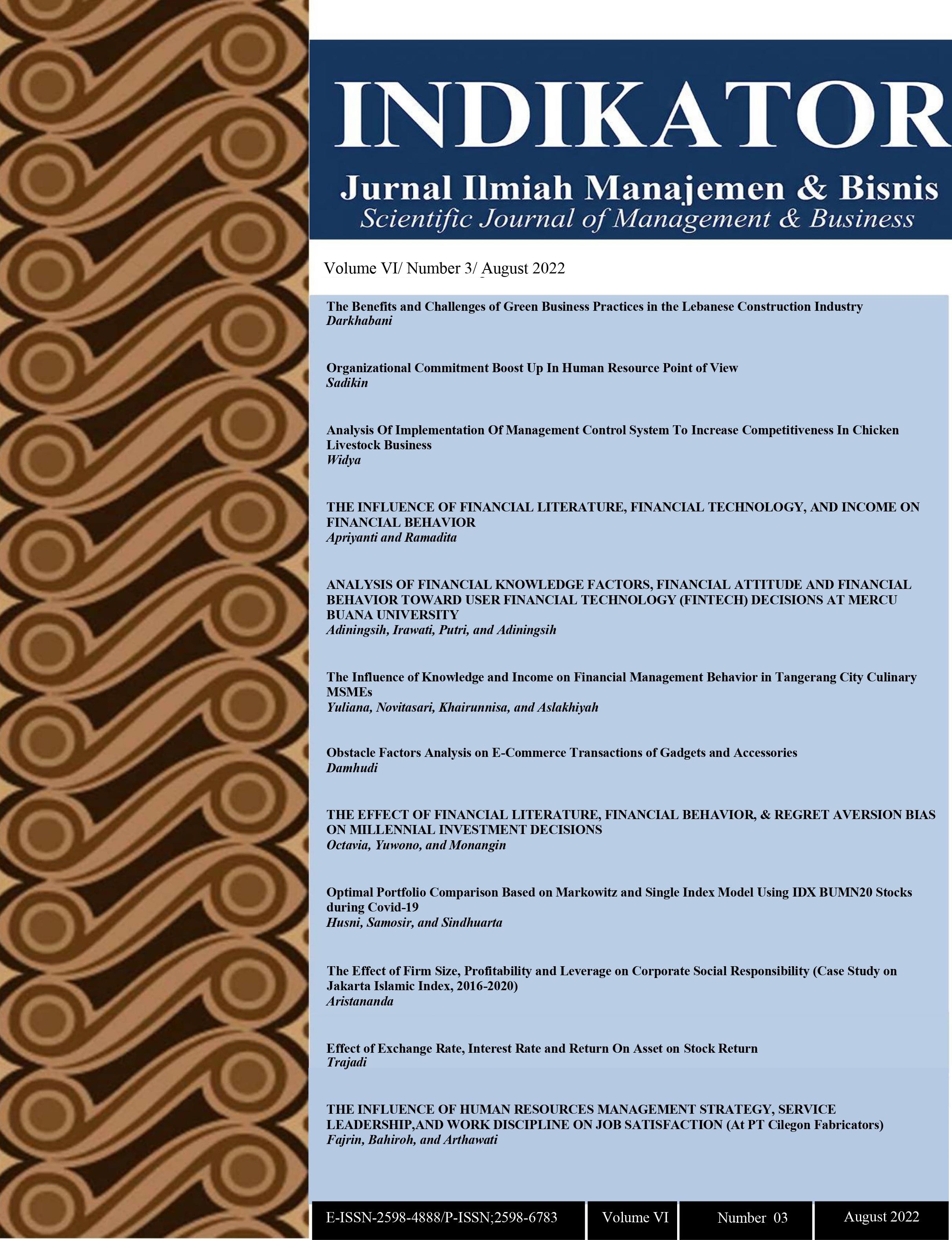
The Benefits and Challenges of Green Business Practices in the Lebanese Construction Industry
DOI:
https://doi.org/10.22441/indikator.v6i3.15356Keywords:
Environmental Aspects, Sustainability, Green Practices, Benefits, Challenges, Construction SectorAbstract
Growing awareness of environmental concerns, including the depletion of natural resources and the degradation of environmental quality, sparked the latter's interest. Green business concepts still have a shaky foundation, as seen by the wide range of definitions that can be found for them. The research relied on the survey approach to get data since it was well accepted that questionnaires were an effective way to gather data from many individuals. The sample included 181 respondents, including project managers, engineers, quantity surveyors, architects, and clients, who completed the survey, including those in Lebanon and those working outside the nation. The data was collected using google forms and then analyzed by the SPSS statistical tool to generate and analyze results.
Going green might be a massive opportunity for Lebanon, a country with a vast budget deficit and economic difficulties, as energy bills continue to climb. Although the green business concept has been pushed to help Lebanon's businesses preserve the environment, many companies are still unable to apply it to all aspects of their operations. Many companies in Lebanon are already preparing to implement the Green Business model, which is expected to happen shortly.References
Abuzeinab, A., Arif, M., Kulonda, D. J., & Awuzie, B. O. (2016). Green business models transformation: evidence from the UK construction sector. Built Environment Project and Asset Management, 6(5), 478–490. https://doi.org/10.1108/BEPAM-10-2015-0060
Alqadami, A., Zawawi, N. A., Rahmawati, Y., & Alaloul, W. (2020). Challenges of implementing green procurement in public construction projects in Malaysia. IOP Conference Series: Materials Science and Engineering, 849(1). https://doi.org/10.1088/1757-899X/849/1/012047
Chin Yee, H., Ismail, R., & Terh Jing, K. (2020). The Barriers of Implementing Green Building in Penang Construction Industry Progress in Energy and Environment The Barriers of Implementing Green Building in Penang Construction Industry. Progress in Energy and Environment, 12, 1–10.
Fathalizadeh, A., Hosseini, M. R., Vaezzadeh, S. S., Edwards, D. J., Martek, I., & Shooshtarian, S. (2021). Barriers to sustainable construction project management: the case of Iran. Smart and Sustainable Built Environment. https://doi.org/10.1108/SASBE-09-2020-0132
Khan, M. W. A., Ting, N. H., Kuang, L. C., Darun, M. R., Mehfooz, U., & Khamidi, M. F. (2018). Green Procurement in Construction Industry: A Theoretical Perspective of Enablers and Barriers. MATEC Web of Conferences, 203. https://doi.org/10.1051/matecconf/201820302012
Marichova, A. (2020). Role of the Government for Development of Sustainable Construction. Ovidius University Annals of Constanta - Series Civil Engineering, 22(1), 53–62. https://doi.org/10.2478/ouacsce-2020-0006
Onubi, H. O., Yusof, N., & Hassan, A. S. (2020). Effects of green construction on project's economic performance. Journal of Financial Management of Property and Construction, 25(3), 331–346. https://doi.org/10.1108/JFMPC-09-2019-0076
Opoku, A., & Ahmed, V. (2014). Embracing sustainability practices in UK construction organizations: Challenges facing intra-organizational leadership. Built Environment Project and Asset Management, 4(1), 90–107. https://doi.org/10.1108/BEPAM-02-2013-0001
Osobajo, O. A., Oke, A., Omotayo, T., & Obi, L. I. (2020). A systematic review of circular economy research in the construction industry. In Smart and Sustainable Built Environment. Emerald Group Publishing Ltd. https://doi.org/10.1108/SASBE-04-2020-0034
Powmya, A., & Abidin, N. Z. (2014). The Challenges of Green
Construction in Oman. In International Journal of Sustainable Construction Engineering & Technology (Vol. 5, Issue 1). http://penerbit.uthm.edu.my/ojs/index.php/IJSCET
Published
How to Cite
Issue
Section
License
The copyright to this article is transferred to Universitas Mercu Buana (UMB) if and when the article is accepted for publication. The undersigned hereby transfers any and all rights in and to the paper including without limitation all copyrights to UMB. The undersigned hereby represents and warrants that the paper is original and that he/she is the author of the paper, except for material that is clearly identified as to its original source, with permission notices from the copyright owners where required. The undersigned represents that he/she has the power and authority to make and execute this assignment.
We declare that:
1. This paper has not been published in the same form elsewhere.
2. It will not be submitted anywhere else for publication prior to acceptance/rejection by this Journal.
3. A copyright permission is obtained for materials published elsewhere and which require this permission for reproduction.
Furthermore, I/We hereby transfer the unlimited rights of publication of the above mentioned paper in whole to UMB. The copyright transfer covers the exclusive right to reproduce and distribute the article, including reprints, translations, photographic reproductions, microform, electronic form (offline, online) or any other reproductions of similar nature.
The corresponding author signs for and accepts responsibility for releasing this material on behalf of any and all co-authors. This agreement is to be signed by at least one of the authors who have obtained the assent of the co-author(s) where applicable. After submission of this agreement signed by the corresponding author, changes of authorship or in the order of the authors listed will not be accepted.
Retained Rights/Terms and Conditions
1. Authors retain all proprietary rights in any process, procedure, or article of manufacture described in the Work.
2. Authors may reproduce or authorize others to reproduce the Work or derivative works for the authors personal use or for company use, provided that the source and the UMB copyright notice are indicated, the copies are not used in any way that implies UMB endorsement of a product or service of any employer, and the copies themselves are not offered for sale.
3. Although authors are permitted to re-use all or portions of the Work in other works, this does not include granting third-party requests for reprinting, republishing, or other types of re-use.
This work is also licensed under a Creative Commons Attribution-NonCommercial 4.0 International License.









