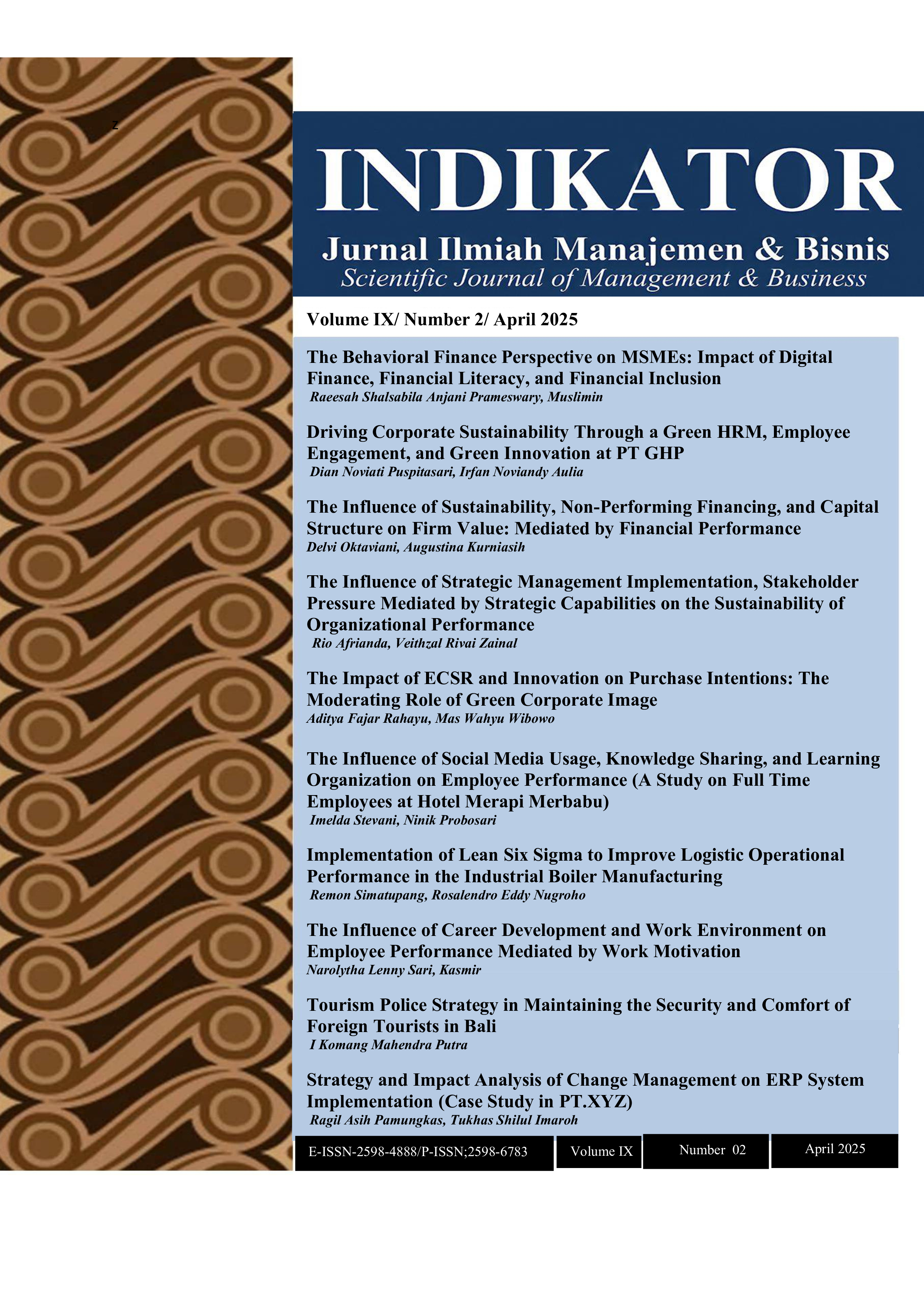
The Behavioral Finance Perspective on MSMEs: Impact of Digital Finance, Financial Literacy, and Financial Inclusion
DOI:
https://doi.org/10.22441/indikator.v9i2.32979Abstract
This study aims to analyze the influence of Digital Finance, Financial Literacy, and Financial Inclusion on the financial management behavior of MSME actors in Bandar Lampung City. The research method used is quantitative, with data collected through surveys using questionnaires as the research instrument. The population in this study includes all MSMEs in Bandar Lampung City, with a sample of 105 MSME actors who meet the criteria as recipients of People’s Business Credit (KUR) or members of savings and loan cooperatives, have been operating for at least one year, and reside in Bandar Lampung City. The sample was determined using Hair’s formula, with a sampling technique based on purposive sampling, which is part of Non-Probability Sampling. Data analysis was conducted using Partial Least Square (PLS).The results indicate that Digital Finance, Financial Literacy, and Financial Inclusion positively influence financial management behavior. Digital Finance enhances transaction efficiency and financial recording accuracy, Financial Literacy assists in budget management and investment planning, while Financial Inclusion expands access to formal financial services. The implications of this study emphasize the importance of financial education and broader access to digital financial services to enhance the sustainability of MSMEs.
References
Ajzen, I. (1991). The theory of planned behavior. Organizational Behavior and Human Decision Processes, 50(2), 179–211.
Andriyani, P., & Sulistyowati, A. (2021). Analisis pengaruh literasi keuangan, inklusi keuangan, dan tingkat pendidikan terhadap perilaku keuangan pelaku UMKM kedai/warung makanan di Desa Bahagia Kabupaten Bekasi. Aliansi: Jurnal Manajemen Dan Bisnis, 16(2), 61–70.
Angeles, I. T. (2022). The moderating effect of digital and financial literacy on the digital financial services and financial behavior of MSMEs. Available at SSRN 5055949.
Davis, F. D. (1989). Perceived usefulness, perceived ease of use, and user acceptance of information technology. MIS Quarterly, 319–340.
Demirgüç-Kunt, A., & Singer, D. (2017). Financial inclusion and inclusive growth: A review of recent empirical evidence. World Bank Policy Research Working Paper, 8040.
Dinas Koperasi dan UKM Kota Bandar Lampung. (2024). Jumlah UMK di Kota Bandar Lampung pada tahun 2024.
Erlangga, M. Y., & Krisnawati, A. (2020). Pengaruh fintech payment terhadap perilaku manajemen keuangan mahasiswa. Jurnal Riset Manajemen Dan Bisnis, 15(1), 53–62.
Gunawan, A. C., & Aziz, A. (2021). Analysis Of Financial Technology, Financial Inclusion, Financial Literation, And Income To Financial Behaviour on SMEs East Jakarta. Jurnal Akuntansi dan Auditing, 18(2), 128–146.
Hair, J. F., Hult, G. T. M., Ringle, C. M., & Sarstedt, M. (2014). A Primer on Partial Least Squares Structural Equation Modeling (PLS-SEM). SAGE Publications.
Klein, V. B., & Todesco, J. L. (2021). COVID‐19 Crisis and SMEs Responses: The Role of Digital Transformation. Knowledge and Process Management, 28(2), 117–133.
Lestari, N., Levyta, F., Rosman, D., Zainal, V., & Affini, D. (2022). Technology is a Solution for MSMEs Sustainability. Indikator: Jurnal Ilmiah Manajemen dan Bisnis, 6(2), 71–80.
OECD. (2012). Measuring Financial Literacy: Results of the OECD/INFE Pilot Study. OECD Publishing.
OJK. (2024). Survei Nasional Literasi dan Inklusi Keuangan (SNLIK) 2024. https://ojk.go.id/id/berita-dan-kegiatan/publikasi/Pages/Survei-Nasional-Literasi-dan-Inklusi-Keuangan-(SNLIK)-2024.aspx
Pinem, D., & Mardiatmi, B. D. (2021). Analisis literasi keuangan, inklusi keuangan dan pendapatan terhadap perilaku pelaku UMKM di Depok Jawa Barat. Syntax Literate; Jurnal Ilmiah Indonesia, 6(1), 104–120.
Rahayu, F. S., Risman, A., Firdaus, I., & Haningsih, L. (2023). The Behavioral Finance of MSME in Indonesia: Financial Literacy, Financial Technology (Fintech), and Financial Attitudes. International Journal of Digital Entrepreneurship and Business, 4(2), 95–107.
Risman, A. (2024). The Behavioral Finance of MSME: Digital Finance, Managerial Biases, Financial Literacy. Dinasti International Journal of Economics, Finance & Accounting (DIJEFA), 5(2).
Risman, A. (2025). Perilaku Keuangan Personal. In Sepriano Efitra. Manajemen Keuangan: Teori dan Praktik dalam Mencapai Financial Freedom (pp. 102–120). Sonpedia Publishing Indonesia.
Risman, A., Ali, A. J., Soelton, M., & Siswanti, I. (2023). The behavioral finance of MSMEs in the advancement of financial inclusion and financial technology (Fintech). The Indonesian Accounting Review, 13(1), 91–101. https://doi.org/10.14414/tiar.v13i1.3213
Risman, A., Mulyana, B., Silvatika, B., & Sulaeman, A. (2021). The effect of digital finance on financial stability. Management Science Letters, 11(7), 1979–1984.
Saputra, R., & Dahmiri, D. (2022). Pengaruh Financial Technology Terhadap Perilaku Keuangan Melalui Niat Berperilaku Sebagai Variabel Mediasi Pada Usaha Kecil Menengah Di Kabupaten Tebo. Jurnal Manajemen Terapan Dan Keuangan, 11(03), 755–768.
Waty, N. Q., Triwahyuningtyas, N., & Warman, E. (2021). Analisis perilaku manajemen keuangan mahasiswa dimasa pandemi covid-19. Konferensi Riset Nasional Ekonomi Manajemen Dan Akuntansi, 2(1), 477–495.
Downloads
Additional Files
Published
How to Cite
Issue
Section
License
The copyright to this article is transferred to Universitas Mercu Buana (UMB) if and when the article is accepted for publication. The undersigned hereby transfers any and all rights in and to the paper including without limitation all copyrights to UMB. The undersigned hereby represents and warrants that the paper is original and that he/she is the author of the paper, except for material that is clearly identified as to its original source, with permission notices from the copyright owners where required. The undersigned represents that he/she has the power and authority to make and execute this assignment.
We declare that:
1. This paper has not been published in the same form elsewhere.
2. It will not be submitted anywhere else for publication prior to acceptance/rejection by this Journal.
3. A copyright permission is obtained for materials published elsewhere and which require this permission for reproduction.
Furthermore, I/We hereby transfer the unlimited rights of publication of the above mentioned paper in whole to UMB. The copyright transfer covers the exclusive right to reproduce and distribute the article, including reprints, translations, photographic reproductions, microform, electronic form (offline, online) or any other reproductions of similar nature.
The corresponding author signs for and accepts responsibility for releasing this material on behalf of any and all co-authors. This agreement is to be signed by at least one of the authors who have obtained the assent of the co-author(s) where applicable. After submission of this agreement signed by the corresponding author, changes of authorship or in the order of the authors listed will not be accepted.
Retained Rights/Terms and Conditions
1. Authors retain all proprietary rights in any process, procedure, or article of manufacture described in the Work.
2. Authors may reproduce or authorize others to reproduce the Work or derivative works for the authors personal use or for company use, provided that the source and the UMB copyright notice are indicated, the copies are not used in any way that implies UMB endorsement of a product or service of any employer, and the copies themselves are not offered for sale.
3. Although authors are permitted to re-use all or portions of the Work in other works, this does not include granting third-party requests for reprinting, republishing, or other types of re-use.
This work is also licensed under a Creative Commons Attribution-NonCommercial 4.0 International License.









