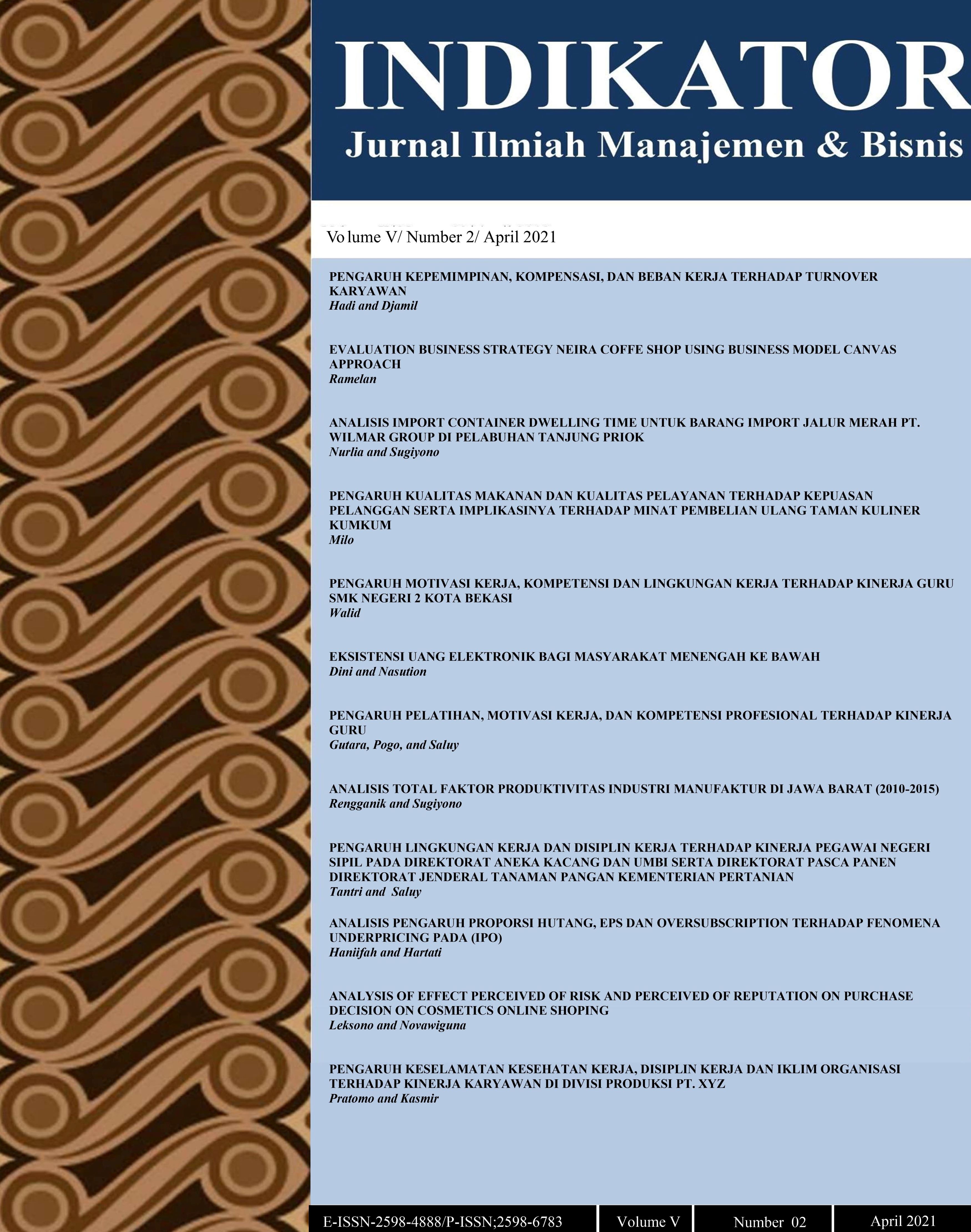
PENGARUH KEPEMIMPINAN, KOMPENSASI, DAN BEBAN KERJA TERHADAP TURNOVER KARYAWAN (STUDI KASUS : PT. XYZ – JAKARTA)
DOI:
https://doi.org/10.22441/indikator.v5i2.6366Keywords:
leadership, compensation, workload, employee turnoverAbstract
ABSTRACT
This purpose of this study is to examine and analyze the effect of leadership, compensation, and workload on employee turnover. The high turnover rate has become a serious problem for PT. XYZ Jakarta. The negative impact that is felt due to the turnover of the company is the quality and ability of employees to replace employees who leave the company, so it takes time and new costs to recruit and train new employees. PT. XYZ Jakarta detected high turnover. This can be seen based on employee turnover data from 2015 to 2017. The population in this study were all employees of PT. XYZ Jakarta as many as 76 employees where all members of the population are used as samples. The method used in this study is a quantitative method, with the type of survey and data collection through a questionnaire. Data analysis was used to test the validity, reliability, and multiple linear regression. The results of this research indicate that leadership variables, compensation and workload have a jointly significant effect on employee turnover. Good leadership, good compensation and workloads that are in accordance with ABK standards (Workload Analysis) will reduce employee turnover rates.
ABSTRAK
Penelitian ini bertujuan untuk menguji dan menganalisis pengaruh kepemimpinan, kompensasi, dan beban kerja terhadap turnover karyawan. Tinggi nya tingkat turnover telah menjadi masalah serius bagi PT. XYZ Jakarta. Dampak negatif yang dirasakan akibat terjadinya turnover pada perusahaan yaitu pada kualitas dan kemampuan karyawan untuk menggantikan karyawan yang keluar dari perusahaan, sehingga butuh waktu serta biaya baru dalam merekrut dan melatih karyawan baru. PT. XYZ Jakarta terdeteksi mengalami turnover yang tinggi. Hal ini dapat dilihat berdasarkan data keluar masuk karyawan dari tahun 2015 sampai 2017. Populasi dalam penelitian ini adalah seluruh karyawan PT. XYZ Jakarta sebanyak 76 karyawan dimana semua anggota populasi digunakan sebagai sampel. Metode yang digunakan dalam penelitian ini adalah dengan metode kuantitatif, dengan tipe survei dan pengumpulan data melalui kuesioner. Analisis data digunakan untuk uji validitas, reliabilitas, dan regresi linier berganda. Hasil penelitian ini menunjukan bahwa variabel kepemimpinan, kompensasi dan beban kerja berpengaruh signifikan secara bersama-sama terhadap turnover pada karyawan. Kepemimpinan yang baik, Kompensasi yang baik dan Beban Kerja yang sesuai dengan standar ABK (Analisa Beban Kerja) akan menurunkan tingkat Turnover karyawan.
Published
How to Cite
Issue
Section
License
The copyright to this article is transferred to Universitas Mercu Buana (UMB) if and when the article is accepted for publication. The undersigned hereby transfers any and all rights in and to the paper including without limitation all copyrights to UMB. The undersigned hereby represents and warrants that the paper is original and that he/she is the author of the paper, except for material that is clearly identified as to its original source, with permission notices from the copyright owners where required. The undersigned represents that he/she has the power and authority to make and execute this assignment.
We declare that:
1. This paper has not been published in the same form elsewhere.
2. It will not be submitted anywhere else for publication prior to acceptance/rejection by this Journal.
3. A copyright permission is obtained for materials published elsewhere and which require this permission for reproduction.
Furthermore, I/We hereby transfer the unlimited rights of publication of the above mentioned paper in whole to UMB. The copyright transfer covers the exclusive right to reproduce and distribute the article, including reprints, translations, photographic reproductions, microform, electronic form (offline, online) or any other reproductions of similar nature.
The corresponding author signs for and accepts responsibility for releasing this material on behalf of any and all co-authors. This agreement is to be signed by at least one of the authors who have obtained the assent of the co-author(s) where applicable. After submission of this agreement signed by the corresponding author, changes of authorship or in the order of the authors listed will not be accepted.
Retained Rights/Terms and Conditions
1. Authors retain all proprietary rights in any process, procedure, or article of manufacture described in the Work.
2. Authors may reproduce or authorize others to reproduce the Work or derivative works for the authors personal use or for company use, provided that the source and the UMB copyright notice are indicated, the copies are not used in any way that implies UMB endorsement of a product or service of any employer, and the copies themselves are not offered for sale.
3. Although authors are permitted to re-use all or portions of the Work in other works, this does not include granting third-party requests for reprinting, republishing, or other types of re-use.
This work is also licensed under a Creative Commons Attribution-NonCommercial 4.0 International License.









