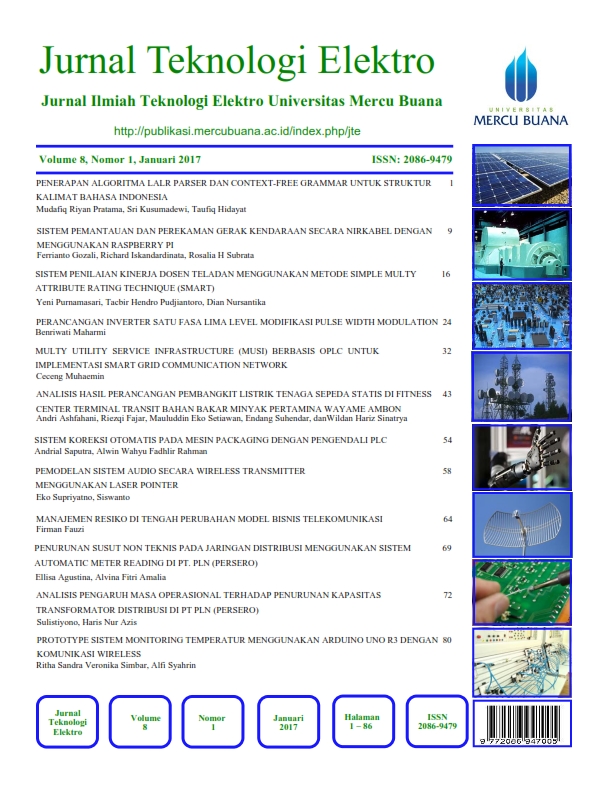
PENERAPAN ALGORITMA LALR PARSER DAN CONTEXT-FREE GRAMMAR UNTUK STRUKTUR KALIMAT BAHASA INDONESIA
DOI:
https://doi.org/10.22441/jte.v8i1.1364Abstract
Penyajian bahasa dalam bentuk tulisan, dapat menyimpan pengetahuan dari generasi ke generasi berikutnya. Setiap penulisan karya tulis seperti buku, hendaknya ditulis dengan tata bahasa yang benar sesuai kaidah-kaidah bahasa Indonesia, karena akan berpengaruh pada kesempurnaan proses penyampaian ide atau pesan. Parsing adalah proses untuk memeriksa kebenaran struktur kalimat berdasarkan suatu grammar (tata bahasa). Salah satu algoritma untuk parsing kata dalam Context-Free Grammar (CFG) adalah LALR Parser. LALR Parser merupakan salah satu varian dari LR Parser yang mampu menangani grammar (Gupta, 2013). Uji coba dilakukan pada tiga jenis kalimat yaitu kalimat tunggal, kalimat majemuk setara, dan kalimat majemuk bertingkat. LALR Parser efektif dalam melakukan parsing terhadap CFG bahasa Indonesia pada kalimat tunggal (nilai akurasi 90.30%), kalimat majemuk setara (nilai akurasi 76.66%), dan kalimat majemuk bertingkat (nilai akurasi 78.57%). Kegagalan deteksi dipengaruhi oleh 3 hal yaitu (1) struktur kalimat tidak sesuai dengan kaidah bahasa Indonesia, (2) unsur pembentuk kalimat tidak tersedia dalam CFG, dan (3) kata yang terdapat dalam kalimat tidak tersedia dalam lexicon.Downloads
References
Wilkins, David A. Linguistics and Language Teaching. London: Edward Arnold. 1972.
Magdum, P. G., & Kodavade, D. V. Recognizing English Grammar Using Predictive Parser. International Journal of Engineering Research and Applications (IJERA), 3(4), 306–312. 2013.
Boogerd, C.J. A Framework for SGLR Parsing in Java. Amsterdam: Universiteit van Amsterdam. 2005.
Shivani Gupta, D. S. Y. Extraction of Link Context using Tag Tree and LALR Parsing. Proceedings of 2013 IEEE Conference on Information and Communication Technologies (ICT 2013), (lCT), 253–257. 2013.
Pandiangan, Vita M. Implementasi Left Corner Parser pada Perancangan Aplikasi Pemeriksaan Tata Bahasa dalam Kalimat Bahasa Indonesia. Informasi dan Teknologi Ilmiah (INTI), 2, 161-165. 2015.
Departemen Pendidikan Nasional. Kamus Besar Bahasa Indonesia. Jakarta: Pusat Bahasa. 2008.
Moeliono, Anton., dkk. Tata Bahasa Baku Bahasa Indonesia (Edisi Ketiga). Jakarta: Balai Pustaka. 1998.
Aho, A. V., & Ullman, J. D. Principals of Compiler Design. Narosa Publishing House (25th reprint 2003), 197-214. 1977.
Badudu, J.S. Pintar Bahasa Indonesia Untuk Sekolah Lanjutan Tingkat Pertama Kelas 1. Jakarta: Balai Pustaka. 1997.
Chaer, Abdul. Tata Bahasa Praktis Bahasa Indonesia (Edisi Revisi). Jakarta: Penerbit Rineka Cipta. 1998.
Putrayasa, Ida Bagus. Tata Kalimat Bahasa Indonesia. Bandung: PT Refika Aditama. 2006.
Downloads
Published
How to Cite
Issue
Section
License
The copyright to this article is transferred to Universitas Mercu Buana (UMB) if and when the article is accepted for publication. The undersigned hereby transfers any and all rights in and to the paper including without limitation all copyrights to UMB. The undersigned hereby represents and warrants that the paper is original and that he/she is the author of the paper, except for material that is clearly identified as to its original source, with permission notices from the copyright owners where required. The undersigned represents that he/she has the power and authority to make and execute this assignment.
We declare that:
1. This paper has not been published in the same form elsewhere.
2. It will not be submitted anywhere else for publication prior to acceptance/rejection by this Journal.
3. A copyright permission is obtained for materials published elsewhere and which require this permission for reproduction.
Furthermore, I/We hereby transfer the unlimited rights of publication of the above mentioned paper in whole to UMB. The copyright transfer covers the exclusive right to reproduce and distribute the article, including reprints, translations, photographic reproductions, microform, electronic form (offline, online) or any other reproductions of similar nature.
The corresponding author signs for and accepts responsibility for releasing this material on behalf of any and all co-authors. This agreement is to be signed by at least one of the authors who have obtained the assent of the co-author(s) where applicable. After submission of this agreement signed by the corresponding author, changes of authorship or in the order of the authors listed will not be accepted.
Retained Rights/Terms and Conditions
1. Authors retain all proprietary rights in any process, procedure, or article of manufacture described in the Work.
2. Authors may reproduce or authorize others to reproduce the Work or derivative works for the authors personal use or for company use, provided that the source and the UMB copyright notice are indicated, the copies are not used in any way that implies UMB endorsement of a product or service of any employer, and the copies themselves are not offered for sale.
3. Although authors are permitted to re-use all or portions of the Work in other works, this does not include granting third-party requests for reprinting, republishing, or other types of re-use.









