
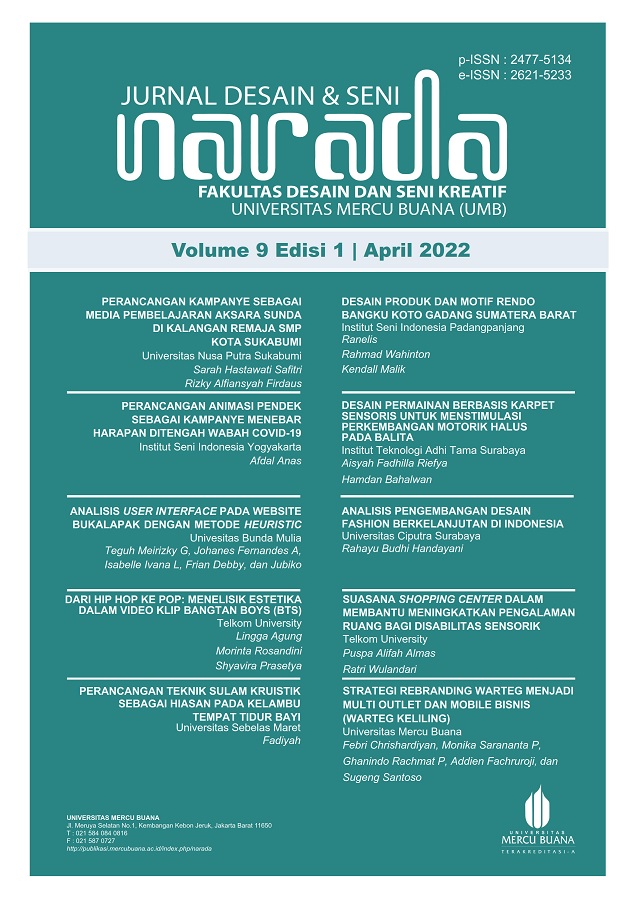
ANALISIS USER INTERFACE PADA WEBSITE BUKALAPAK DENGAN METODE HEURISTIC
DOI:
https://doi.org/10.22441/narada.2022.v9.i1.003Keywords:
Bukalapak, E-Commerce, Heuristic Evaluation, Usability, User InterfaceAbstract
Human and computer interaction is a science that focused on system planning and design a system so that users can interact and collaborate according to the needs of the users themselves in the most effective way at every step of their work. The role of the user interface has a significant impact on the usability of an application or system. Heuristic evaluation (HE) is considered to be the best usability evaluation method compared to other methods because it can find serious problems that cannot be detected by other methods. Therefore, researchers will analyze the user interface on the Bukalapak website using the HE method. User Interface Analysis on the Website with the HE Method through the distribution of online questionnaires, from the results of distributing questionnaires online, it can be concluded that the website has shortcomings in terms of helping and documentation features to assist users in using the system. It is declared lacking because it has the lowest rcount (Total) value of 0.587 compared to other rcount. Suggestions for research on user satisfaction analysis using the HE method, authors convey suggestions that need to be improved in future research, namely it is necessary to conduct research on Bukalapak user satisfaction using the HE method in a wider scope.
Downloads
References
Bakar, Z. A., Salim, F. S., Zainuddin, N. F. F., Mohamad Noor, N. M., & Mohemad, R. (2021). Analysis of web-based learning interface design based on experts’ verification for higher education. International Journal on Informatics Visualization, 5(2), 134–138.
DOI: https://doi.org/10.30630/joiv.5.2.410
Baladina, A., Aknuranda, I., & Kusyanti, A. (2018). Analisis Hasil Perbandingan Penerapan Metode Heuristic Evaluation Menggunakan Persona dan Tanpa Persona (Studi Kasus: Situs Web Female Daily). Jurnal Pengembangan Teknologi Informasi Dan Ilmu Komputer (J-PTIIK) Universitas Brawijaya, 2(12), 7050–7057.
Díaz, J., Rusu, C., & Collazos, C. A. (2017). Experimental validation of a set of cultural-oriented usability heuristics: E-Commerce websites evaluation. Computer Standards & Interfaces, 50, 160–178.
DOI:https://doi.org/10.1016/j.csi.2016.09.013
Febriyanthi, A., Naufal, M. N., Rahmatullah, M., Islahuddin & Parlindungan. (2021). Interface Design Heuristic Evaluation Website Yayasan Kesehatan Telkom. Turkish Journal of Computer and Mathematics Education (TURCOMAT), 12(4), 852–859.
DOI:https://doi.org/10.17762/turcomat.v12i4.573
Foster, E. C. (2021). Software Engineering, Chapter User Interface Design. London: Taylor & Francis group.
DOI:https://doi.org/10.1201/9780367746025-17
Geasela, Y. M., Ranting, P.-, & Andry, J. F. (2018). Analisis User Interface Terhadap Website Berbasis E-Learning dengan Metode Heuristic Evaluation. Jurnal Informatika, 5(2), 270–277.
DOI: https://doi.org/10.31311/ji.v5i2.3741
Nugraheny, D. (2016). Analisis User Interface dan User Experience pada Website Sekolah Tinggi Teknologi Adisutjipto Yogyakarta. Conference SENATIK STT Adisutjipto Yogyakarta, 2, 183.
DOI:https://doi.org/10.28989/senatik.v2i0.77
Joo, H. (2017). A study on understanding of UI and UX, and understanding of design according to user interface change. International Journal of Applied Engineering Research, 12(20), 9931–9935.
Kasmi, K., & Candra, A. N. (2017). Penerapan E-Commerce Berbasis Business To Consumers Untuk Meningkatan Penjualan Produk Makanan Ringan Khas Pringsewu. Jurnal AKTUAL, 15(2), 109.
DOI:https://doi.org/10.47232/aktual.v15i2.27
Kumar, B. A., Goundar, M. S., & Chand, S. S. (2020). A framework for heuristic evaluation of mobile learning applications. Education and Information Technologies, 25, 3189-3204.
DOI: https://doi.org/10.1007/s10639-020-10112-8
Kurniawan, A., & Syakur, A. (2017). The Correlation of Emotional Intelligence and Spiritual of Intelligence to Effectiveness Principals of Leadership. International Journal of Psychological and Brain Sciences, 2(1), 1-9.
DOI:https://doi.org/10.11648/j.ijpbs.20170201.11
Rajanen, M., & Rajanen, D. (2018). Heuristic evaluation in game and gamification development. GamiFIN Conference Pori, Finland, May 21-23, 158-168.
Safira, C. F., Kusyanti, A., & Aryadita, H. (2017). Analisis kualitas layanan website bukalapak terhadap kepuasan pengguna menggunakan E-S-Qual. Jurnal Pengembangan Teknologi Informasi Dan Ilmu Komputer, 1(12), 1813–1821.
Shahroom, A. A., & Hussin, N. (2018). Industrial Revolution 4.0 and Education. International Journal of Academic Research in Business and Social Sciences, 8(9), 314–319.
Downloads
Published
How to Cite
Issue
Section
License
A writer who will publish their article in the NARADA Journal of Design and Art agrees to the following conditions:
- The author owns the copyright and grants the rights to NARADA Journal of Design and Art as the party entrusted with publishing the article for the first time simultaneously licensed under the "Creative Commons Attribution-ShareAlike 4.0" License. This makes it possible for other people to share the work with a form of acknowledgment of authorship of the work and initial publication in this journal according to the authorship of the article provided.
- Authors may enter into separate additional contractual agreements for non-exclusive distribution of the published journal version of the work (e.g., posting it to an institutional repository or publishing it in a book) with acknowledgment of initial publication in the NARADA Journal of Design and Art.
- Authors are permitted and asked to post their work online (for example, institutional repositories or on personal websites) after the article publication process. This avoids double publication or multiple submissions which will affect the similarity of writing of the published work.
- In order to maintain the value of originality and similarity of articles sent or submitted. Authors are asked to temporarily remove or hide the original article from other online systems until they receive the results and decisions from the NARADA Journal of Design and Art regarding the decision to publish the article.
- The author, in this case the contributing author (Contributor Author), will be sent a form or letter stating the validity of the scientific work, signed on an IDR 10,000 stamp. Then the author will be asked to send the email to [email protected].
Pemberitahuan Hak Cipta
Seorang penulis yang akan menerbitkan artikelnya dalam NARADA Jurnal Desain dan Seni setuju dengan ketentuan berikut:
- Penulis memiliki hak cipta dan memberikan hak kepada pihak NARADA Jurnal Desain dan Seni sebagai pihak yang diberikan kepercayaan untuk mempublikasi artikelnya pertama kali secara bersamaan dilisensikan di bawah Lisensi "Creative Commons Attribution-ShareAlike 4.0". Hal ini memungkinkan kepada orang lain untuk membagi karya dengan bentuk pengakuan kepengarangan karya dan publikasi awal dalam jurnal ini sesuai dengan penulisan artikel yang diberikan.
- Penulis dapat membuat perjanjian kontrak tambahan yang terpisah untuk distribusi non-eksklusif versi jurnal yang diterbitkan dari karya tersebut (misalnya, mempostingnya ke repositori institusional atau menerbitkannya dalam sebuah buku) dengan pengakuan publikasi awal dalam NARADA Jurnal Desain dan Seni.
- Penulis diizinkan dan diminta untuk mempostingkan karyanya secara online (semisal, repositori institusional atau di situs web pribadi) setelah proses penerbitan artikel, Hal ini menghindari adanya double publikasi atau pengajuan jamak yang akan berpengaruh kepada adanya kesamaan penulisan dari karya yang diterbitkan.
- Demi menjaga nilai orisinalitas dan nilai kesamaan dari artikel yang dikirim atau diajukan. Penulis diminta untuk menghilangkan atau menyembunyikan secara sementara artikel orisinil dari sistem online lain yang sampai mendapatkan hasil nilai dan ketetapan dari pihak NARADA Jurnal Desain dan Seni mengenai keputusan publikasi dari artikel.
- Penulis dalam hal ini penulis kontributor (Contributor Author) akan dikirimkan form atau surat pernyataan keabsahan karya ilmiah, yang ditanda tangani di atas materai 10000. Dan selanjutnya penulis diminta untuk mengirimkan ke email [email protected].









