UPCYCLING LIMBAH PLASTIK DENGAN TEKNIK MERENDA (CROCHET) UNTUK PEMBUATAN UPHOLSTERY PADA PRODUK POUF
DOI:
https://doi.org/10.22441/narada.2023.v10.i2.005Keywords:
Crochet, Plastic bag waste, Upcycling, Upholstery poufAbstract
The daily use of plastic bags on a large scale has an impact on the increasing amount of plastic bag waste generated. Responding to these problems, the author initiated the utilization of plastic bag waste in the interior field, namely by upcycling plastic bag waste using crochet techniques for making upholstery on pouf products. That way in this design can be formulated a problem of how to process plastic bag waste with crochet techniques into upholstery on pouf products. The purpose of designing this work is to provide alternatives and variations in the processing of plastic bag waste using crochet techniques. This design uses the method of creation proposed by Palgunadi (2007), which includes three processes of planning and making products, namely the exploration process, extraction process, and termination point. The results obtained from this design are that plastic bag waste, especially HDPE types, can be made into plastic fibers because this plastic waste has a medium thickness, but is still strong and very much available. Furthermore, to process plastic waste into plastic fibers, steps are needed such as sorting, cleaning and then cutting plastic bag waste to produce plastic fibers that are ready to be crocheted to produce upholstery poufs that are in accordance with taste.
Downloads
References
Anita, R. R., & Puspitasari, C. (2019). Penerapan Olahan Limbah Kantong Plastik dengan Teknik Crochet sebagai Unsur Dekoratif pada Produk Fesyen. Atrat Jurnal Seni Rupa, 7(1), 81–91.
DOI:https://doi.org/10.26742/atrat.v7i1.646
Aryanto, Y. (2012). 173 meja & kursi. Bogor: Griya Kreasi.
Djamil, S. (2008). Kamus Besar Bahasa Indonesia. (T. R. Publisher (ed.)). Surabaya: Reality Publisher.
Kay, S. (2017). "Reclaim Upcycled at Salvo Fair 2017". SalvoNEWS, 2017, Juni 5. Wales, UK. Diambil dari: https://www.salvoweb.com/salvonews/18484-reclaim-upcycled-at-salvo-fair-2017
Keim, C., & Werker, K. P. (2011). Teach Yourself Visually Crochet (2nd ed.). New Jersey: Wiley Publishing Inc.
Maulana, A. H., & Diah, S. R. S. (2021). “Perhatikan, Ini Dampak Buruk Membakar Sampah Rumah Tangga”. KOMPAS.COM, 2021, Juli 6. Jakarta. Diambil dari: https://www.kompas.com/homey/read/2021/07/06/200500976/perhatikan-ini-dampak-buruk-membakar-sampah-rumah-tangga?page=all
Muthu, S. S. (2017). Textiles and Clothing Sustainability: Recycled and Upcycled Textiles and Fashion. Hong Kong: Springer.
Palgunadi, B. (2007). Disain Produk 1: Disain, Disainer, Dan Proyek Disain. Bandung: Institut Teknologi Bandung.
Rahmaningtyas, W., Suryani, N., & Harnanik, H. (2019). Peningkatan Mutu Produk Barang Fungsional Di Desa Candirejo Melalui Pelatihan Pemanfaatan Limbah Plastik Untuk Mengurangi Pencemaran Lingkungan. Jurnal Puruhita, 1(1), 34–37.
Richardson, M. (2014). “Design for Reuse: Integrating Upcycling Into Industrial Design Practice.” Academia, 2014, Agustus 6. Caulfield East, Australia. Diambil dari: https://www.academia.edu/1052431/Design_for_Reuse_Integrating_Upcycling_Into_Industrial_Design_Practice
Sandjaya, I. (2003). Ruang Duduk: Seri Menata Rumah. Granmedia Pustaka Utama.
Wicaksono, A. A., Trisnawati, E., Kharisma, D., & Setyawan, A. (2014). Teori Interior. (H. Aditama (ed.)). Griya Kreasi.
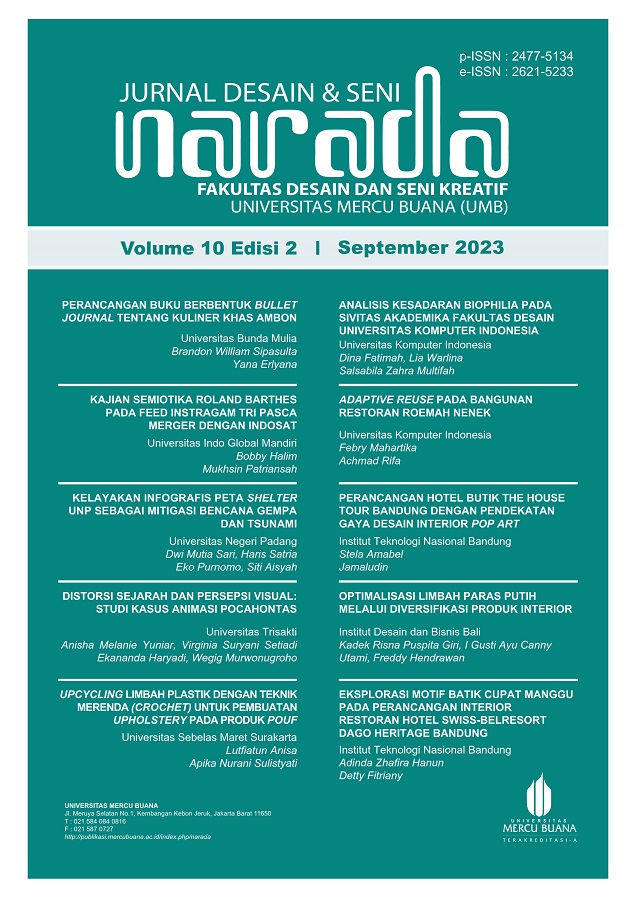
Downloads
Published
How to Cite
Issue
Section
License
A writer who will publish their article in the NARADA Journal of Design and Art agrees to the following conditions:
- The author owns the copyright and grants the rights to NARADA Journal of Design and Art as the party entrusted with publishing the article for the first time simultaneously licensed under the "Creative Commons Attribution-ShareAlike 4.0" License. This makes it possible for other people to share the work with a form of acknowledgment of authorship of the work and initial publication in this journal according to the authorship of the article provided.
- Authors may enter into separate additional contractual agreements for non-exclusive distribution of the published journal version of the work (e.g., posting it to an institutional repository or publishing it in a book) with acknowledgment of initial publication in the NARADA Journal of Design and Art.
- Authors are permitted and asked to post their work online (for example, institutional repositories or on personal websites) after the article publication process. This avoids double publication or multiple submissions which will affect the similarity of writing of the published work.
- In order to maintain the value of originality and similarity of articles sent or submitted. Authors are asked to temporarily remove or hide the original article from other online systems until they receive the results and decisions from the NARADA Journal of Design and Art regarding the decision to publish the article.
- The author, in this case the contributing author (Contributor Author), will be sent a form or letter stating the validity of the scientific work, signed on an IDR 10,000 stamp. Then the author will be asked to send the email to [email protected].
Pemberitahuan Hak Cipta
Seorang penulis yang akan menerbitkan artikelnya dalam NARADA Jurnal Desain dan Seni setuju dengan ketentuan berikut:
- Penulis memiliki hak cipta dan memberikan hak kepada pihak NARADA Jurnal Desain dan Seni sebagai pihak yang diberikan kepercayaan untuk mempublikasi artikelnya pertama kali secara bersamaan dilisensikan di bawah Lisensi "Creative Commons Attribution-ShareAlike 4.0". Hal ini memungkinkan kepada orang lain untuk membagi karya dengan bentuk pengakuan kepengarangan karya dan publikasi awal dalam jurnal ini sesuai dengan penulisan artikel yang diberikan.
- Penulis dapat membuat perjanjian kontrak tambahan yang terpisah untuk distribusi non-eksklusif versi jurnal yang diterbitkan dari karya tersebut (misalnya, mempostingnya ke repositori institusional atau menerbitkannya dalam sebuah buku) dengan pengakuan publikasi awal dalam NARADA Jurnal Desain dan Seni.
- Penulis diizinkan dan diminta untuk mempostingkan karyanya secara online (semisal, repositori institusional atau di situs web pribadi) setelah proses penerbitan artikel, Hal ini menghindari adanya double publikasi atau pengajuan jamak yang akan berpengaruh kepada adanya kesamaan penulisan dari karya yang diterbitkan.
- Demi menjaga nilai orisinalitas dan nilai kesamaan dari artikel yang dikirim atau diajukan. Penulis diminta untuk menghilangkan atau menyembunyikan secara sementara artikel orisinil dari sistem online lain yang sampai mendapatkan hasil nilai dan ketetapan dari pihak NARADA Jurnal Desain dan Seni mengenai keputusan publikasi dari artikel.
- Penulis dalam hal ini penulis kontributor (Contributor Author) akan dikirimkan form atau surat pernyataan keabsahan karya ilmiah, yang ditanda tangani di atas materai 10000. Dan selanjutnya penulis diminta untuk mengirimkan ke email [email protected].









