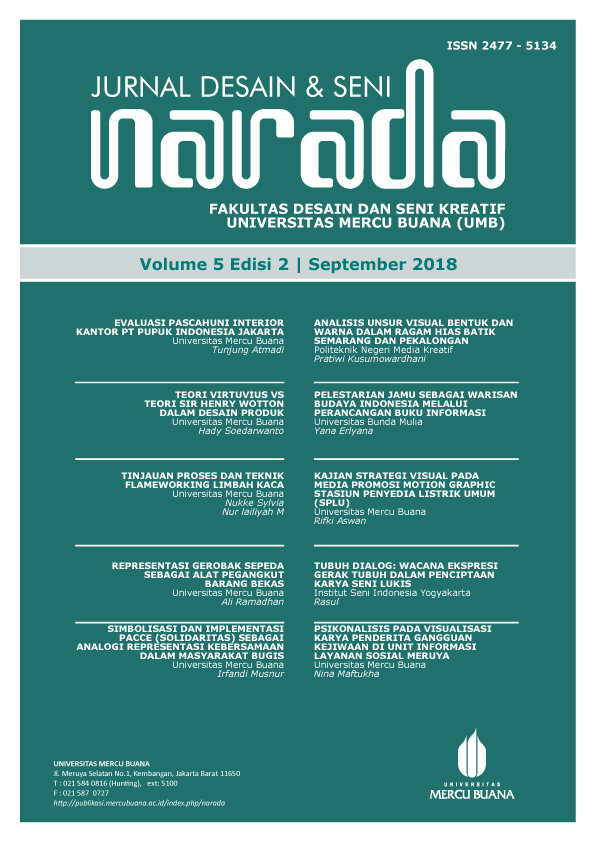
TEORI VITRUVIUS VS TEORI SIR HENRY WOTTON DALAM DESAIN PRODUK
Keywords:
vitruvius, sir henry wotton, utilitas, firmitas, venustas, commodity, firmness, delightAbstract
ABSTRAK
Masa berubah, dunia berubah dan manusia ikut berubah didalamnya. Ketiga hal tersebut saling berkaitan satu dengan yang lainnya. Waktu pasti berubah selanjutnya tinggal duni dan manusia yang saling mempengaruhi untuk membuat perubahan. Manusia berfikir mengatasi keadaannya sehingga mampu merubah dunia, begitu juga sebaliknya dunia yang berubah memaksa manusia untuk berubah. Dalam ranah desain perubahan adalah sesuatu yang sangat penting, dimana desainer selalu dituntut untuk senantiasa melahirkan kebaruan. Dalam setiap bidang ilmu memiliki teori. Di bidang desain ada satu teori yang cukup tua dan bersifat mendasar yaitu Teori Vitruvius (15 SM). Vitruvius mengemukakan bahwa sebuah benda desain harus memenuhi syarat minimal yaitu Utilitas (Aspek Fungsi), Firmitas (Aspek Kekokohan dan system) serta Venustas (Aspek Keindahan). Hingga pada tahun 1626, Sir Henry Wotton mangemukakan sebuah teori yang berhubungan dengan Teori Vitruvius yang menyatakan bahwa bukan Utilitas – Firmitas – Venustas tetapi Commodity – Firmness – Delight. Namun demikian lahirnya sebuah teori bukanlah menandakan matinya teori pendahulunya, namun lebih kepada upaya menciptakan lebih banyak kemungkinan baru terutama untuk keperluan bermetode dan berstartegi dalam mendesain.
Kata Kunci: vitruvius, sir henry wotton, utilitas, firmitas, venustas, commodity, firmness, delight
Abstract
Times change, the world changes and people change in it. The three things are related to each other. Time must change and then live the world and humans influence each other to make changes. Humans always think in order to overcome the situation so as to change the world, and vice versa, the changing world forces people to change. In the realm of design change is something that is very important, there designers are always required to always create novelty. In every field of science has a theory. In the field of design there is one theory that is quite old and fundamental is the Theory of Vitruvius (15 BC). Vitruvius argued that a design object must meet the minimum requirements of Utilitas (Aspect Function), Firmitas (Aspects of strength and system) and Venustas (Aspects of Beauty). Until in 1626, Sir Henry Wotton expressed a theory related to the Theory of Vitruvius. He states that it is not Utilitas - Firmitas - Venustas but Commodity - Firmness - Delight. However, the emergence of a theory is not a sign of the demise of the theory of its predecessor, but rather the attempt to create more new possibilities, especially for the purposes of applying methods and strategy in designing.
Key Word: vitruvius, sir henry wotton, utilitas, firmitas, venustas, commodity, firmness, delight
Downloads
References
Amrose, G. & Harris, P. (2010). Design Thinking. San Antonio: Ava Publishing.
Bohm, D. (1998). Bohm On Creativity. New York: Routledge.
Foster, H. (1983).The Anti Aesthetics Essay. Bay Press. Port Townsend, Washington.
Hady Soedarwanto, Tinjauan Mainan Lokal Menggunakan Kecenederungan Basic Needs Design, Social Needs Design Dan Local Wisdom Design, Volume 6 Edisi 2 September 2019 NARADA: Jurnal Desain Dan Seni. 6(2)
Harrison, S. (ed). (2009). Media Space 20+ Years of Mediated Life. Springer.
Ibrahim, I.S. (1997). Ecstasy, gaya hidup: kebudayaan pop dalam masyarakat komoditas Indonesia. Jakarta: Mizan.
Lawson, B. (2005). How Designers Think. Oxford: Elsevier.
Mallgrave, H.F. (ed). (2005). An Anthology from Vitruvius to 1870. Blackwell Publishing.
Norman, D.A. (1988). Design of Everyday Things. New York: Currency Dobleday.
Norman, D. A . (2004). Emotional Design: Why We Love or Hate Everyday Things. New York: Basic Book.
Papanek, V. (1985). Design for The Real World. New York: Van Nostrand.
Soedjatmiko, H. (2008). Saya Berbelanja Maka Saya Ada. Jakarta: Jalasutra.
Downloads
Published
How to Cite
Issue
Section
License
A writer who will publish their article in the NARADA Journal of Design and Art agrees to the following conditions:
- The author owns the copyright and grants the rights to NARADA Journal of Design and Art as the party entrusted with publishing the article for the first time simultaneously licensed under the "Creative Commons Attribution-ShareAlike 4.0" License. This makes it possible for other people to share the work with a form of acknowledgment of authorship of the work and initial publication in this journal according to the authorship of the article provided.
- Authors may enter into separate additional contractual agreements for non-exclusive distribution of the published journal version of the work (e.g., posting it to an institutional repository or publishing it in a book) with acknowledgment of initial publication in the NARADA Journal of Design and Art.
- Authors are permitted and asked to post their work online (for example, institutional repositories or on personal websites) after the article publication process. This avoids double publication or multiple submissions which will affect the similarity of writing of the published work.
- In order to maintain the value of originality and similarity of articles sent or submitted. Authors are asked to temporarily remove or hide the original article from other online systems until they receive the results and decisions from the NARADA Journal of Design and Art regarding the decision to publish the article.
- The author, in this case the contributing author (Contributor Author), will be sent a form or letter stating the validity of the scientific work, signed on an IDR 10,000 stamp. Then the author will be asked to send the email to [email protected].
Pemberitahuan Hak Cipta
Seorang penulis yang akan menerbitkan artikelnya dalam NARADA Jurnal Desain dan Seni setuju dengan ketentuan berikut:
- Penulis memiliki hak cipta dan memberikan hak kepada pihak NARADA Jurnal Desain dan Seni sebagai pihak yang diberikan kepercayaan untuk mempublikasi artikelnya pertama kali secara bersamaan dilisensikan di bawah Lisensi "Creative Commons Attribution-ShareAlike 4.0". Hal ini memungkinkan kepada orang lain untuk membagi karya dengan bentuk pengakuan kepengarangan karya dan publikasi awal dalam jurnal ini sesuai dengan penulisan artikel yang diberikan.
- Penulis dapat membuat perjanjian kontrak tambahan yang terpisah untuk distribusi non-eksklusif versi jurnal yang diterbitkan dari karya tersebut (misalnya, mempostingnya ke repositori institusional atau menerbitkannya dalam sebuah buku) dengan pengakuan publikasi awal dalam NARADA Jurnal Desain dan Seni.
- Penulis diizinkan dan diminta untuk mempostingkan karyanya secara online (semisal, repositori institusional atau di situs web pribadi) setelah proses penerbitan artikel, Hal ini menghindari adanya double publikasi atau pengajuan jamak yang akan berpengaruh kepada adanya kesamaan penulisan dari karya yang diterbitkan.
- Demi menjaga nilai orisinalitas dan nilai kesamaan dari artikel yang dikirim atau diajukan. Penulis diminta untuk menghilangkan atau menyembunyikan secara sementara artikel orisinil dari sistem online lain yang sampai mendapatkan hasil nilai dan ketetapan dari pihak NARADA Jurnal Desain dan Seni mengenai keputusan publikasi dari artikel.
- Penulis dalam hal ini penulis kontributor (Contributor Author) akan dikirimkan form atau surat pernyataan keabsahan karya ilmiah, yang ditanda tangani di atas materai 10000. Dan selanjutnya penulis diminta untuk mengirimkan ke email [email protected].





