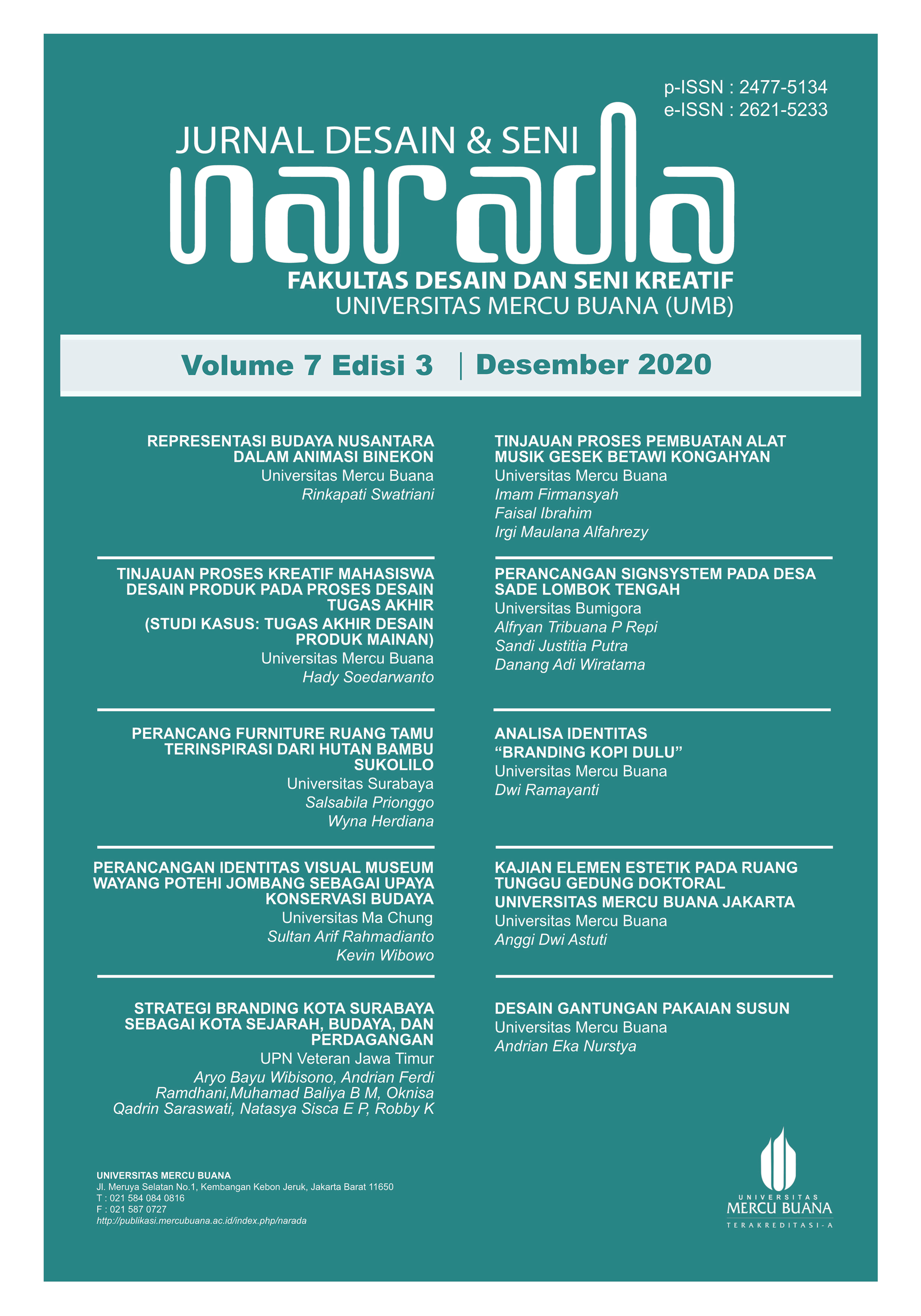
TINJAUAN PROSES KREATIF MAHASISWA DESAIN PRODUK PADA PROSES DESAIN TUGAS AKHIR (STUDI KASUS: TUGAS AKHIR DESAIN PROUK MAINAN)
DOI:
https://doi.org/10.22441/narada.2020.v7.i3.002Keywords:
design methods, products, toys, creativeAbstract
To complete a design requires a series of processes that must be presented in the designer's mind. There are many design methods that are learned in learning to design to produce extraordinary designs and can solve problems as a philosophical basis for design activities. In the toy product design process has a fundamental goal, which is to achieve fun (fun) to its users, through the fulfillment of aspects of function, fulfillment of aspects of the system and fulfillment of aesthetic aspects. The Final Assignment course was chosen to be sampled because this course was followed by the final year students who had experienced several design methods, so that by reviewing their process of completing the final assignment course it was hoped that a more significant creative process would be found in solving problems especially in the field of product design toy. Data obtained by taking the Final Project with the title of toy product design. Data collection is also carried out by in-depth interview methods in the process of assistance and design testing and then analyzed using the theory of design methods (design methods) and the theory of creative processes (creative thinking). The results of this study are expected to be a tendency of students (designers) to complete their design projects. know the aspects of concern and to find out their strategies in overcoming design problems.
Downloads
References
Broadbent, G. (1973). Design in Architecture: Architecture and Human Science. New York: John Wiley and Sons.
Camburn, B., & Wood, K. (2018). Principles of maker and DIY fabrication: Enabling design prototypes at low cost. Design Studies, Volume 58, 63-88.
Cornwell, Alex (Ed), (2012). Breakthrough Overcome Creative Block. Princetown: Architectural Press.
Crilly, N., & Cardoso, C. (2017). Where next for research on fixation, inspiration and creativity in design?. Design Studies, Volume 50, 1-38.
Dong, A., Garbuio, M., & Lovallo, D. (2016). Generative sensing in design evaluation. Design Studies, Part A (July 2016), 68-91.
Fletcher, S. B. (1905). A History of Arcchitecture on The Comparative Method. London: High Holborn.
Frampton, K. (2007). Modern Architecture: A Critical History (4thEdition). London: Thames and Hudson.
Gama, R. V. (2018). “Mainan Dengan Sistem Rakit Bergerak Dengan Tema Transportasi Jadul Dengan Penggayaan Rupa Steampunk”, [Tugas Akhir]. Jakarta: FDSK, Desain Produk. Universitas Mercu Buana.
Jones, John Christopher. (1992) Design Methods (2nd Edition). New York: John Wiley & Sons, Inc.
Lewis, M. (2008). Evolutionary visual art and design. In The art of artificial evolution. Heidelberg: Springer.
Papanek, Viktor. (1983). Design for The Real World. Van Nostrand Reinhold Co.
Shroyer, K., Lovins, T., Turns, J., Cardella, M. E., & Atman, C. J. (2018). Timescales and ideaspace: An examination of idea generation in design practice. Design Studies. Volume 57 (July 2018), 9-36.
Soedarwanto, H. (2018). Teori Vitruvius Vs Teori Sir Henry Wotton (Utilitas-Firmitas-Venustas dan Commodity-Firmness-Delight) Dalam Desain Produk. Jurnal Narada, Volume 5 (2), 155-164.
Stake, R.E. (2017). Studi Kasus, dalam Sumartono, Metode Penelitian Kualitatif Seni Rupa dan Desain. Jakarta: Universitas Trisakti.
Yulia, R.S. (2020). “Boneka dengan Estetika Khas Penari Gambyong”. [Tugas Akhir]. Jakarta: FDSK, Desain Produk. Universitas Mercu Buana.
Downloads
Published
How to Cite
Issue
Section
License
A writer who will publish their article in the NARADA Journal of Design and Art agrees to the following conditions:
- The author owns the copyright and grants the rights to NARADA Journal of Design and Art as the party entrusted with publishing the article for the first time simultaneously licensed under the "Creative Commons Attribution-ShareAlike 4.0" License. This makes it possible for other people to share the work with a form of acknowledgment of authorship of the work and initial publication in this journal according to the authorship of the article provided.
- Authors may enter into separate additional contractual agreements for non-exclusive distribution of the published journal version of the work (e.g., posting it to an institutional repository or publishing it in a book) with acknowledgment of initial publication in the NARADA Journal of Design and Art.
- Authors are permitted and asked to post their work online (for example, institutional repositories or on personal websites) after the article publication process. This avoids double publication or multiple submissions which will affect the similarity of writing of the published work.
- In order to maintain the value of originality and similarity of articles sent or submitted. Authors are asked to temporarily remove or hide the original article from other online systems until they receive the results and decisions from the NARADA Journal of Design and Art regarding the decision to publish the article.
- The author, in this case the contributing author (Contributor Author), will be sent a form or letter stating the validity of the scientific work, signed on an IDR 10,000 stamp. Then the author will be asked to send the email to [email protected].
Pemberitahuan Hak Cipta
Seorang penulis yang akan menerbitkan artikelnya dalam NARADA Jurnal Desain dan Seni setuju dengan ketentuan berikut:
- Penulis memiliki hak cipta dan memberikan hak kepada pihak NARADA Jurnal Desain dan Seni sebagai pihak yang diberikan kepercayaan untuk mempublikasi artikelnya pertama kali secara bersamaan dilisensikan di bawah Lisensi "Creative Commons Attribution-ShareAlike 4.0". Hal ini memungkinkan kepada orang lain untuk membagi karya dengan bentuk pengakuan kepengarangan karya dan publikasi awal dalam jurnal ini sesuai dengan penulisan artikel yang diberikan.
- Penulis dapat membuat perjanjian kontrak tambahan yang terpisah untuk distribusi non-eksklusif versi jurnal yang diterbitkan dari karya tersebut (misalnya, mempostingnya ke repositori institusional atau menerbitkannya dalam sebuah buku) dengan pengakuan publikasi awal dalam NARADA Jurnal Desain dan Seni.
- Penulis diizinkan dan diminta untuk mempostingkan karyanya secara online (semisal, repositori institusional atau di situs web pribadi) setelah proses penerbitan artikel, Hal ini menghindari adanya double publikasi atau pengajuan jamak yang akan berpengaruh kepada adanya kesamaan penulisan dari karya yang diterbitkan.
- Demi menjaga nilai orisinalitas dan nilai kesamaan dari artikel yang dikirim atau diajukan. Penulis diminta untuk menghilangkan atau menyembunyikan secara sementara artikel orisinil dari sistem online lain yang sampai mendapatkan hasil nilai dan ketetapan dari pihak NARADA Jurnal Desain dan Seni mengenai keputusan publikasi dari artikel.
- Penulis dalam hal ini penulis kontributor (Contributor Author) akan dikirimkan form atau surat pernyataan keabsahan karya ilmiah, yang ditanda tangani di atas materai 10000. Dan selanjutnya penulis diminta untuk mengirimkan ke email [email protected].









