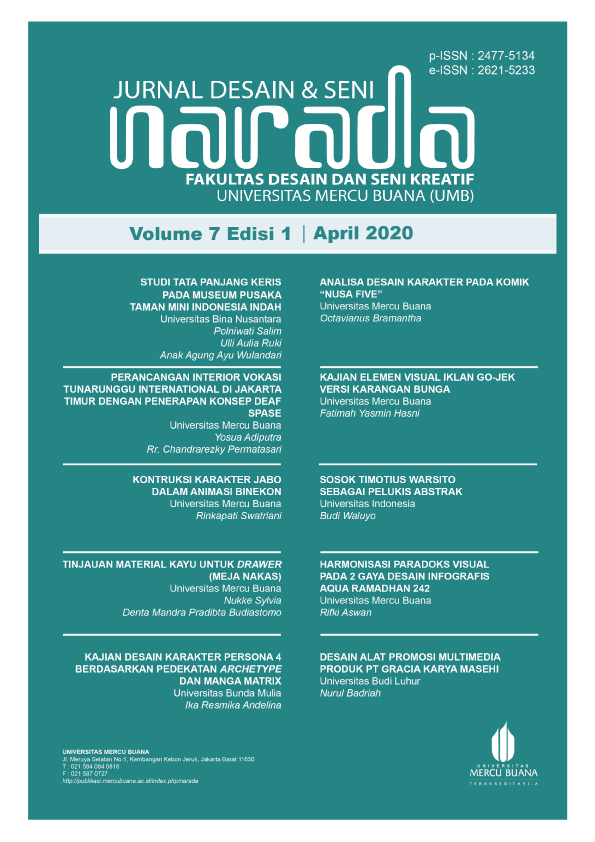
STUDI TATA PAJANG KERIS PADA MUSEUM PUSAKA, TAMAN MINI INDONESIA INDAH
DOI:
https://doi.org/10.22441/narada.2020.v7.i1.001Keywords:
Museum, Heirlooms, Display System, KerisAbstract
The purpose of this research is to find a good and interesting collection system of the heirlooms at museum as to provide the visitors with an appeal and clarity information about collections in Museum as a public spaces. The background of this research is looking at the condition of Heritage Museum which looks like been abandoned and not neatly arranged, we concern about the suistainablity of collections’s display that are not maintained well. They need to be upgraded for a display system to be more interesting and easily seen. Especially the ancient museums of heirlooms which is keris that are not quite interesting for youngster nowaday due to the proliferation of contemporary museums. Therefor it is our duty to make the museum look more interesting to be visited and show much more information to the visitors. However, there are many aspects that need to be considered in designing good museum display, while many supporting factors such as the grouping of collections, the signage systems, as well as lighting are needed too. This study will examine how the object of research solves the issue above and researchers will provide appropriate and better display system as the solution, hoping that it will increase the interest and attention of visitors to know the museum colletion better. The method used in the research are documentation of the research object, combined with the study of literature. Hopefully this research will give contribution to the design of the museum's display system with ergonomical and clearly information about the collection, also gives happiness to the wider community. For the further development of museums, this research is aimed to contributes a good and friendly display technique and system in the future.
Downloads
References
Ahmad, S., Abbas, M. Y., Taib, M. Z. M., & Masri, M. (2014). Museum Exhibition Design: Communication of Meaning and the Shaping of Knowledge.
Procedia - Social and Behavioral Sciences, 153, 254–265. DOI https://doi.org/10.1016/j.sbspro.2014.10.059
Çıldır, Z., & Karadeniz, C. (2014). Museum, Education and Visual Culture Practices: Museums in Turkey.
American Journal of Educational Research, 2(7), 543–551. DOI: https://doi.org/10.12691/education-2-7-18
McLean, K. (1993). Planning for People in Museum Exhibitions.
Washington: Association of Science-Technology Centers.
Nickols, F & Ledgerwood R. (2005). The Goals Grid: A New Tool for Strategic Planning available visited on web https://www.nickols.us/strategic_planning_tool.pdf
Salim, P. (2018). Persepsi Kualitas Ruang Pamer Museum Seni: Sebuah Studi Observasi. NARADA Jurnal Desain dan Seni. 5(1)
Lelo,L & Laksono, M, A. (2018). Perancangan Desain Interior Museum Seni Rupa Dan Keramik Jakarta. NARADA Jurnal Desain dan Seni. 5(1)
Sutalaksana, I. Z. (1979). Teknik Tata Cara Kerja. Bandung: Penerbit ITB.
Urry, J. (2002). The Tourist Gaze: Leisure and Travel in Contemporary Societies (2nd ed.). London: Sage Publications.
Wulandari, A. A. A. (2013). Taman Mini Indonesia Indah: Education or Entertainment?. Humaniora, 4 (1), 156. DOI: https://doi.org/10.21512/humaniora.v4i1.3425
Wulandari, A. A. A., & Ruki, U. A. (2018). Education and Exhibition Display Design in Taman Mini Indonesia Indah. Humaniora, 9 (2), 199. DOI: https://doi.org/10.21512/humaniora.v9i2.4597
Downloads
Published
How to Cite
Issue
Section
License
A writer who will publish their article in the NARADA Journal of Design and Art agrees to the following conditions:
- The author owns the copyright and grants the rights to NARADA Journal of Design and Art as the party entrusted with publishing the article for the first time simultaneously licensed under the "Creative Commons Attribution-ShareAlike 4.0" License. This makes it possible for other people to share the work with a form of acknowledgment of authorship of the work and initial publication in this journal according to the authorship of the article provided.
- Authors may enter into separate additional contractual agreements for non-exclusive distribution of the published journal version of the work (e.g., posting it to an institutional repository or publishing it in a book) with acknowledgment of initial publication in the NARADA Journal of Design and Art.
- Authors are permitted and asked to post their work online (for example, institutional repositories or on personal websites) after the article publication process. This avoids double publication or multiple submissions which will affect the similarity of writing of the published work.
- In order to maintain the value of originality and similarity of articles sent or submitted. Authors are asked to temporarily remove or hide the original article from other online systems until they receive the results and decisions from the NARADA Journal of Design and Art regarding the decision to publish the article.
- The author, in this case the contributing author (Contributor Author), will be sent a form or letter stating the validity of the scientific work, signed on an IDR 10,000 stamp. Then the author will be asked to send the email to [email protected].
Pemberitahuan Hak Cipta
Seorang penulis yang akan menerbitkan artikelnya dalam NARADA Jurnal Desain dan Seni setuju dengan ketentuan berikut:
- Penulis memiliki hak cipta dan memberikan hak kepada pihak NARADA Jurnal Desain dan Seni sebagai pihak yang diberikan kepercayaan untuk mempublikasi artikelnya pertama kali secara bersamaan dilisensikan di bawah Lisensi "Creative Commons Attribution-ShareAlike 4.0". Hal ini memungkinkan kepada orang lain untuk membagi karya dengan bentuk pengakuan kepengarangan karya dan publikasi awal dalam jurnal ini sesuai dengan penulisan artikel yang diberikan.
- Penulis dapat membuat perjanjian kontrak tambahan yang terpisah untuk distribusi non-eksklusif versi jurnal yang diterbitkan dari karya tersebut (misalnya, mempostingnya ke repositori institusional atau menerbitkannya dalam sebuah buku) dengan pengakuan publikasi awal dalam NARADA Jurnal Desain dan Seni.
- Penulis diizinkan dan diminta untuk mempostingkan karyanya secara online (semisal, repositori institusional atau di situs web pribadi) setelah proses penerbitan artikel, Hal ini menghindari adanya double publikasi atau pengajuan jamak yang akan berpengaruh kepada adanya kesamaan penulisan dari karya yang diterbitkan.
- Demi menjaga nilai orisinalitas dan nilai kesamaan dari artikel yang dikirim atau diajukan. Penulis diminta untuk menghilangkan atau menyembunyikan secara sementara artikel orisinil dari sistem online lain yang sampai mendapatkan hasil nilai dan ketetapan dari pihak NARADA Jurnal Desain dan Seni mengenai keputusan publikasi dari artikel.
- Penulis dalam hal ini penulis kontributor (Contributor Author) akan dikirimkan form atau surat pernyataan keabsahan karya ilmiah, yang ditanda tangani di atas materai 10000. Dan selanjutnya penulis diminta untuk mengirimkan ke email [email protected].









