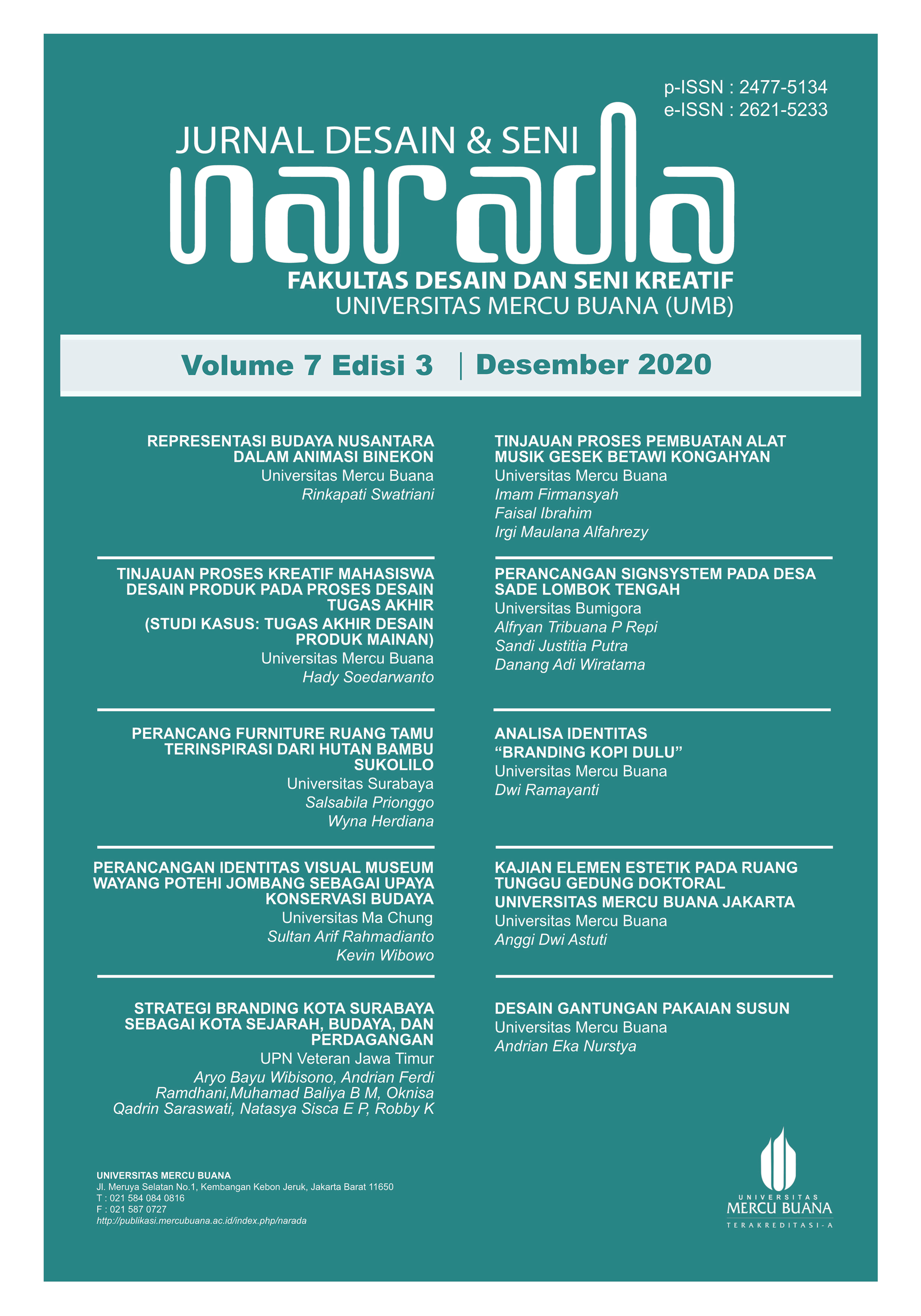
PERANCANGAN IDENTITAS VISUAL MUSEUM WAYANG POTEHI JOMBANG SEBAGAI UPAYA KONSERVASI BUDAYA
DOI:
https://doi.org/10.22441/narada.2020.v7.i3.004Keywords:
visual identity, potehi puppetAbstract
Technological developments such as television, internet, and smartphones that can be easily accessed are becoming more in demand by the younger generation than traditional performing arts. this is the cause of the decline of the existence of traditional art, especially wayang potehi. One of the museums that held a puppet art show potehi is Potehi Jombang Puppet Museum located in Raya Gudo area, Jombang, East Java. Potehi Puppet Museum is also affected by the many technological developments and other entertainment media. Therefore, it is necessary to visual identity of Potehi Jombang Puppet Museum as a step to introduce and preserve potehi puppet art because it is one of the cultures of acculturation in Indonesia. The design method used is a qualitative method. The result of this design is a visual identity in the form of Logo accompanied by the application in various media used as an effort to confectione Indonesian culture.
Downloads
References
Augustine, A. (2016). Perancangan Media Promosi Jasa Photobooth Snap In Frame Di Surabaya. Jurnal Desain Komunikasi Visual Adiwarna, 1(8), 1-9.
Dharmadi, A. L. (2016). Perancangan Visual Branding Media Promosi Kampung Djawi Kabupaten Jombang. Jurnal Desain Komunikasi Visual Adiwarna, 1 (8). 1-10.
Galih, B. (2020). Menelusuri Sejarah Awal Masuknya Masyarakat Tionghoa Di Indonesia. Kompas. Diakses pada tanggal 22 Juni 2020. Diambil dari: https://nasional.kompas.com/read/2020/01/18/12220121/menelusuri-sejarah-awal-masuknya-masyarakat-tionghoa-di-indonesia?page=all.
Harianti, M. (2015). Analisis Data Kualitatif Menurut Miles dan Hubbermen. Kompasiana. Diakses tanggal 25 Juni 2020. Diambil dari: https://www.kompasiana.com/meykurniawan/556c450057937332048b456c/analisis-data-kualitatif-miles-dan-hubermen
Ikranegara, D. T. (2013). Perancangan Identitas Visual Museum 10 Nopember 1945 Surabaya. Jurnal Sains dan Seni POMITS 2 (1). 5-10.
DOI:https://dx.doi.org/10.12962/j23373520
Kurniawan, H. (2017). Potehi In New Order’s Restraint : The Lost Of Inheritor Generation of Chinese Wayang Culture. International Journal of Humanity Studies 1(1). 47-55.
DOI:https://doi.org/10.24071/ijhs.2017.010105
Moleong, J. L. (2006). Metodologi Penelitian Kualitatif. Bandung: PT. Remaja Rosdakarya.
Nugraha, E. F. S. (2013). Perancangan Branding Kampoeng Batik Jetis Sidoarjo Sebagai Upaya Melestarikan Produk Budaya Lokal. Jurnal Art Nouveau 1 (1). 31- 38.
Pratiwi, N. R. (2018). Adaptasi PT.Freeport Indonesia Terhadap Budaya Lokal Papua Yang Tersaji Dalam Konsep Visual Branding Perusahaan. Journal ISI 1(1). 24-3.
DOI:https://doi.org/10.24821/dkv.v11i1.2486
Sanyoto, S. E. (2006). Metode Perancangan Komunikasi Visual Periklanan. Yogyakarta: Dimensi Press.
Tanuatmadja, Y., Swandi, I W., & Raditya, A. (2014). Perancangan Branding “Marilyn Cake” Surabaya, Jurnal Adiwarna 1(4). 5-6.
Wardana, B. R. (2017). Akulturasi Budaya Masyarakat Tionghoa Dengan Masyarakat Pribumi Di Desa KarangTuri, Kecamatan Lasem, Kabupaten Rembang. Jurnal Unnes 1(1). 14-28.
Wheeler, Alina. (2012). Designing Brand Identity An Essential Guide for the Whole Branding Team. US: John &Willey Sons.
Downloads
Published
How to Cite
Issue
Section
License
A writer who will publish their article in the NARADA Journal of Design and Art agrees to the following conditions:
- The author owns the copyright and grants the rights to NARADA Journal of Design and Art as the party entrusted with publishing the article for the first time simultaneously licensed under the "Creative Commons Attribution-ShareAlike 4.0" License. This makes it possible for other people to share the work with a form of acknowledgment of authorship of the work and initial publication in this journal according to the authorship of the article provided.
- Authors may enter into separate additional contractual agreements for non-exclusive distribution of the published journal version of the work (e.g., posting it to an institutional repository or publishing it in a book) with acknowledgment of initial publication in the NARADA Journal of Design and Art.
- Authors are permitted and asked to post their work online (for example, institutional repositories or on personal websites) after the article publication process. This avoids double publication or multiple submissions which will affect the similarity of writing of the published work.
- In order to maintain the value of originality and similarity of articles sent or submitted. Authors are asked to temporarily remove or hide the original article from other online systems until they receive the results and decisions from the NARADA Journal of Design and Art regarding the decision to publish the article.
- The author, in this case the contributing author (Contributor Author), will be sent a form or letter stating the validity of the scientific work, signed on an IDR 10,000 stamp. Then the author will be asked to send the email to [email protected].
Pemberitahuan Hak Cipta
Seorang penulis yang akan menerbitkan artikelnya dalam NARADA Jurnal Desain dan Seni setuju dengan ketentuan berikut:
- Penulis memiliki hak cipta dan memberikan hak kepada pihak NARADA Jurnal Desain dan Seni sebagai pihak yang diberikan kepercayaan untuk mempublikasi artikelnya pertama kali secara bersamaan dilisensikan di bawah Lisensi "Creative Commons Attribution-ShareAlike 4.0". Hal ini memungkinkan kepada orang lain untuk membagi karya dengan bentuk pengakuan kepengarangan karya dan publikasi awal dalam jurnal ini sesuai dengan penulisan artikel yang diberikan.
- Penulis dapat membuat perjanjian kontrak tambahan yang terpisah untuk distribusi non-eksklusif versi jurnal yang diterbitkan dari karya tersebut (misalnya, mempostingnya ke repositori institusional atau menerbitkannya dalam sebuah buku) dengan pengakuan publikasi awal dalam NARADA Jurnal Desain dan Seni.
- Penulis diizinkan dan diminta untuk mempostingkan karyanya secara online (semisal, repositori institusional atau di situs web pribadi) setelah proses penerbitan artikel, Hal ini menghindari adanya double publikasi atau pengajuan jamak yang akan berpengaruh kepada adanya kesamaan penulisan dari karya yang diterbitkan.
- Demi menjaga nilai orisinalitas dan nilai kesamaan dari artikel yang dikirim atau diajukan. Penulis diminta untuk menghilangkan atau menyembunyikan secara sementara artikel orisinil dari sistem online lain yang sampai mendapatkan hasil nilai dan ketetapan dari pihak NARADA Jurnal Desain dan Seni mengenai keputusan publikasi dari artikel.
- Penulis dalam hal ini penulis kontributor (Contributor Author) akan dikirimkan form atau surat pernyataan keabsahan karya ilmiah, yang ditanda tangani di atas materai 10000. Dan selanjutnya penulis diminta untuk mengirimkan ke email [email protected].









