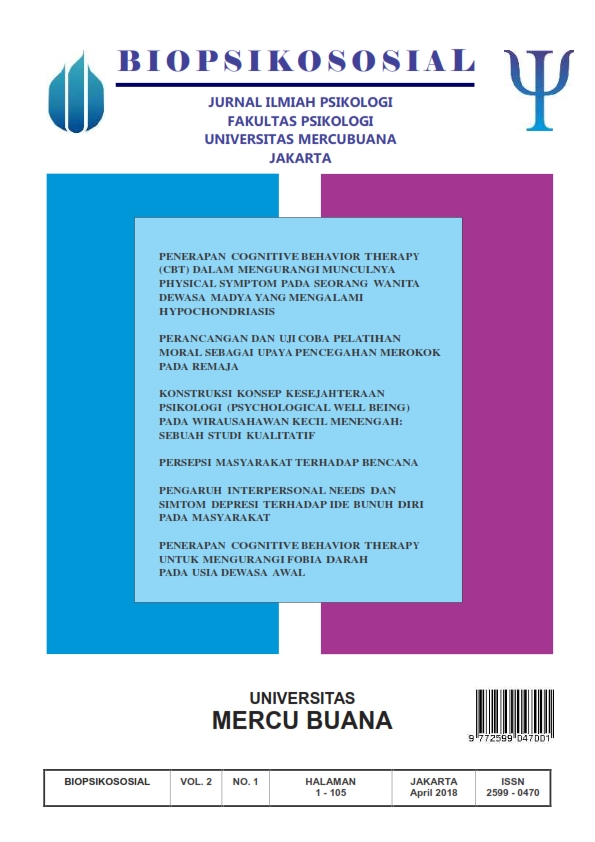
Konstruksi Konsep Kesejahteraan Psikologi (Psychological Well Being) Pada Wirausahawan Kecil Menengah: Sebuah Studi Kualitatif
DOI:
https://doi.org/10.22441/biopsikososial.v2i1.7222Keywords:
Psychological Well-Being, Wirausahawan, kesejahteraanAbstract
Penelitian ini bertujuan untuk mendalami area kesejahteraan psikologi pada wirausahawan khususnya yang berada tingkatan kecil dan menengah (UKM). Hal ini disebabkan kebutuhan bagi para wirausahawan untuk mencapai kesejahteran di dalam menjalankan usahanya. Di dalam upaya mencapai kesejahteraan maka kesejahteraan psikologis mengambil peran penting bagi wirausahawan kecil menengah. Konsep kesejahteraan psikologi pada wirausahawan kecil menengah tentu saja mempunyai keunikan dan belum banyak terungkap. Oleh sebab itu penelitian ini ingin mengungkapkan keunikan dan mengkonstruksi kesejahteraan psikologis pada wirausahawan kecil menengah. Penelitian ini menggunakan metode kualitatif dengan metode wawancara mendalam dan observasi. Subjek yang diteliti adalah wirausahawan yang sudah menjalani usaha minimal lima tahun. Dari hasil penelitian terungkap bahwa aspek kebermanfaatan terhadap orang lain menjadi konsep utama kesejahteraan psikologis dan faktor dukungan sosial sebagai anteseden utama. Dukungan sosial memberikan peran signifikan khususnya pada dimensi hubungan positif, pertumbuhan pribadi, dan tujuan hidupDownloads
References
Bradburn, N. (1969). The Sructure of psychological well-being. Chicago: ALDINE Publishing Company.
Biopsikososial ISSN
- 0470
Brown, Steven D. & Robert W. Lent. (2015). Vocational psychology: agency, equity, and well being. The Annual Review of Psychology. 2016. 67: 27, 1-27, 25. DOI 10.1146/annurev-psych-122414-033237
Carera-Fernandez, M.J. (2014). Qualitative methods of data analysis in psychology: an analysis of the literature. Qualitative Research, Vol 14 (1) 20 – 36. DOI: 10.1177/1468794112465633
Demerouti, E., A. B. Bakker, & J.M.P. Gavers. (2015). Job Crafting and extra role behaviour: The role of wok engagement and flourishing. Journal of vocational behaviour. DOI: 10.1016/j.jvb.2015.09.001
Dolan, P., Tessa Peasgood, & Mathew White. (2008). Do we really know what make us happy? A review of the economic literature on the factors associated with subjective well being. Journal of Economic Psychology (29), 94-122. DOI: 10.1016/j.joep.2007.09.001
Frese, M. & Michael M. Gielnik. (2014). The psychology of entrepreneurship. The Annual Review of Organizational Psychology and Organizational Behavior. 38 (1) : 413 – 438. DOI: 10.1146/annurev-orgpsych-031413-091326
Hahn, V. C., Frese, M., Binnewies, C., & Schmitt, A. (2011). Happy and proactive? the role of hedonic and eudaimonic well-being in business owners' personal initiative. 1042-2587.
Heizomi, H., Allahverdipour, H., Jafarabadi, M. A., & Safaian, A. (2015). Happiness and its relation to psychological well-being of adolescents. Asian Journal of Psychiatry, 1-6.
Kasali, R. (2010). Wirausaha Muda Mandiri. Jakarta: Gramedia Pustaka Utama.
Kuswarno, E. (2005). Tradisi Fenomenologi pada Penelitian Komunikasi Kualitatif: Sebuah Pengalaman Akademis. MediaTor, 47-58.
Lakoy, F. S. (2009). Psychological well-Being pada Perempuan Pekerja dengan Status Menikah dan Belum Menikah. Jakarta: Universitas Esa Unggul.
Lu, L., & Gilmour, R. (2006). Individual-oriented and socially-oriented cultural conceptions of subjective well-being: conceptual analysis and scale development. Asian Journal of Social Psychology, 9, 36-49. doi: 10.1111/j.1367-2223.2006.00183.x
Makhlouf, H. H. (2011). Social Entrepreneurship: Generating solutions to global challanges. International Journal of Management and Information System, 1.
Pavot, W. & Dinner. (2008) The Satisfaction with Life Scale and the emerging construct of life satisfaction. The Journal of Positive Psychology, 3(2), 137-152.
Poerwandari, E. K. (2013). Pendekatan Kualitatif Untuk Penelitian Perilaku Manusia. Depok: Lembaga Pengembangan Sarana Pengukuran dan Pendidikan Psikologi (LPSP3).
Ryff, C. D., & Singer, B. (1996). Psychological well-Being: Meaning, measurement, and implications for psychotherapy research. Psychotherapy and Psychosomatics, 14-23.
Biopsikososial ISSN
- 0470
Ryff, C.D., & Singer, B. H. (2008). Know thyself and become what you are: A Eudamonic approach to psychological well-being. Journal of Happiness Studies, 9-13-39. DOI: 10.1007/s10902-006-9019-0
Ryff, C. D. (1989). Happiness Is Everything, or Is It ? Explorations on the Meaning of Psychological Well-Being. Journal of Personality and Social Psychology, 1069-1081.
Ryff, C. D. (1995). Psychological well-being in adult life. Association For Psychological Science, 99-104.
Ryff, C. D., & M.Keyes, C. L. (1995). The Structure of psychological well-Being revisited. Journal of Personality and Social Psychology, 719-727.
Suharyadi, Nugroho, A., S, P., & Faturohman, M. (2012). Membangun Usaha Sukses Sejak Usia Muda. Jakarta: Salemba Empat.
`Wikanestri, W., & Prabowo, A. (2015). Psychological Well-Being pada Pelaku Wirausaha. Malang: Universitas Muhammadiyah Malang.
Downloads
Published
How to Cite
Issue
Section
License
1. The journal and respective authors hold exclusive copyrights of all materials published in Jurnal Biopsikososial: Jurnal Ilmiah Psikologi Fakultas Psikologi Universitas Mercubuana (JBUMB).
2. Any reproduction of any parts from the journal, without proper acknowledgment or prior permission, will result in an infringement of intellectual property laws.
3. JBUM is licensed under a Creative Commons Attribution-ShareAlike (CC BY-SA), which means that this journal has the rights to copy and redistribute its materials in any medium or format and adapt the materials for any purpose as long as it keeps the Author's name as the owner of Copyright.
4. Printed and electronically published manuscripts are open access for educational, research, and library purposes. The editorial board shall not be liable for violations of copyright law for other purposes.









