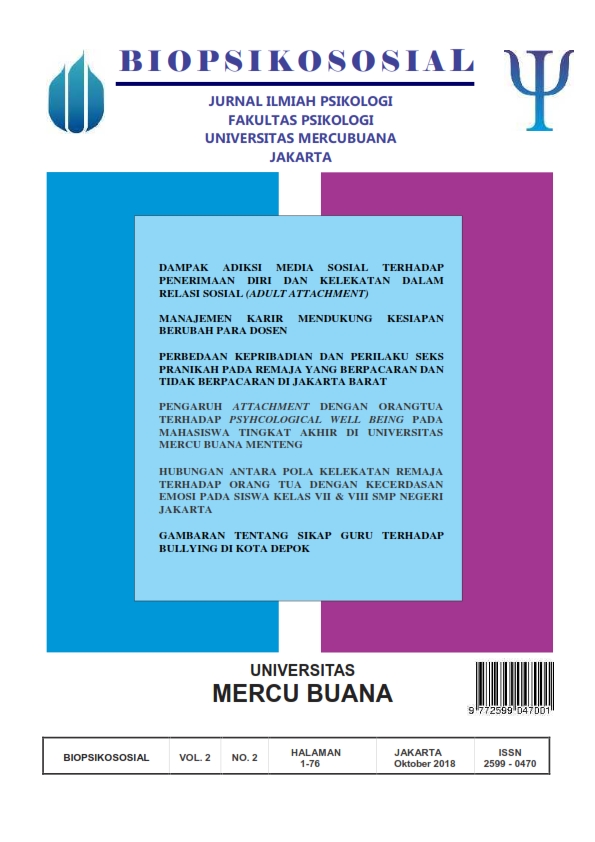
Dampak Adiksi Media Sosial terhadap Penerimaan Diri dan Kelekatan dalam Relasi Sosial (Adult Attachment)
DOI:
https://doi.org/10.22441/biopsikososial.v2i2.7365Kata Kunci:
Social Media Addiction, Self-Acceptance, Adult Attachment StyleAbstrak
The use of social media is becoming an increasingly widespread trend among millennials. Normal use can provide many benefits for users, but in excessive use up to the stage of addiction can have a negative impact on many aspects of the user's life. This study aims to explore the impact of social media addiction on self-acceptance and attachment style in adult sosial relationship which was conducted in two studies of 488 subjects. Primary data was collected through three research questionnaires. Based on the results of data analysis conducted in the first study, it is known that social media addiction is negatively correlated with self-acceptance (r = 0.326, p = 0,000) and contributes a negative impact of 10.6% to self-acceptance (r2 = 0.106). The results of data analysis in the second study show that social media addiction has an impact on subject’s attachment style to his attachment figure (r = 0.247, p = 0.000). Further analysis with analysis of varians, showed that the fearful attachment style had a significantly higher tendency to social media addiction than the secure, preoccupied and dismissing attachment style (p = 0,000-0,017).Unduhan
Referensi
(2019, Desembert 11). Indonesia Digital 2019 : Media Sosial. Retrieved from websindo.com: https://websindo.com/indonesia-digital-2019-media-sosial/
Berger, E. M. (1963). The Relation Between Expressed Acceptance of Self and Expressed Acceptance of others. Journal of Abnormal and Social Psychology , 778-782.
Bowlby, J. (1983). Attachment and Loss. New York: Basic Books.
Chak, K., & Leung, L. (2004). Shyness and Locus of Control as Predictors of Internet Addiction and Internet Use. CyberPsychology & BehaviorVol. 7, No. 5, https://doi.org/10.1089/cpb.2004.7.559.
Durm, M., & Glaze, P. (2001). Construct Validity for Self-Acceptance and Fear of Negative Evaluation. Sage Journal Vol 89, Issue 2, https://doi.org/10.2466/pr0.2001.89.2.386.
Griffiths, M. (2018). Adolescent Social Networking: How Do Social Media Operators Facilitate Habitual Use? Educational dan Behavior Journal. Vol. 36 No. 3, 66-69. ISSN 2049-3665.
Hazan, C., & Shaver, P. (1994). Attachment as an Organizational Framework for Research on Close Relationships. Journal Psychological Inquiry, https://doi.org/10.1207/s15327965pli0501_1.
Iqbal, M., & Nurdiani, G. (2016). Is Smartphone Addiction Related to Loneliness? Science Arena Publications, 1-6.
Kusuma, H., & Hidayati, D. (2014). Rasa Malu dan Presentasi Diri Remaja di Media Sosial. Jurnal Psikologi Teori & Terapan, 91-105.
Kwon, M., Lee, J., Wong, W., Park, J., Min , J., Hahn, C., Kim, D. (2013). Development and Validation of a Smartphone Addiction Scale (SAS). Plos One, 1-8. https://doi.org/10.1371/journal.pone.0056936.
Majorsy, U., Kinasih, D., Andriani, I., & Lisa, W. (2013). Hubungan Antara Keterampilan Sosial dan Kecanduan Situs Jejaring Sosial pada Masa Dewasa Awal. Proceeding PESAT (Psikologi, Ekonomi, Sastra, Arsitektur, (pp. 80-95).
Oldmeadow, J., Quin, S., & Kowert, R. (2013). Attachment Style, Social Skills and Facebook Use Amongst Adults. Computers in Human Behavior. Volume 29, Issue 23, https://doi.org/10.1016/j.chb.2012.10.006.
Peele, S., & Brodsky, A. (1991). Truth About Addiction and Recovery: Life Process for Outgrowing Destruction Habits. New York: Simon & Schuste.
Pertiwi, W. (2019, 02 04). Separuh Penduduk Indonesia Sudah "Melek" Media Sosial. Retrieved from tekno.compas.com: https://tekno.kompas.com/read/2019/02/04/19140037/separuh-penduduk-indonesia-sudah-melek-media-sosial
Wilson, K., Fornashier, S., & White, K. (2009). Psychological Predictors of Young Adults' Use of Social Networking Sites. Cyberpsychology, Behavior, and Social NetworkingVol. 13, No. 2, https://doi.org/10.1089/cyber.2009.0094.
Young, K. (2009). Internet Addiction: The Emergence of a New Clinical Disorder. CyberPsychology and Behavior, https://doi.org/10.1089/cpb.1998.1.237.
Young, K., & de Abreu, C. (2011). Internet Addiction : A Handbook and Guide to Evaluation and Treatment. New York: Willey & Sons.
Unduhan
Diterbitkan
Cara Mengutip
Terbitan
Bagian
Lisensi
1. The journal and respective authors hold exclusive copyrights of all materials published in Jurnal Biopsikososial: Jurnal Ilmiah Psikologi Fakultas Psikologi Universitas Mercubuana (JBUMB).
2. Any reproduction of any parts from the journal, without proper acknowledgment or prior permission, will result in an infringement of intellectual property laws.
3. JBUM is licensed under a Creative Commons Attribution-ShareAlike (CC BY-SA), which means that this journal has the rights to copy and redistribute its materials in any medium or format and adapt the materials for any purpose as long as it keeps the Author's name as the owner of Copyright.
4. Printed and electronically published manuscripts are open access for educational, research, and library purposes. The editorial board shall not be liable for violations of copyright law for other purposes.









