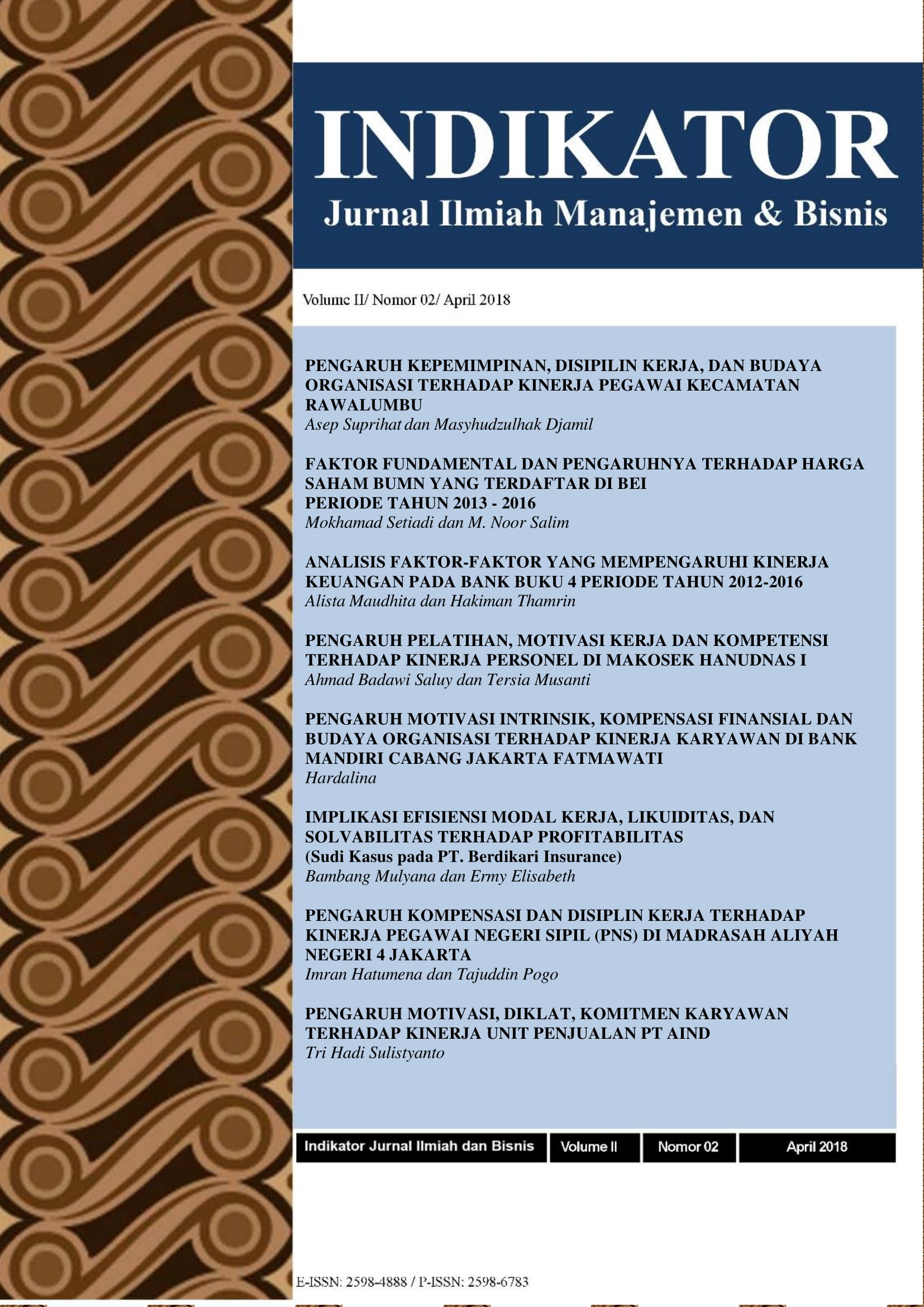
IMPLIKASI EFISIENSI MODAL KERJA, LIKUIDITAS, DAN SOLVABILITAS TERHADAP PROFITABILITAS
DOI:
https://doi.org/10.22441/indikator.v2i2.3274Kata Kunci:
the efficiency of working capital, liquidity, solvency, net profit margin, return on investment, return on equityAbstrak
This research aims to know and to analyze the influence of the efficiency of working capital, liquidity and solvency toward company’s profitability. The Object for this research is financial statements of a national general insurance company, PT. Berdikari Insurance, that located in Jakarta. This research was done toward quarterly’s financial statement that regularly submitted to Otoritas Jasa Keuangan from year 2010 until 2014 by using associative approach. Thus, data analysis which is used is statistic analysis in the form of multiple linear regression test. The result of this research shows that simultaneously the variable of the efficiency of working capital, liquidity and solvency influence to profitability for Net Profit Margin and Return On Equity. Meanwhile, all independend variables are not influence to profitability for Return On Investment. Partially, solvency influence to profitability for Net Profit Margin. The variable of the effiency of working capital and solvency influence to profitability for Return On Equity. It has been proven from the result of (F) simultant test and the result of (t) partial shows significant point of the three independend variables that support the hipothesys. Therefore, the accepted assumptions are, (1) there is influence between the efficiency of working capital, liquidity and solvency toward Net Profit Margin (2) there is no influence between the efficiency of working capital, liquidity and solvency toward Return On Investment (3) there is influence between the efficiency of working capital, liquidity and solvency toward Return On Equity.Referensi
Biro Riset Infobank (2014, Juli 10). Rating 123 Asuransi 2014. Majalah Infobank No.424, Juli 2014, Vol. XXXVI.
Falope, O.I., Ajilore, O.T. (2009).Working Capital Management and Corporate Profitabilitay : Evidence from Panel Data Analysis of Selected Quoted Company in Nigeria. Research Journal Business Management,3,73-84. Retrieved from http://scialert.net/abstract/?doi=rjbm.2009.73.84
Ghozali, H. Imam. 2011. Aplikasi Analisis Multivariate dengan program IBM SPSS 19. Badan Penerbit Universitas Diponegoro, Semarang.
Harahap, Sofyan Syafri. 2010. Analisis Kritis Atas Laporan Keuangan. Rajawali Pers, Jakarta.
Kasmir. 2014. Analisa Laporan Keuangan. PT Rajagrafindo Persada, Jakarta.
Keputusan Menteri Keuangan (2003). Kesehatan Keuangan Perusahaan Asuransi dan Perusahaan Reasuransi. (KMK Nomor 424/KMK.06/2003). Jakarta.
Keputusan Menteri Keuangan (2004). Kesehatan Keuangan Perusahaan Asuransi dan Perusahaan Reasuransi. (KMK Nomor 424/KMK.06/2003). Jakarta.
Kusdianti, F. M. (2013). Pengaruh Efisiensi Modal Kerja, Likuiditas dan Solvabilitas terhadap Profitabilitas pada perusahaan tekstil dan garmen di Bursa Efek Indonesia. Jurnal Manajemen Unversitas Tanjungpinang. Vol.1 No.1 Tahum 2012.
Nugroho, S. B. (2012).Analisis Pengaruh Efisiensi Modal Kerja, Likuiditas Dan Sovabilitas Terhadap Profitabilitas Studi Kasus pada PT Telekomunikasi Indonesia, Tbk. Jurnal Ilmu Administrasi Bisnis Universitas Negeri Semarang, Vol.1 No.1 Tahun 2012.
Peraturan Ketua BAPEPAM dan LK. (2008). Pedoman Perhitungan Batas Tingkat Solvabilitas Minimum Bagi Perusahaan Asuransi Dan Perusahaan Reasuransi. (PER-02/BL/2008). Jakarta.
Peraturan Ketua BAPEPAM dan LK. (2012). Pedoman Perhitungan Modal Minimum Berbasis Risiko Bagi Bagi Perusahaan Asuransi Dan Perusahaan Reasuransi. (PER-08/BL/2012). Jakarta.
Raheman, A., Nasr, M. (2007). Working Capital Management And Profitability – Case Of Pakistani Firms. International Review of Business Research Papers, 3(1), 279-300. Retrieved from www.bizresearchpapers.com
Riyanto, B. 2010. Dasar-dasar Manajemen Pembelanjaan Perusahaan. BPFE, Yogyakarta.
Riduwan & Sunarto. 2009. Pengantar Statistika Untuk Penelitian Pendidikan, Sosial, Ekonomi, Komunikasi, dan Bisnis. Alfabeta, Bandung.
Sartono, R. Agus. 2012. Manajemen Keuangan Teori dan Aplikasi 4 th Ed. BPFE, Yogyakarta.
Sawir, Agnes 2001. Analisa Kinerja Keuangan dan Perencanaan Keuangan Perusahaan. PT. Gramedia Pustaka Utama, Jakarta
Setyono, R. (2000). “Pengaruh Likuiditas, Leverage dan Manajemen Modal Kerja, terhadap Profitabilitas pada perusahaan tekstil yang go public di BEJ”. Retrieved from http://eprints.undip.ac.id/9877
Sugiyono. 2013. Statistika Untuk Penelitian. Alfabeta, Bandung.
Suharyadi & Purwanto S.K. 2012. Statistika Untuk Ekonomi dan Keuangan Modern Buku 1 Edisi 2. Salemba Empat, Jakarta.
Suharyadi & Purwanto S.K. 2013. Statistika Untuk ekonomi dan Keuangan Modern Buku 2 Edisi 2. Salemba Empat, Jakarta.
Sunyoto, Danang. 2009. Analisis Regresi Dan Uji Hipotesis Ed.1. Medpress, Yogyakarta
Wibowo, A. Wartini, S. (2012). Efisiensi Modal Kerja, Likuiditas dan Leverage Terhadap Profitabilitas pada Perusahaan Manufaktur di BEI. Jurnal Dinamika Manajemen. Vol.3 No.1 ,2012,pp :49-58. Universitas Negeri Semarang.
Vadri, Taqwa, & Utami ,(2014). Pengaruh Efisiensi Modal Kerja, Likuiditas dan Solvabilitas Terhadap Profitabilitas pada Perusahaan Otomotif yang terdaftar di BEI 2007-2011. Jurnal Dinamika Manajemen. Vol.3 No.1 ,2012,pp :49-58. Universitas Negeri Semarang.
Yulianto (2010). Essential of Financial Management (Eugene F. Bringham & Joel F. Houston). Cengange Learning asia Pte.Ltd (Original published 2007).
Unduhan
Diterbitkan
Cara Mengutip
Terbitan
Bagian
Lisensi
The copyright to this article is transferred to Universitas Mercu Buana (UMB) if and when the article is accepted for publication. The undersigned hereby transfers any and all rights in and to the paper including without limitation all copyrights to UMB. The undersigned hereby represents and warrants that the paper is original and that he/she is the author of the paper, except for material that is clearly identified as to its original source, with permission notices from the copyright owners where required. The undersigned represents that he/she has the power and authority to make and execute this assignment.
We declare that:
1. This paper has not been published in the same form elsewhere.
2. It will not be submitted anywhere else for publication prior to acceptance/rejection by this Journal.
3. A copyright permission is obtained for materials published elsewhere and which require this permission for reproduction.
Furthermore, I/We hereby transfer the unlimited rights of publication of the above mentioned paper in whole to UMB. The copyright transfer covers the exclusive right to reproduce and distribute the article, including reprints, translations, photographic reproductions, microform, electronic form (offline, online) or any other reproductions of similar nature.
The corresponding author signs for and accepts responsibility for releasing this material on behalf of any and all co-authors. This agreement is to be signed by at least one of the authors who have obtained the assent of the co-author(s) where applicable. After submission of this agreement signed by the corresponding author, changes of authorship or in the order of the authors listed will not be accepted.
Retained Rights/Terms and Conditions
1. Authors retain all proprietary rights in any process, procedure, or article of manufacture described in the Work.
2. Authors may reproduce or authorize others to reproduce the Work or derivative works for the authors personal use or for company use, provided that the source and the UMB copyright notice are indicated, the copies are not used in any way that implies UMB endorsement of a product or service of any employer, and the copies themselves are not offered for sale.
3. Although authors are permitted to re-use all or portions of the Work in other works, this does not include granting third-party requests for reprinting, republishing, or other types of re-use.
This work is also licensed under a Creative Commons Attribution-NonCommercial 4.0 International License.









