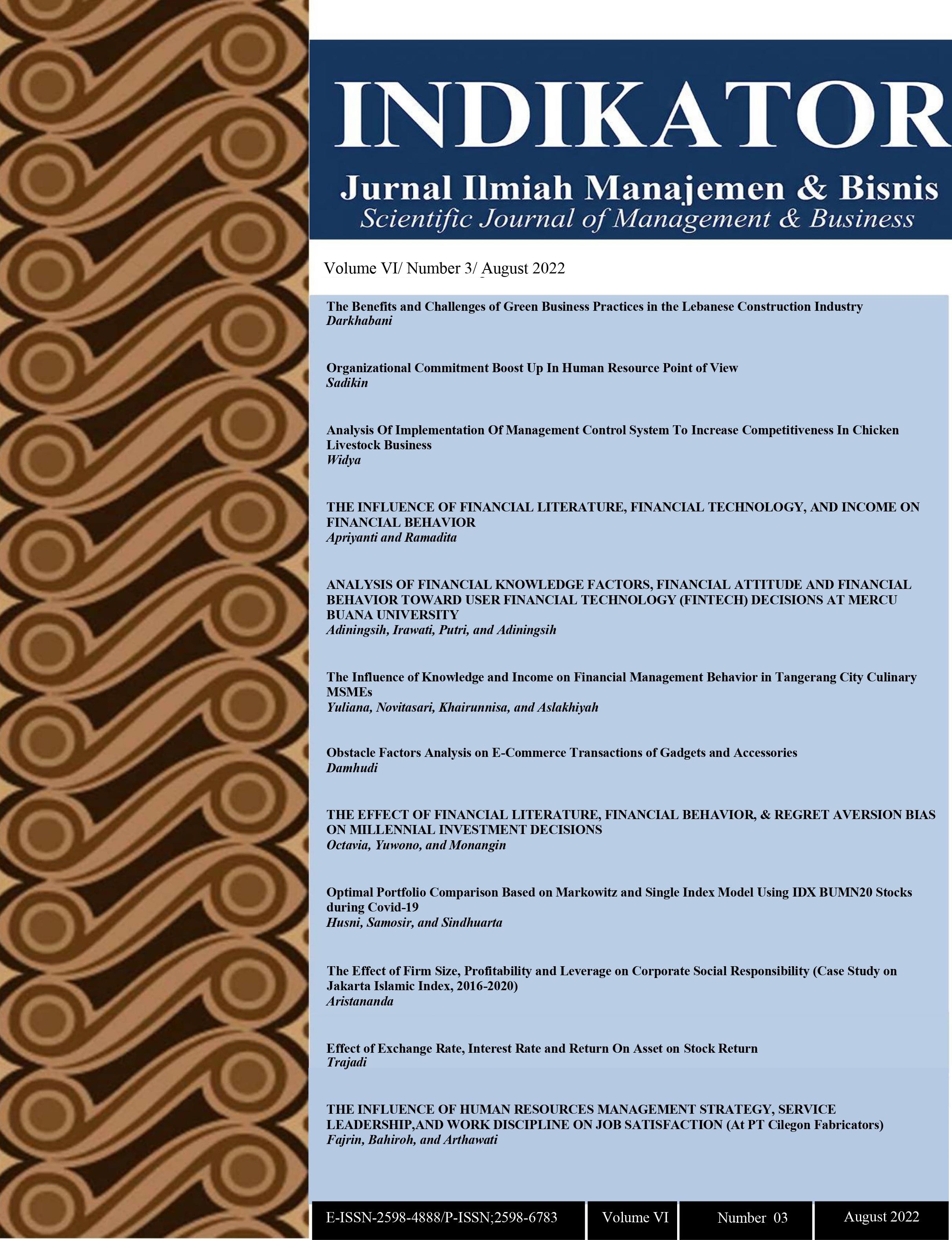
Optimal Portfolio Comparison Based on Markowitz and Single Index Model Using IDX BUMN20 Stocks during Covid-19
DOI:
https://doi.org/10.22441/indikator.v6i3.15305Kata Kunci:
Optimal Portfolio, Markowitz Model, Single Index Model, IDX BUMN20, Covid-19Abstrak
The study aims to compare between an optimal portfolio of stocks formed with the Markowitz model and those formed with the Single Index model during the Covid-19 pandemic. This study's goal is to determine which model will give a higher expected return or lower portfolio risk. Samples used are the stocks member of index IDX BUMN20 which never leave the index, never had changes in shares amount in major and minor reviews, also didn’t do stock split along the period of January 2020 – January 2022. The study method used is a quantitative method with a cross-sectional approach. The results show that both higher expected returns and lower portfolio risk are given by the Single Index model. This demonstrates that the optimal portfolio formed with the Single Index model is better than those formed with the Markowitz model.Referensi
Bodie, Z., Kane, A., & Marcus, A. J. (2018). Investments. McGraw-Hill Education.
Dirgantara, H. (2022). Hore! Jumlah Investor di Pasar Modal Indonesia Sentuh 8,1 Juta per
Februari 2022. (N. Laoli, Ed.)Kontan. Accessed March 25, 2022, from
Djajadi, I. (2021). Idx Stock Index Handbook. IDX (Indonesia Stock Exchange). Bursa Efek
Indonesia. Accessed March 25, 2022, from https://www.idx.co.id/media/9816/idx-stock-index-handbook-v12-_-januari-2021.pdf.
Elton, E. J., Gruber, M. J., Brown, S. J., & Goetzmann, W. N. (2014). Modern Portfolio Theory
and Investment Analysis (9th ed.). Wiley Custom.
Imung, F. S. (2020). Bertambah 28% Selama Pandemi, Investor Saham Tembus 1.5 Juta Sid.
Investor.id. Accessed March 25, 2022, from https://investor.id/literation/bertambah-28-selama-pandemiinvestor-saham-tembus-15-juta-sid.
Jogiyanto, H. (2010). Teori Portofolio dan Analisis Investasi (7th ed.). BPFE.
Kurniawan, T. A., Mulyana, B., & Risman, A. (2021). Comparison of Financial Performance
of Government Banks and National Private Banks in Book Category 4. The EUrASEANs: Journal on Global Socio-Economic Dynamics, (3(28), 24–36. https://doi.org/10.35678/2539-5645.3(28).2021.24-36
Maryani, E., Haryetti, H., & Wijaya, E. Y. (2015). Analisis Pembentukan Portofolio Saham
Optimal Menggunakan Model Indeks Tunggal dan Model Markowitz (Studi Kasus Pada
Saham BUMN Yang Terdaftar di Bursa Efek Indonesia) (Doctoral dissertation, Riau
University).
Nurdianingsih, R., & Suryadi, E. (2021). Analisis Perbandingan Portofolio Optimal dengan
Menggunakan Model Single Indeks dan Model Markowitz dalam Penetapan Investasi
Saham (Studi pada Perusahaan Manufaktur Sektor Industri Barang Konsumsi yang
Terdaftar di Bursa Efek Indonesia Tahun 2019). Jurnal Produktivitas, 8(1).
https://doi.org/10.29406/jpr.v8i1.2875
Reilly, F. K., & Brown, K. C. (2012). Investment Analysis & Portfolio Management (10th ed.).
Cengage Learning Australia.
Septyanto, D., & Kertopati, B. (2014). Analisis pembentukan portofolio dengan menggunakan
Model Markowitz dan Single Index Model pada saham yang masuk dalam Indeks Lq45 di Bursa Efek Indonesia tahun 2009-2013. Jurnal Keuangan dan Perbankan, 16(2).
Sidik, S. (2021). Naik 56%, Jumlah Investor Pasar Modal Ri Mencapai 3.88 Juta. CNBC
Indonesia. Accessed March 25, 2022, from
https://www.cnbcindonesia.com/market/20210629153854-17- 256818/naik-56-
jumlah-investor-pasar-modal-ri-mencapai-388-juta.
Susanti, E., Ervina, N., Grace, E., & Siregar, L. (2021). Comparison Analysis Of Optimal
Portfolio Formation Results Using Single Index Model With Markowitz Model During
The Covid 19 Pandemic In LQ 45 Index Company. International Journal of Educational Research & Social Sciences, 2(5), 1146-1156.
Tandelilin, E. (2010). Portofolio dan Investasi. Kanisius.
Unduhan
Diterbitkan
Cara Mengutip
Terbitan
Bagian
Lisensi
The copyright to this article is transferred to Universitas Mercu Buana (UMB) if and when the article is accepted for publication. The undersigned hereby transfers any and all rights in and to the paper including without limitation all copyrights to UMB. The undersigned hereby represents and warrants that the paper is original and that he/she is the author of the paper, except for material that is clearly identified as to its original source, with permission notices from the copyright owners where required. The undersigned represents that he/she has the power and authority to make and execute this assignment.
We declare that:
1. This paper has not been published in the same form elsewhere.
2. It will not be submitted anywhere else for publication prior to acceptance/rejection by this Journal.
3. A copyright permission is obtained for materials published elsewhere and which require this permission for reproduction.
Furthermore, I/We hereby transfer the unlimited rights of publication of the above mentioned paper in whole to UMB. The copyright transfer covers the exclusive right to reproduce and distribute the article, including reprints, translations, photographic reproductions, microform, electronic form (offline, online) or any other reproductions of similar nature.
The corresponding author signs for and accepts responsibility for releasing this material on behalf of any and all co-authors. This agreement is to be signed by at least one of the authors who have obtained the assent of the co-author(s) where applicable. After submission of this agreement signed by the corresponding author, changes of authorship or in the order of the authors listed will not be accepted.
Retained Rights/Terms and Conditions
1. Authors retain all proprietary rights in any process, procedure, or article of manufacture described in the Work.
2. Authors may reproduce or authorize others to reproduce the Work or derivative works for the authors personal use or for company use, provided that the source and the UMB copyright notice are indicated, the copies are not used in any way that implies UMB endorsement of a product or service of any employer, and the copies themselves are not offered for sale.
3. Although authors are permitted to re-use all or portions of the Work in other works, this does not include granting third-party requests for reprinting, republishing, or other types of re-use.
This work is also licensed under a Creative Commons Attribution-NonCommercial 4.0 International License.









