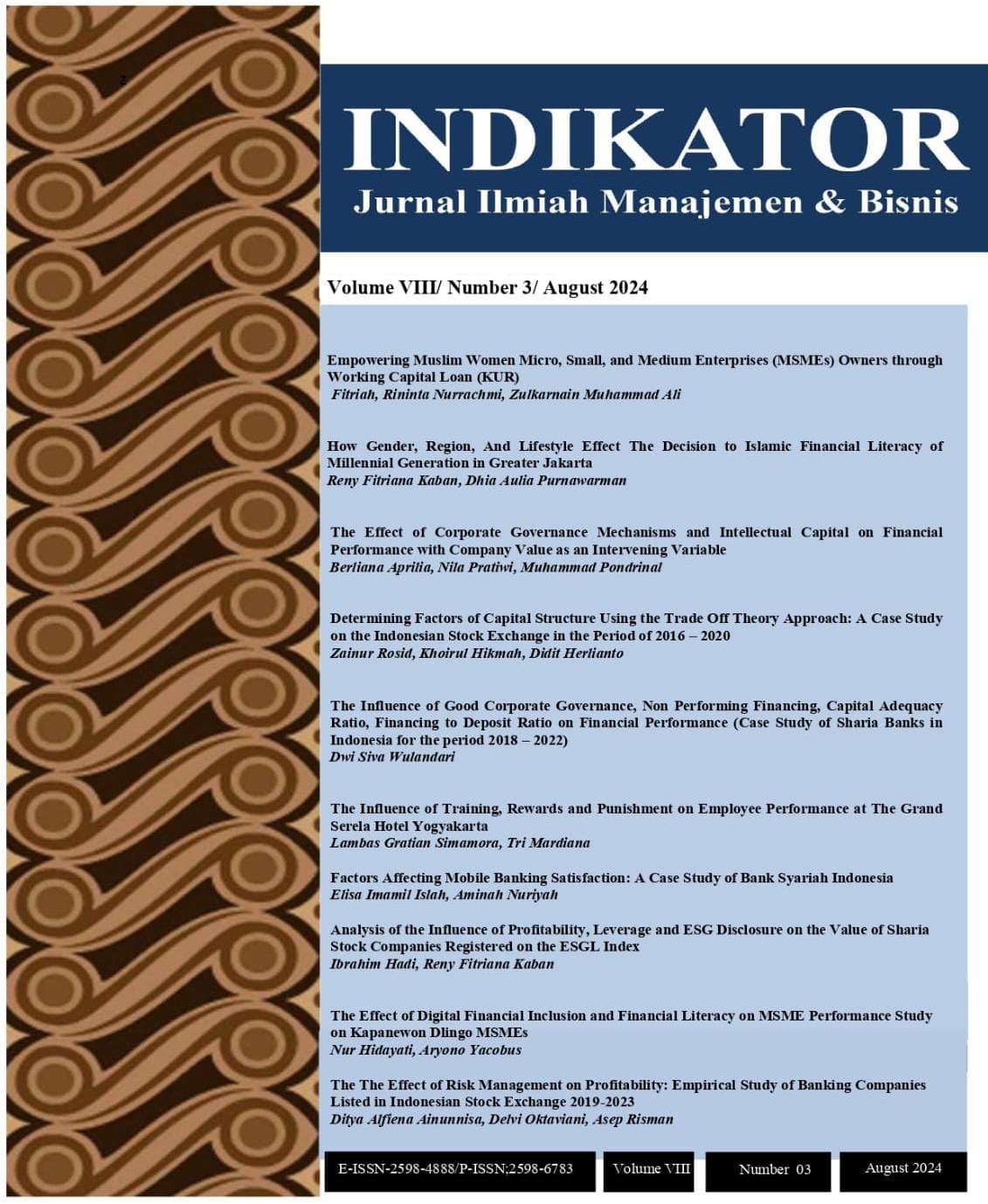
The Influence of Training, Rewards and Punishment on Employee Performance at The Grand Serela Hotel Yogyakarta
DOI:
https://doi.org/10.22441/indikator.v8i3.26506Abstrak
This study aims to determine the effect of Training, Reward, and Punishment on Employee Performance of Grand Serela Yogyakarta hotel. The data collection technique used is the census technique or saturated sampling using a questionnaire. The data analysis method in this study used multiple regression analysis techniques using SPSS 25. This research is a casual associative research using a quantitative approach. The population in this study were all employees at Grand Serela Hotel Yogyakarta. The number of samples used in this study were 38 respondents. The results of this study reveal that training, reward and punishment have a joint effect on employee performance at the Grand Serela Yogyakarta Hotel, and training and the most dominant variable and influence on employee performance is the training variable..
Referensi
Dessler, G. (2020). Human Resources Management (6th ed.)
Dessler, Gary. (2006). Human Resource Management (1st ed.). PT. Index.
Handoko, TH (2012). Personnel and Human Resources Management. BPFE.
Hasibuan. (2016). Human Resource Management. Literary Earth
Fahmi, I. (2016). Human Resource Management Theory and Application. Alphabet.
Kadarisman. (2012). Human Resource Development Management. Raja Grafindo Persada.
Kussriyanto, B. (2010). Increasing Employee Productivity (Management). LPPM.
Mahmudi. (2005). Public Sector Performance Management. UPP AMP YKPN.
Purwanto, MN (2006). Theoretical and Practical Education Science. Rosdakarya Teenager.
Robbins, & Coulter. (2017). Management (13th ed.). Erlangga.
Unduhan
Diterbitkan
Cara Mengutip
Terbitan
Bagian
Lisensi
The copyright to this article is transferred to Universitas Mercu Buana (UMB) if and when the article is accepted for publication. The undersigned hereby transfers any and all rights in and to the paper including without limitation all copyrights to UMB. The undersigned hereby represents and warrants that the paper is original and that he/she is the author of the paper, except for material that is clearly identified as to its original source, with permission notices from the copyright owners where required. The undersigned represents that he/she has the power and authority to make and execute this assignment.
We declare that:
1. This paper has not been published in the same form elsewhere.
2. It will not be submitted anywhere else for publication prior to acceptance/rejection by this Journal.
3. A copyright permission is obtained for materials published elsewhere and which require this permission for reproduction.
Furthermore, I/We hereby transfer the unlimited rights of publication of the above mentioned paper in whole to UMB. The copyright transfer covers the exclusive right to reproduce and distribute the article, including reprints, translations, photographic reproductions, microform, electronic form (offline, online) or any other reproductions of similar nature.
The corresponding author signs for and accepts responsibility for releasing this material on behalf of any and all co-authors. This agreement is to be signed by at least one of the authors who have obtained the assent of the co-author(s) where applicable. After submission of this agreement signed by the corresponding author, changes of authorship or in the order of the authors listed will not be accepted.
Retained Rights/Terms and Conditions
1. Authors retain all proprietary rights in any process, procedure, or article of manufacture described in the Work.
2. Authors may reproduce or authorize others to reproduce the Work or derivative works for the authors personal use or for company use, provided that the source and the UMB copyright notice are indicated, the copies are not used in any way that implies UMB endorsement of a product or service of any employer, and the copies themselves are not offered for sale.
3. Although authors are permitted to re-use all or portions of the Work in other works, this does not include granting third-party requests for reprinting, republishing, or other types of re-use.
This work is also licensed under a Creative Commons Attribution-NonCommercial 4.0 International License.









