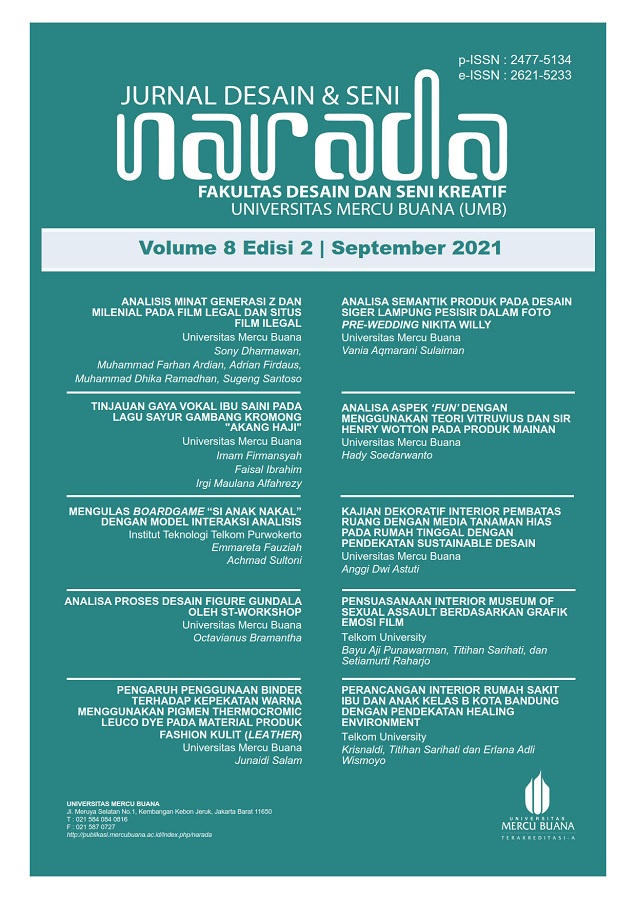
KAJIAN DEKORATIF INTERIOR PEMBATAS RUANG DENGAN MEDIA TANAMAN HIAS PADA RUMAH TINGGAL DENGAN PENDEKATAN SUSTAINABELE DESAIN
DOI:
https://doi.org/10.22441/narada.2021.v8.i2.008Keywords:
Dekorasi Ruang, Pembatas Ruang, Sustaineble Desain, Elemen InteriorAbstract
The development of interior design and decoration is growing rapidly, and all interior spaces need interior decoration. Room decoration is an important element in beautifying the room. This research discusses the study of interior decorative room dividers with ornamental plant media in residential homes with a sustainable design approach. The method used is environmentally friendly space decorative elements with a design trend in 2020, namely Tropical Vibe, which can be interpreted as decorating a house with plants. The plants selected are indoor plants that do not require direct sunlight, with varying plant sizes. The space elements that are applied make the psychology of space more lively and colorful. This study seeks to discuss how (1) Expression of design by combining interior decoration with ornamental plants (2) Providing an alternative space divider with plant media (3) Linking decorative design with the concept of sustainable design. The results of this study indicate that the design with the ornamental garden method applied to buildings effectively uses resources efficiently. This study uses a descriptive qualitative method to describe alternative designs of space dividers and decorative designs with the concept of sustainable design.
Downloads
References
Atmadi, T. (2016). Kajian Metode Pendekatan Desain Interior. NARADA Jurnal Desain dan Seni, 3(1).
Bogdan, R. C., & Biklen, S. K. (1982). Qualitative Research for Education:An Introduction to Theory and Methods. Boston: Allyn and Bacon, Inc.
Ehteshami, A. (2019). “The influence of interior design on house.” Eastern Mediterranean Unversity. Diambil dari : https://www.researchgate.net/publication/336580550
Hanser, A. (2002). Assembly and Disassembly of Interior Wall.” Hongkong: Advances in Building Technology.
Hartanti, G. (2010). Keberadaan Material Bambu sebagai Subtitusi Material Kayu pada Penerapan Desain Interior dan Arsitektur. Humaniora 1(1), 11-19.
Hayles, C. S. (2015). Environmentally sustainable interior design: A snapshot of current supply of and demand for green, sustainable or Fair Trade products for interior design practice. International Journal of Sustainable Built Environment 4(1), 100-108.
DOI: https://doi.org/10.1016/j.ijsbe.2015.03.006
Kania. (2018). "Ada Berapa Jenis Konstruksi yang Perlu Kamu Tahu?". Dekoruma, 15 Agustus 2018. Diambil dari: https://www.dekoruma.com/artikel/72838/jenis-konstruksi
Krishna. (2019). "Different types of walls used in Building Construction" Civil Read 1 July 2019. Diambil dari: https://civilread.com/wall-types/.
Li, J. (Juli, 2016). “Application of Green Plants in Interior Design.” 2nd International Conference on Economics, Social Science, Arts, Education and Management Engineering (ESSAEME) (Juli 30-31) Vol.71, 611-618.
Nugrahani, F. (2014). Metode Penelitian Kualitatif Dalam Pendidikan Bahasa. Solo: Cakra Books.
Salim, I. M. (2011). Taman Dalam Rumah Studi Kasus : Penelitian Terhadap Kebutuhan Jenis Tanaman Bromelia Pada Taman Dalam Rumah Tinggal. Seminar Nasional Life Style And Architecture 2, 598-604.
Downloads
Additional Files
Published
How to Cite
Issue
Section
License
A writer who will publish their article in the NARADA Journal of Design and Art agrees to the following conditions:
- The author owns the copyright and grants the rights to NARADA Journal of Design and Art as the party entrusted with publishing the article for the first time simultaneously licensed under the "Creative Commons Attribution-ShareAlike 4.0" License. This makes it possible for other people to share the work with a form of acknowledgment of authorship of the work and initial publication in this journal according to the authorship of the article provided.
- Authors may enter into separate additional contractual agreements for non-exclusive distribution of the published journal version of the work (e.g., posting it to an institutional repository or publishing it in a book) with acknowledgment of initial publication in the NARADA Journal of Design and Art.
- Authors are permitted and asked to post their work online (for example, institutional repositories or on personal websites) after the article publication process. This avoids double publication or multiple submissions which will affect the similarity of writing of the published work.
- In order to maintain the value of originality and similarity of articles sent or submitted. Authors are asked to temporarily remove or hide the original article from other online systems until they receive the results and decisions from the NARADA Journal of Design and Art regarding the decision to publish the article.
- The author, in this case the contributing author (Contributor Author), will be sent a form or letter stating the validity of the scientific work, signed on an IDR 10,000 stamp. Then the author will be asked to send the email to [email protected].
Pemberitahuan Hak Cipta
Seorang penulis yang akan menerbitkan artikelnya dalam NARADA Jurnal Desain dan Seni setuju dengan ketentuan berikut:
- Penulis memiliki hak cipta dan memberikan hak kepada pihak NARADA Jurnal Desain dan Seni sebagai pihak yang diberikan kepercayaan untuk mempublikasi artikelnya pertama kali secara bersamaan dilisensikan di bawah Lisensi "Creative Commons Attribution-ShareAlike 4.0". Hal ini memungkinkan kepada orang lain untuk membagi karya dengan bentuk pengakuan kepengarangan karya dan publikasi awal dalam jurnal ini sesuai dengan penulisan artikel yang diberikan.
- Penulis dapat membuat perjanjian kontrak tambahan yang terpisah untuk distribusi non-eksklusif versi jurnal yang diterbitkan dari karya tersebut (misalnya, mempostingnya ke repositori institusional atau menerbitkannya dalam sebuah buku) dengan pengakuan publikasi awal dalam NARADA Jurnal Desain dan Seni.
- Penulis diizinkan dan diminta untuk mempostingkan karyanya secara online (semisal, repositori institusional atau di situs web pribadi) setelah proses penerbitan artikel, Hal ini menghindari adanya double publikasi atau pengajuan jamak yang akan berpengaruh kepada adanya kesamaan penulisan dari karya yang diterbitkan.
- Demi menjaga nilai orisinalitas dan nilai kesamaan dari artikel yang dikirim atau diajukan. Penulis diminta untuk menghilangkan atau menyembunyikan secara sementara artikel orisinil dari sistem online lain yang sampai mendapatkan hasil nilai dan ketetapan dari pihak NARADA Jurnal Desain dan Seni mengenai keputusan publikasi dari artikel.
- Penulis dalam hal ini penulis kontributor (Contributor Author) akan dikirimkan form atau surat pernyataan keabsahan karya ilmiah, yang ditanda tangani di atas materai 10000. Dan selanjutnya penulis diminta untuk mengirimkan ke email [email protected].









