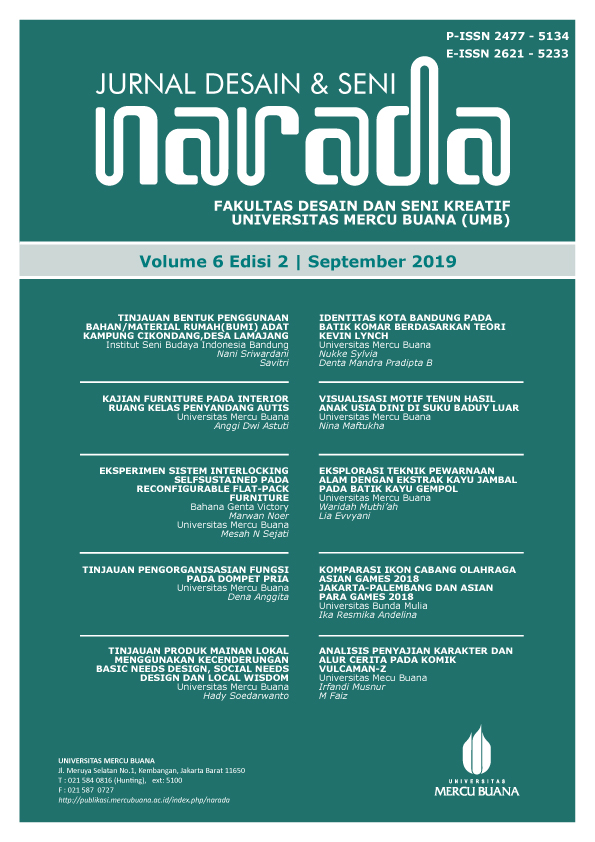
KAJIAN FURNITURE PADA INTERIOR RUANG KELAS PENYANDANG AUTIS
DOI:
https://doi.org/10.22441/narada.2019.v6.i2.002Keywords:
Anak Autis, Layout Ruang, Perabot BelajarAbstract
Autism sufferers have a disruption to social interaction, communication, imagination with repetitive behavior patterns and resistance (not easy to adjust) to the environment and routine in general. This disorder in social interaction issue causes autism sufferers to look strange and different from other people. Autistic sufferers must be given the widest opportunity to develop their potential by creating a special forum that aims to get special education for children with special needs such as autistic children. One form of therapy offered is one on one method. Designing the right layout and using the right furniture can provide an autistic child to be relaxed and comfortable to undergo the therapy and learning. Objectives to be achieved in the design of children’s autism desk is to help children and mentors carry out the therapeutic process by considering several factors namely safety, comfort, and optimization of the therapeutic process. In the process with the existing planning and design methods among them; Data collection, design concepts, design alternatives, design development of selected alternatives, and final design, the final result of the design of this autistic children’s desk is designed to function as well as a means of sensory and motor therapy of children
Downloads
References
Astuti, D.A. (2018). Penerapan Warna Pada Desain Ruang Interior Anak Autis. Narada. Vol.5(1). Jakarta: Universitas Mercu Buana.
Ariani, R. (2010). Desain Sistem Furniture Untuk Terapi Anak Autis. Skripsi Pada Jurusan Desain Produk Industri. Surabaya: FTSP ITS.
Ayu, S.K. (2014). Upaya meningkatkan keterampilan sosial pada anak autis melalui terapi bermain (studi terhadap anak autis di SLB khusus autistic yayasan Fajar Nugraha Yogyakarta). Yogyakarta: Universitas Islam Negeri Sunan Kalijaga.
Departemen Pendidikan Nasional. Direk-torat Pendidikan Luar Biasa. (2002). Pedoman Pelayanan bagi Anak Autistik. DEPDIKNAS: Jakarta.
Fatimah, D., & Mahardika, F. (2014). Analisis penerapan gaya desain dan eksplorasi bentuk yang digunakan mahasiswa pada mata kuliah desain mebel I. Bandung: Fakultas Desain UNIKOM.
Hidayat & Assjari, M. (2006). Identifikasi dan asesmen anak autis & layanan pendidikannya. Bandung: Universitas Pendidikan Indonesia.
Hindarto, M. P. (2006). Warna Untuk Desain Interior. Yogyakarta: Media Pressindo.
Indina, G., Handajani, R.P., & Laksmiwati, T. (2014). Penerapan warna dan cahaya pada interior ruang terapi dasar dengan pendekatan visual anak autis. Malang: Universitas Brawijaya.
Luke, S., & Watson, Jr. (1979). Child Behavior Modification. Ohio: Pergamon Press Inc.
Merry, (2008). Studi desain interior pusat terapi anak berkebutuhan khusus pada sekolah safir di Surabaya. Surabaya: Universitas Kristen Petra.
Nainggolan, J.A. (2016). Penyesuaian diri orang tua dan keberfungsian keluarga yang memiliki anak penyandang autisme di samarinda. Samarinda: Universitas Samarinda.
Quill, K.A. (1995). Teaching Children With Autism, Strategion to Enhance Communication and Socialization. New York: Delmar Publisher Inc.
Phil F. Ed. (2001). Integration and Inclusion in Action. Australia: Nelson Thomas Learning.
Rudi Sutady, dkk .(2003). Penatalaksanaan Holistik Autisme. Jakarta: Pusat Informasi FKUI.
Siegel B. (1996). The Word of The Autistic Child. New York: Oxford University Press.
Sugiarmin, M. (2005). Individu dengan Gangguan Autisme. Bandung: PLB UPI.
Sugiarmin, M. (2007). Hambatan Perkembangan dan Belajar Anak Autis. Jakarta: BPG Diknas Jabar.
Sugiarmin, M.,Dkk. (2004). Pedoman Penyelenggaraan Pendidikan Bagi Anak Autis. Jakarta: Diknas Jabar.
Atmadi, T. (2016). Kajian Metode Kedekatan Desain Interior. Narada, Vol.3(1). Jakarta: Universitas Mercu Buana.
Downloads
Additional Files
Published
How to Cite
Issue
Section
License
A writer who will publish their article in the NARADA Journal of Design and Art agrees to the following conditions:
- The author owns the copyright and grants the rights to NARADA Journal of Design and Art as the party entrusted with publishing the article for the first time simultaneously licensed under the "Creative Commons Attribution-ShareAlike 4.0" License. This makes it possible for other people to share the work with a form of acknowledgment of authorship of the work and initial publication in this journal according to the authorship of the article provided.
- Authors may enter into separate additional contractual agreements for non-exclusive distribution of the published journal version of the work (e.g., posting it to an institutional repository or publishing it in a book) with acknowledgment of initial publication in the NARADA Journal of Design and Art.
- Authors are permitted and asked to post their work online (for example, institutional repositories or on personal websites) after the article publication process. This avoids double publication or multiple submissions which will affect the similarity of writing of the published work.
- In order to maintain the value of originality and similarity of articles sent or submitted. Authors are asked to temporarily remove or hide the original article from other online systems until they receive the results and decisions from the NARADA Journal of Design and Art regarding the decision to publish the article.
- The author, in this case the contributing author (Contributor Author), will be sent a form or letter stating the validity of the scientific work, signed on an IDR 10,000 stamp. Then the author will be asked to send the email to [email protected].
Pemberitahuan Hak Cipta
Seorang penulis yang akan menerbitkan artikelnya dalam NARADA Jurnal Desain dan Seni setuju dengan ketentuan berikut:
- Penulis memiliki hak cipta dan memberikan hak kepada pihak NARADA Jurnal Desain dan Seni sebagai pihak yang diberikan kepercayaan untuk mempublikasi artikelnya pertama kali secara bersamaan dilisensikan di bawah Lisensi "Creative Commons Attribution-ShareAlike 4.0". Hal ini memungkinkan kepada orang lain untuk membagi karya dengan bentuk pengakuan kepengarangan karya dan publikasi awal dalam jurnal ini sesuai dengan penulisan artikel yang diberikan.
- Penulis dapat membuat perjanjian kontrak tambahan yang terpisah untuk distribusi non-eksklusif versi jurnal yang diterbitkan dari karya tersebut (misalnya, mempostingnya ke repositori institusional atau menerbitkannya dalam sebuah buku) dengan pengakuan publikasi awal dalam NARADA Jurnal Desain dan Seni.
- Penulis diizinkan dan diminta untuk mempostingkan karyanya secara online (semisal, repositori institusional atau di situs web pribadi) setelah proses penerbitan artikel, Hal ini menghindari adanya double publikasi atau pengajuan jamak yang akan berpengaruh kepada adanya kesamaan penulisan dari karya yang diterbitkan.
- Demi menjaga nilai orisinalitas dan nilai kesamaan dari artikel yang dikirim atau diajukan. Penulis diminta untuk menghilangkan atau menyembunyikan secara sementara artikel orisinil dari sistem online lain yang sampai mendapatkan hasil nilai dan ketetapan dari pihak NARADA Jurnal Desain dan Seni mengenai keputusan publikasi dari artikel.
- Penulis dalam hal ini penulis kontributor (Contributor Author) akan dikirimkan form atau surat pernyataan keabsahan karya ilmiah, yang ditanda tangani di atas materai 10000. Dan selanjutnya penulis diminta untuk mengirimkan ke email [email protected].









