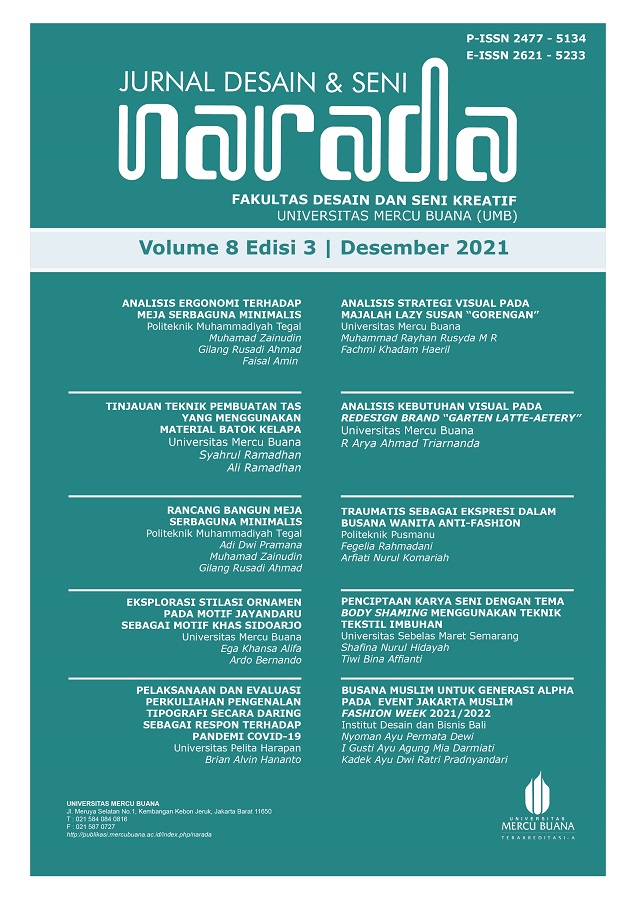
TRAUMATIS SEBAGAI EKSPRESI DALAM BUSANA WANITA ANTI-FASHION
DOI:
https://doi.org/10.22441/narada.2021.v8.i3.008Keywords:
Anti-fashion, Fashion, Craft Art., TraumaticAbstract
The fraumatic issue upon childern need to be expose to public as one of social issue to notice in the society. In this writing, case is being responed as an expression of the craftmanship of women’s fashion. This expression roled as the representation of mother. The final products of this thesis is a critic work was a critic about behasioral digression to the attitude of mothers in rising their children that caused a traumatic effect on the children itself. Fashion, in this cuse, used as communication media to communicat experientes and traumatic phenomenon throgh partice, artefac, intuition, and metaphor to express the emotional values that comes from social enviarnment.
The method used in this work is a practice based on research method, Process that used logical understanding or reason in creating research into art creation can produce academic document that has function to help communicate the description of the work, both conceptually and contextually. Meanwhile, the theory used in this work was the theory of art function and imagination. The works itself is manifested using a manipulating of fabric technique which will produce a response to the traumatic feeling of the children.
The writings of this final assignment are in the form of eight design works, and five of that will come to a work realization. Each work represent the perspective values of the author about traumatic phenomenon of the children as the manifestation of behavior digression of mothers in rising or educating their children. In addition, the design of women’s clothing was an anti-fashion style inspired by Japanese design Rei Kawakubo. Anti-fashion was a form of fashion innovation that do not have timeline of fashion and break the gap of fashion because it does not fond of the market trends and desires.
Downloads
References
Barnard, M. (1996), Fashion as Communication atau Fashion Sebagai Komunikasi, terjemahan I, Subandy Ibrahim, & Y, Iriantara. (2018), Yogyakarta: Jalasutra.
Barry, N. (1991). Image, Object, and Ideas: Viewing The Visual Arts. United States of America: Ted Buchholz.
George, R. (2011), Spociological Theory atau Teori Sosiologi, terjemahan S, Pasaribu, Rh. Widada, & E, Adinugraha. (2012), Yogyakarta: Pustaka Pelajar.
Gunarsa, S. D., & Gunarsa, Y. S. D. (2011). Psikologi Perkembangan Anak dan Remaja. Jakarta: Libri.
Gray, C., & Malians, J. (1993). Research Procedures/Methodology forArtisan and Designers. Inggris: The Robet Gordon University.
Martin, S. (2016). Sejarah Estetika: Era Klasik Sampai Kontemporer. Jakarta: Gang Kabel dan Indie Book Corner.
Nur, I. (2016). Drama: Teori dan Praktik Seni Peran. Yogyakarta: Media Kreatif.
Paul, S, J. (1940). The Psycology of The Imagination. New York: Citadel Press.
Rais, H, E. (2012), Kamus Ilmiah Populer. Yogyakarta: Pustaka Pelajar.
Scivener & R, S, A. (2000). Reflection In and On Action and Practice in Creative - Production Doctoral Projects In Art Design. Helsinki: University of Art & Design.
Soedarsono, R. M. (1999). Metodelogi Penelitian Pertunjukan dan Seni Rupa. Bandung: Masyarakat Seni Pertunjukan Indonesia.
Suyanto, B. (2010). Desain Masalah Sosial Anak. Jakarta: Kencana Prenanda Media Grup.
Syamsul, B., & Thalib. (2010). Psikologis Pendidikan Berbasis Analisis Empiris Aplikatif. Jakarta: Kencana Prenanda Media Grup.
Downloads
Published
How to Cite
Issue
Section
License
A writer who will publish their article in the NARADA Journal of Design and Art agrees to the following conditions:
- The author owns the copyright and grants the rights to NARADA Journal of Design and Art as the party entrusted with publishing the article for the first time simultaneously licensed under the "Creative Commons Attribution-ShareAlike 4.0" License. This makes it possible for other people to share the work with a form of acknowledgment of authorship of the work and initial publication in this journal according to the authorship of the article provided.
- Authors may enter into separate additional contractual agreements for non-exclusive distribution of the published journal version of the work (e.g., posting it to an institutional repository or publishing it in a book) with acknowledgment of initial publication in the NARADA Journal of Design and Art.
- Authors are permitted and asked to post their work online (for example, institutional repositories or on personal websites) after the article publication process. This avoids double publication or multiple submissions which will affect the similarity of writing of the published work.
- In order to maintain the value of originality and similarity of articles sent or submitted. Authors are asked to temporarily remove or hide the original article from other online systems until they receive the results and decisions from the NARADA Journal of Design and Art regarding the decision to publish the article.
- The author, in this case the contributing author (Contributor Author), will be sent a form or letter stating the validity of the scientific work, signed on an IDR 10,000 stamp. Then the author will be asked to send the email to [email protected].
Pemberitahuan Hak Cipta
Seorang penulis yang akan menerbitkan artikelnya dalam NARADA Jurnal Desain dan Seni setuju dengan ketentuan berikut:
- Penulis memiliki hak cipta dan memberikan hak kepada pihak NARADA Jurnal Desain dan Seni sebagai pihak yang diberikan kepercayaan untuk mempublikasi artikelnya pertama kali secara bersamaan dilisensikan di bawah Lisensi "Creative Commons Attribution-ShareAlike 4.0". Hal ini memungkinkan kepada orang lain untuk membagi karya dengan bentuk pengakuan kepengarangan karya dan publikasi awal dalam jurnal ini sesuai dengan penulisan artikel yang diberikan.
- Penulis dapat membuat perjanjian kontrak tambahan yang terpisah untuk distribusi non-eksklusif versi jurnal yang diterbitkan dari karya tersebut (misalnya, mempostingnya ke repositori institusional atau menerbitkannya dalam sebuah buku) dengan pengakuan publikasi awal dalam NARADA Jurnal Desain dan Seni.
- Penulis diizinkan dan diminta untuk mempostingkan karyanya secara online (semisal, repositori institusional atau di situs web pribadi) setelah proses penerbitan artikel, Hal ini menghindari adanya double publikasi atau pengajuan jamak yang akan berpengaruh kepada adanya kesamaan penulisan dari karya yang diterbitkan.
- Demi menjaga nilai orisinalitas dan nilai kesamaan dari artikel yang dikirim atau diajukan. Penulis diminta untuk menghilangkan atau menyembunyikan secara sementara artikel orisinil dari sistem online lain yang sampai mendapatkan hasil nilai dan ketetapan dari pihak NARADA Jurnal Desain dan Seni mengenai keputusan publikasi dari artikel.
- Penulis dalam hal ini penulis kontributor (Contributor Author) akan dikirimkan form atau surat pernyataan keabsahan karya ilmiah, yang ditanda tangani di atas materai 10000. Dan selanjutnya penulis diminta untuk mengirimkan ke email [email protected].









