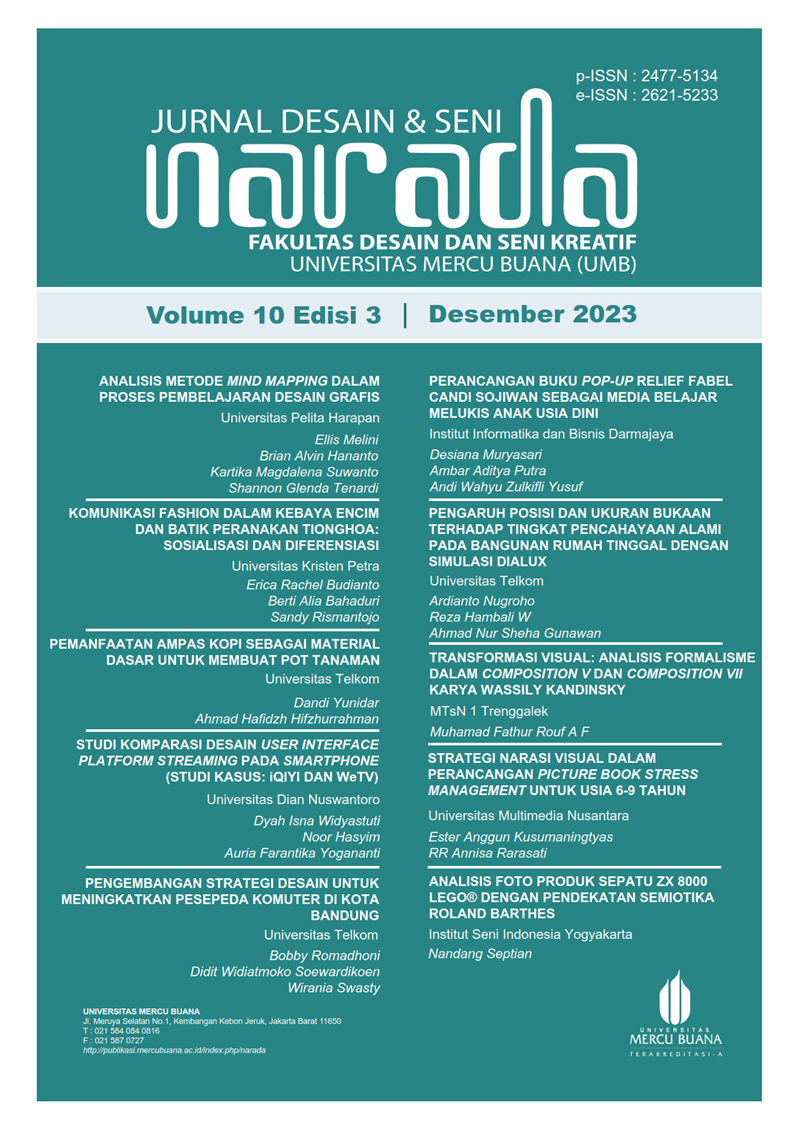
ANALISIS FOTO PRODUK SEPATU ZX 8000 LEGO® DENGAN PENDEKATAN SEMIOTIKA ROLAND BARTHES
DOI:
https://doi.org/10.22441/narada.2023/v10.i3.010Keywords:
Product Photo, Semiotics, Shoes, ZX 8000 Lego.Abstract
A prominent global shoe brand, such as Adidas, is intricately linked to its identity as a product and a fashion symbol. The brand's commitment to innovation and development is evident through various collaborations, a notable example being the partnership with Lego. The focus of this research is the ZX 8000 Lego® shoes, a product made from the fusion of Adidas and Lego. Analyzing the product photo of these shoes serves as the basis for exploring symbols and their meanings. Product photos, as a powerful tool, contain information that captivates consumers and influences purchasing decisions. This qualitative research, employing a descriptive analysis method with the Roland Barthes Semiotics approach, delves into denotation (signifiers) and connotation (signified) meanings within the elements of the product photo. The identified meanings lay the groundwork for unraveling the myth or ideology embedded in the product photos. The study reveals denotations like dominant shoe pairs, vibrant colors, contrasting materials, dual logos, scattered Lego blocks, a white background, and trademark presence. Connotations, on the other hand, revolve around roles, harmonization of meaning, strategic displays, simplicity as a value, and trademarks as assets and symbols of approval. These meanings collectively aim at attracting new consumers, suggesting an underlying ideology favoring capitalism. Despite this, the collaboration proves mutually beneficial, portraying a harmonious coexistence that benefits both brands.
Downloads
References
Arana, A. (2021). “Adidas LEGO® Partnership and How It’s Building the Creative Identity of Future Athletes on the Adidas Blog GamePlan A.” Lego.Com. Diambil dari: https://www.lego.com/en-sa/aboutus/news/2020/october/adidas-lego-group-multi-year-partnership?locale=en-sa&age-gate=grown_up.
Astuti, R. (2017). “Semiotika Dalam Bidang Manajemen Pemasaran.” Jurnal Manajemen Dan Kearifan Lokal Indonesia 1(2):116–23.
DOI:https://doi.org/10.26805/jmkli.v1i2.13.
Barthes, R. (1964). Elements of Semiology. New York: Publ. Hill and Wang.
Braithwaite, N. (2021). “The History Of Sneakers: From Commodity To Cultural Icon.” The Conversation. Diambil dari: https://theconversation.com/the-history-of-sneakers-from-commodity-to-cultural-icon-127268.
Cheung, A. (2023). “The Greatest Adidas Sneaker Collaborations In The History Of The Universe.” British GQ. Diambil dari:https://www.gq-magazine.co.uk/article/adidas-sneaker-collaborations
Danforth, C. (2020). “A Brief History of the Adidas ZX: Innovation, Collabs & Raves.” Highsnobiety. Diambil dari: https://www.highsnobiety.com/p/adidas-archive-zx-history/.
Dwyer, R. (2020). “From A to Z(X): How the A-ZX Line Evolved Adidas Collaborations.” Hypebeast. Diambil dari: https://hypebeast.com/2020/9/adidas-a-zx-history-release-dates-info-photos.
Fauzi, S., & Lina, L. F. (2021). “Peran Foto Produk, Online Customer Review Dan Online Customer Rating Pada Minat Beli Konsumen Di E-Commerce.” Jurnal Muhammadiyah Manajemen Bisnis 2(1):21–26.
DOI:https://doi.org/10.24853/jmmb.2.1.21-26.
Guevara, D., Laski-Smith, D., & Ashur, S. (2022). “Interior Design Students’ Perception of Virtual Reality.” SN Social Sciences 2(152).
DOI:https://doi.org/10.1007/s43545-022-00423-7.
Hall, J. S. (1847). The Book of the Feet: A History of Boots and Shoes. United State: William Sidney Graham.
Hjelm, S. I. (2002). Semiotics in Product Design. Stockholm: NADA, Deptartment of Numerical Analysis and Computer Science KTH (Royal Institute of Technology).
Ibrahim, F., Nuraeni, T., Ahmad, F., Kee, Chang Peng., & Mustafa, N. (2012). “Bahasa Komunikasi Visual Dan Pengantaraan Produk: Satu Analisis Semiotik.” GEMA Online Journal of Language Studies 12:257–73.
Itten, J. (1970). The Elements of Color. New York: John Wiley & Sons.
Karlsch, R., Kleinschmidt, C., Lesczenski, J., & Sudrow, A. (2019). Playing the Game: The History of Adidas. New York: Prestel Verlag GmbH & Company KG.
Keenan, W. J. F. (2007). “Book Review: Giorgio Riello and Peter McNeil (Eds) Shoes: A History from Sandals to Sneakers Berg, Oxford and New York.” Cultural Sociology 1(3):435–39.
DOI:https://doi.org/10.1177/1749975507001003070
Keyser, A. J. (2015). Sneaker Century: A History of Athletic Shoes. Minneapolis: Lerner Publishing Group.
Matambo, A. (2021). “On The Power of Brand Collaboration: Adidas and Lego.” AlexanderMatambo.Com. Diambil dari:
https://www.alexandermatambo.com/post/on-the-power-of-brand-collaboration-adidas-and-lego.
Mattei, J. (2013). The Land of Harmony: Embrace Our Differences & There Can Be Harmony! South Carolina: CreateSpace Independent Publishing Platform.
Neira, J. (2021). “Adidas X LEGO Unveil New Superstar Sneaker Collab Including A Building Block Model.” Designboom. Diambil dari: https://www.designboom.com/design/adidas-lego-superstar-sneaker-building-model-06-21-2021/.
Peirce, C. S. (1991). Peirce on Signs: Writings on Semiotic. Carolina, U.S: UNC Press Books.
Pieri, J. (2019). How We Make Stuff Now: Turn Ideas into Products That Build Successful Businesses. New York: McGraw Hill.
Piliang, Y. A. (2004). “Semiotika Teks: Sebuah Pendekatan Analisis Teks.” Mediator: Jurnal Komunikasi 5(2):189–98.
DOI:https://doi.org/10.29313/mediator.v5i2.1156.
Riello, G., & McNeil, P. (2006). Shoes: A History From Sandals to Sneakers. London: Bloomsbury Academic.
Saraf, M. J. (1977). “Semiotic Signs in Sports Activity.” International Review of Sport Sociology 12(2):89–101.
DOI:https://doi.org/10.1177/101269027701200206.
Sena, I. P. A, Netra, I. M., & Mulyawan, I. W. (2016). “The Analysis Of Verbal And Visual Sign Of Adidas Advertisement.” Jurnal Harian Regional 17(1).
Shukla, M., Misra, R., & Singh, D. 2023. “Exploring Relationship among Semiotic Product Packaging, Brand Experience Dimensions, Brand Trust and Purchase Intentions in an Asian Emerging Market.” Asia Pacific Journal of Marketing and Logistics, 35(2):249–65.
DOI:https://doi.org/10.1108/APJML-10-2021-0718.
Tillman, B, Fitts, D. J., Woodson,W. E., Rhonda, R-S., & Tillman, P. (2016). Human Factors and Ergonomics Design Handbook. New York: McGraw-Hill Education.
Vincentius, R. (2020). “Kajian Semiotika Desain Produk ‘Hug Salt And Pepper Shaker’, Karya Desainer Alberto Mantilla.” Jurnal Kreatif 7(2):49–58.
DOI:https://doi.org/10.46964/jkdpia.v7i2.5.
Widiarta, I. Wayan, I. R., Santika, D. A. D. M., & Pratiwi, D. P. E. (2021). “Analysis of Semiotic Found in Football Shoes Advertisements.” Humanis 25(4):452–62.
DOI:https://doi.org/10.24843/JH.2021.v25.i04.p05.
Wolf, G., & Komatsu, E. (1996). Saussure’s First Course of Lectures on General Linguistics (1907): From the Notebooks of Albert Riedlinger (Language and Communication Library). 1st ed. United Kingdom: Pergamon.
Downloads
Published
How to Cite
Issue
Section
License
A writer who will publish their article in the NARADA Journal of Design and Art agrees to the following conditions:
- The author owns the copyright and grants the rights to NARADA Journal of Design and Art as the party entrusted with publishing the article for the first time simultaneously licensed under the "Creative Commons Attribution-ShareAlike 4.0" License. This makes it possible for other people to share the work with a form of acknowledgment of authorship of the work and initial publication in this journal according to the authorship of the article provided.
- Authors may enter into separate additional contractual agreements for non-exclusive distribution of the published journal version of the work (e.g., posting it to an institutional repository or publishing it in a book) with acknowledgment of initial publication in the NARADA Journal of Design and Art.
- Authors are permitted and asked to post their work online (for example, institutional repositories or on personal websites) after the article publication process. This avoids double publication or multiple submissions which will affect the similarity of writing of the published work.
- In order to maintain the value of originality and similarity of articles sent or submitted. Authors are asked to temporarily remove or hide the original article from other online systems until they receive the results and decisions from the NARADA Journal of Design and Art regarding the decision to publish the article.
- The author, in this case the contributing author (Contributor Author), will be sent a form or letter stating the validity of the scientific work, signed on an IDR 10,000 stamp. Then the author will be asked to send the email to [email protected].
Pemberitahuan Hak Cipta
Seorang penulis yang akan menerbitkan artikelnya dalam NARADA Jurnal Desain dan Seni setuju dengan ketentuan berikut:
- Penulis memiliki hak cipta dan memberikan hak kepada pihak NARADA Jurnal Desain dan Seni sebagai pihak yang diberikan kepercayaan untuk mempublikasi artikelnya pertama kali secara bersamaan dilisensikan di bawah Lisensi "Creative Commons Attribution-ShareAlike 4.0". Hal ini memungkinkan kepada orang lain untuk membagi karya dengan bentuk pengakuan kepengarangan karya dan publikasi awal dalam jurnal ini sesuai dengan penulisan artikel yang diberikan.
- Penulis dapat membuat perjanjian kontrak tambahan yang terpisah untuk distribusi non-eksklusif versi jurnal yang diterbitkan dari karya tersebut (misalnya, mempostingnya ke repositori institusional atau menerbitkannya dalam sebuah buku) dengan pengakuan publikasi awal dalam NARADA Jurnal Desain dan Seni.
- Penulis diizinkan dan diminta untuk mempostingkan karyanya secara online (semisal, repositori institusional atau di situs web pribadi) setelah proses penerbitan artikel, Hal ini menghindari adanya double publikasi atau pengajuan jamak yang akan berpengaruh kepada adanya kesamaan penulisan dari karya yang diterbitkan.
- Demi menjaga nilai orisinalitas dan nilai kesamaan dari artikel yang dikirim atau diajukan. Penulis diminta untuk menghilangkan atau menyembunyikan secara sementara artikel orisinil dari sistem online lain yang sampai mendapatkan hasil nilai dan ketetapan dari pihak NARADA Jurnal Desain dan Seni mengenai keputusan publikasi dari artikel.
- Penulis dalam hal ini penulis kontributor (Contributor Author) akan dikirimkan form atau surat pernyataan keabsahan karya ilmiah, yang ditanda tangani di atas materai 10000. Dan selanjutnya penulis diminta untuk mengirimkan ke email [email protected].









