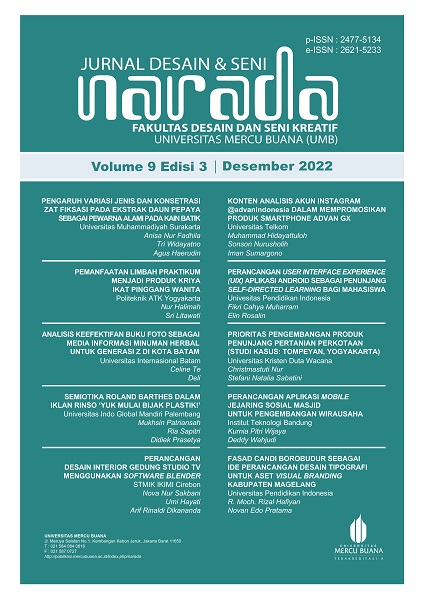
ANALISIS KEEFEKTIFAN BUKU FOTO SEBAGAI MEDIA INFORMASI MINUMAN HERBAL UNTUK GENERASI Z DI KOTA BATAM
DOI:
https://doi.org/10.22441/narada.2022.v9.i3.003Keywords:
Photobook, Information and Promotional Media, Jamu, Generation Z, Multimedia Development Life Cycle, Research and DevelopmentAbstract
Books are one of the information media that is still used today because it can be used anytime and anywhere because its use does not require a special way. Jamu is one of the Indonesian culture that is in line with the development of the times. Due to the development of drugs in the medical world, the role of herbal medicine as an herbal drink and medicines began to be forgotten. Therefore the author will design a photo book containing new or unknown information content about herbal medicine. In this study the author uses the MDLC (Multimedia Development Life Cycle) method and the R&D (Research and Development) method. Both of these methods consist of several stages of preparation, namely determining the potential and problem which at this stage the writer will determine the concept and design of the photo book, the next stage is the collection of data which at this stage the author will gather information and photos that will later become content From the contents of the photo book, the next stage is the design of the product at this stage the writer will design a photo book in accordance with the data that has been collected, the final step is to do the effectiveness testing of the photo books on a small and large scale. The distribution of the questionnaire was carried out on generation Z in Batam City, with a quantitative analysis obtained the results of the photo book assessment were feasible (scale of 4.01 of 5) as a medium for disseminating information.
Downloads
References
Adiguna Putra, J. (2019). Media Promosi Visual Fotografi STPMD “ APMD ” Dalam Fotografi Komersial. 1–22.
Adila, K., & Harisah, Y. (2020). Persepsi Siswa Kelas x MIPA SMA Negeri 1 Bojong Terhadap Pembelajaran Online pada Pelajaran Matematika. Seminar Nasional Pendidikan Matematika, 401–406.
Andriyani, A. (2019). Kajian Literatur pada Makanan dalam Perspektif Islam dan Kesehatan. Jurnal Kedokteran Dan Kesehatan, 15(2), 178.
Hung, T. J. (2020). Scientization of Jamu in Indonesia: Reacting to Fake Jamu, Pressures of Nationalism, and the Preservation of Local Wisdom. … : An International Journal of Humanities and …, 2(1), 105–137.
Hutamy, E. T., Marham, A., Alisyahbana, A. N. Q. A., Arisah, N., & Hasan, M. (2021). Analisis Penerapan Bisnis Model Canvas pada Usaha Mikro Wirausaha Generasi Z. Jurnal Bisnis Dan Pemasaran Digital, 1(1), 1–11.
Ichsan, I., & Ali, A. (2020). Metode Pengumpulan Data Penelitian Musik Berbasis Observasi Auditif. Musikolastika: Jurnal Pertunjukan Dan Pendidikan Musik, 2(2), 85–93.
Larasati, D. (2018). Globalization on Culture and Identity: Pengaruh dan Eksistensi Hallyu (Korean-Wave) Versus Westernisasi di Indonesia. Jurnal Hubungan Internasional, 11(1), 109.
Mahasiswa, J. I., Hayati, F., Oktariana, R., Bina, U., & Getsempena, B. (2021). Pengembangan Media Pohon Huruf Untuk Menstimulasi Kemampuan Mengenal Huruf Anak Kelompok B-5 Di Tk Fkip Unsyiah. 2(2).
Mayssara A. Abo Hassanin Supervised, A. (2018). Tingkatkan Imunitas Tubuh Secara Alami Selama Pandemi. Paper Knowledge . Toward a Media History of Documents, 4(2), 1–7.
Pranatawijaya, V. H., Widiatry, W., Priskila, R., & Putra, P. B. A. A. (2019). Penerapan Skala Likert dan Skala Dikotomi Pada Kuesioner Online. Jurnal Sains Dan Informatika, 5(2), 128–137.
Purnomo, A., Asitah, N., Rosyidah, E., Septianto, A., Daryanti, M. D., & Firdaus, M. (2019). Generasi Z sebagai Generasi Wirausaha. 1–4.
Samosir, R. S., & Purwandari, N. (2020). Aplikasi Literasi Digital Berbasis Web Dengan Metode R&D dan MDLC. Techno.Com, 19(2), 157–167.
Sitompul, J. (2018). Pengaruh Aktivitas Fisik Intensitas Sedang terhadap Kadar Kalium Darah pada Mahasiswa IKOR 2015 Unimed. 1–6.
Wahyu Putra, F. (2018). Perancangan buku cerita bergambar puti sari banilai kabupaten limapuluh kota.
Downloads
Additional Files
Published
How to Cite
Issue
Section
License
A writer who will publish their article in the NARADA Journal of Design and Art agrees to the following conditions:
- The author owns the copyright and grants the rights to NARADA Journal of Design and Art as the party entrusted with publishing the article for the first time simultaneously licensed under the "Creative Commons Attribution-ShareAlike 4.0" License. This makes it possible for other people to share the work with a form of acknowledgment of authorship of the work and initial publication in this journal according to the authorship of the article provided.
- Authors may enter into separate additional contractual agreements for non-exclusive distribution of the published journal version of the work (e.g., posting it to an institutional repository or publishing it in a book) with acknowledgment of initial publication in the NARADA Journal of Design and Art.
- Authors are permitted and asked to post their work online (for example, institutional repositories or on personal websites) after the article publication process. This avoids double publication or multiple submissions which will affect the similarity of writing of the published work.
- In order to maintain the value of originality and similarity of articles sent or submitted. Authors are asked to temporarily remove or hide the original article from other online systems until they receive the results and decisions from the NARADA Journal of Design and Art regarding the decision to publish the article.
- The author, in this case the contributing author (Contributor Author), will be sent a form or letter stating the validity of the scientific work, signed on an IDR 10,000 stamp. Then the author will be asked to send the email to [email protected].
Pemberitahuan Hak Cipta
Seorang penulis yang akan menerbitkan artikelnya dalam NARADA Jurnal Desain dan Seni setuju dengan ketentuan berikut:
- Penulis memiliki hak cipta dan memberikan hak kepada pihak NARADA Jurnal Desain dan Seni sebagai pihak yang diberikan kepercayaan untuk mempublikasi artikelnya pertama kali secara bersamaan dilisensikan di bawah Lisensi "Creative Commons Attribution-ShareAlike 4.0". Hal ini memungkinkan kepada orang lain untuk membagi karya dengan bentuk pengakuan kepengarangan karya dan publikasi awal dalam jurnal ini sesuai dengan penulisan artikel yang diberikan.
- Penulis dapat membuat perjanjian kontrak tambahan yang terpisah untuk distribusi non-eksklusif versi jurnal yang diterbitkan dari karya tersebut (misalnya, mempostingnya ke repositori institusional atau menerbitkannya dalam sebuah buku) dengan pengakuan publikasi awal dalam NARADA Jurnal Desain dan Seni.
- Penulis diizinkan dan diminta untuk mempostingkan karyanya secara online (semisal, repositori institusional atau di situs web pribadi) setelah proses penerbitan artikel, Hal ini menghindari adanya double publikasi atau pengajuan jamak yang akan berpengaruh kepada adanya kesamaan penulisan dari karya yang diterbitkan.
- Demi menjaga nilai orisinalitas dan nilai kesamaan dari artikel yang dikirim atau diajukan. Penulis diminta untuk menghilangkan atau menyembunyikan secara sementara artikel orisinil dari sistem online lain yang sampai mendapatkan hasil nilai dan ketetapan dari pihak NARADA Jurnal Desain dan Seni mengenai keputusan publikasi dari artikel.
- Penulis dalam hal ini penulis kontributor (Contributor Author) akan dikirimkan form atau surat pernyataan keabsahan karya ilmiah, yang ditanda tangani di atas materai 10000. Dan selanjutnya penulis diminta untuk mengirimkan ke email [email protected].









