
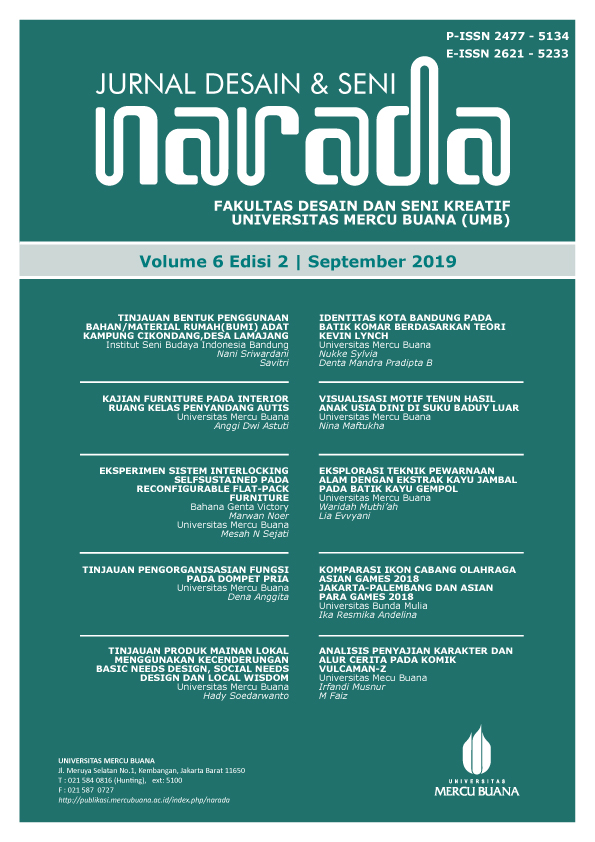
EKSPERIMEN SISTEM INTERLOCKING SELF-SUSTAINED PADA RECONFIGURABLE FLAT PACK FURNITURE
DOI:
https://doi.org/10.22441/narada.2019.v6.i2.003Keywords:
Interlocking, self-sustained, Reconfigurable, Flat-pack, FurnitureAbstract
Flat-Pack furniture and interlocking systems are two terms that have very close links in today's modern furniture manufacturing industry. Where the combination of these two elements can provide many solutions in the creation of a versatile furniture product which is the focus of attention at this time. The self-sustained interlocking system as one of the elements in making flat-pack furniture has an essential function and significant influence in making a flat-pack furniture product that is not only multifunctional and ergonomic but also has a major role in producing environmentally friendly products.
Since the invention of CNC router machine and laser cutting technology and the development of digital engineering software, this self-sustained interlocking system is known to be complex has developed very rapidly, and has produced many reconfigurable, multi-functional flat-pack furniture products with environmentally friendly characteristics at production costs makes sense.
The research aims to review modern types of interlocking joints and try to explore and explore and find new approaches in making interlocking systems that are appropriate for Reconfigurable Flat Pack Furniture applications.
Downloads
References
Babbie, E. (2012). The Practice of Sosial Research. California: Wadsworth, Inc.
Chang, W. S., & Hsu, M. F. (2005). Mechanical characteristics of traditional go-dou and stepped dovetail timber connections in Taiwan. Taiwan Journal of Forest Science, 20(1), 61-71.
Chi-Wing Fu, & Peng Song (2015). Computational Interlocking Furniture Assembly. International Conference on Computer Graphics and Interactive Techniques Vol, 34, No.4, 91:1-91:11
Creswell, J, W. (2010). Research Design: Pendekatan Kualitatif, Kuantitatif, dan Mixed. Yogyakarta: Pustaka Pelajar.
Yin, R K, (2015). Studi Kasus Desain & Metode. Jakarta: RajaGrafindo Persada.
Schwarz, C (2004). Wood Joinery:Build a Table Using Traditional Techniques :Mortise & Tenon for Tables. North Carolina : Woodworking Magazines.
Sumihoshi,T & Matsui,G (1989). Wood Joints In Classical Japanese Architecture Japan: Kajima Institute Publishing
Spon, C. (2009). Woodwork Joints :How to make and where to use them. New York: The Toolemera Press
Downloads
Published
How to Cite
Issue
Section
License
A writer who will publish their article in the NARADA Journal of Design and Art agrees to the following conditions:
- The author owns the copyright and grants the rights to NARADA Journal of Design and Art as the party entrusted with publishing the article for the first time simultaneously licensed under the "Creative Commons Attribution-ShareAlike 4.0" License. This makes it possible for other people to share the work with a form of acknowledgment of authorship of the work and initial publication in this journal according to the authorship of the article provided.
- Authors may enter into separate additional contractual agreements for non-exclusive distribution of the published journal version of the work (e.g., posting it to an institutional repository or publishing it in a book) with acknowledgment of initial publication in the NARADA Journal of Design and Art.
- Authors are permitted and asked to post their work online (for example, institutional repositories or on personal websites) after the article publication process. This avoids double publication or multiple submissions which will affect the similarity of writing of the published work.
- In order to maintain the value of originality and similarity of articles sent or submitted. Authors are asked to temporarily remove or hide the original article from other online systems until they receive the results and decisions from the NARADA Journal of Design and Art regarding the decision to publish the article.
- The author, in this case the contributing author (Contributor Author), will be sent a form or letter stating the validity of the scientific work, signed on an IDR 10,000 stamp. Then the author will be asked to send the email to [email protected].
Pemberitahuan Hak Cipta
Seorang penulis yang akan menerbitkan artikelnya dalam NARADA Jurnal Desain dan Seni setuju dengan ketentuan berikut:
- Penulis memiliki hak cipta dan memberikan hak kepada pihak NARADA Jurnal Desain dan Seni sebagai pihak yang diberikan kepercayaan untuk mempublikasi artikelnya pertama kali secara bersamaan dilisensikan di bawah Lisensi "Creative Commons Attribution-ShareAlike 4.0". Hal ini memungkinkan kepada orang lain untuk membagi karya dengan bentuk pengakuan kepengarangan karya dan publikasi awal dalam jurnal ini sesuai dengan penulisan artikel yang diberikan.
- Penulis dapat membuat perjanjian kontrak tambahan yang terpisah untuk distribusi non-eksklusif versi jurnal yang diterbitkan dari karya tersebut (misalnya, mempostingnya ke repositori institusional atau menerbitkannya dalam sebuah buku) dengan pengakuan publikasi awal dalam NARADA Jurnal Desain dan Seni.
- Penulis diizinkan dan diminta untuk mempostingkan karyanya secara online (semisal, repositori institusional atau di situs web pribadi) setelah proses penerbitan artikel, Hal ini menghindari adanya double publikasi atau pengajuan jamak yang akan berpengaruh kepada adanya kesamaan penulisan dari karya yang diterbitkan.
- Demi menjaga nilai orisinalitas dan nilai kesamaan dari artikel yang dikirim atau diajukan. Penulis diminta untuk menghilangkan atau menyembunyikan secara sementara artikel orisinil dari sistem online lain yang sampai mendapatkan hasil nilai dan ketetapan dari pihak NARADA Jurnal Desain dan Seni mengenai keputusan publikasi dari artikel.
- Penulis dalam hal ini penulis kontributor (Contributor Author) akan dikirimkan form atau surat pernyataan keabsahan karya ilmiah, yang ditanda tangani di atas materai 10000. Dan selanjutnya penulis diminta untuk mengirimkan ke email [email protected].









