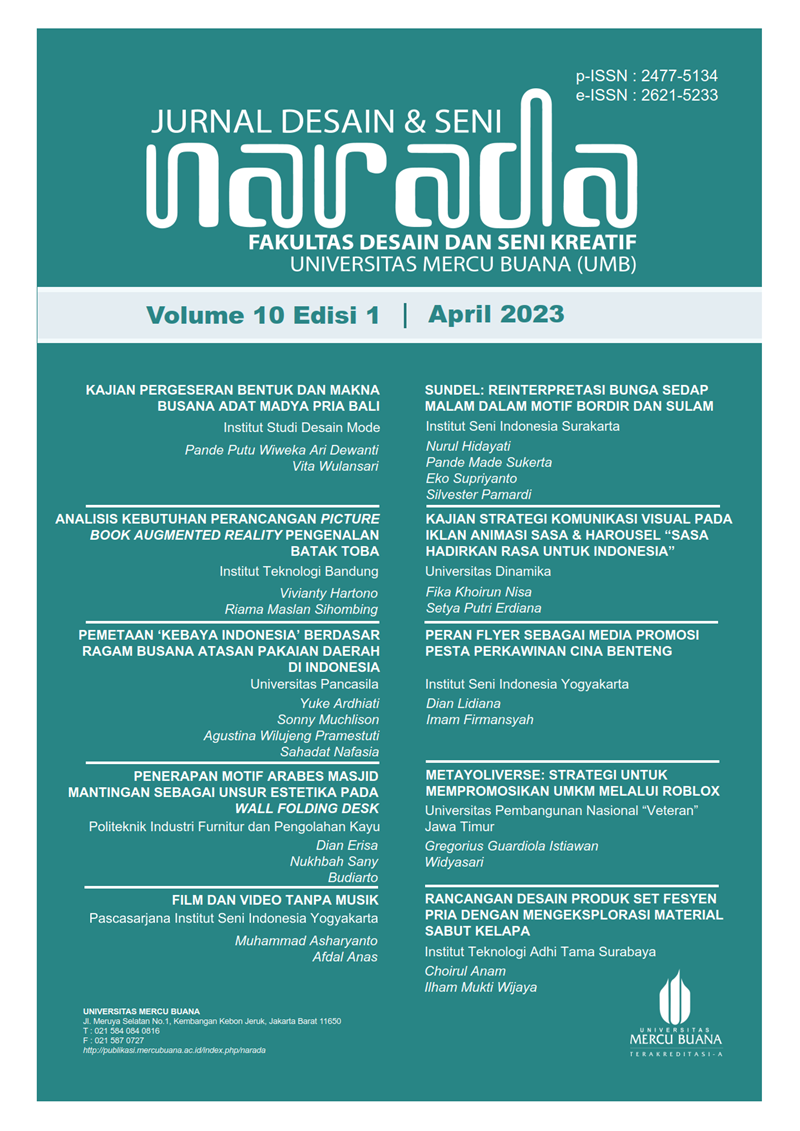
PENERAPAN MOTIF ARABES MASJID MANTINGAN SEBAGAI UNSUR ESTETIKA PADA WALL FOLDING DESK
DOI:
https://doi.org/10.22441/narada.2023.v10.i1.004Keywords:
Aesthetics, Mantingan Mosque, Wall folding desk, Arabesque motifAbstract
Indonesia has a wide variety of art crafts, one example is carving. Art in the form of carving can be found in Jepara Regency, known internationally for its beautiful quality. History records that Jepara carving began in the 16th century which can be seen in the ornaments of the Mantingan Mosque. The purpose of this research is to apply one of the Mantingan Mosque ornaments, namely arabesque motif, as an aesthetic element on a wall folding desk furniture. The wall folding desk is chosen for its multifunctionality, therefore can act as an alternative choice for homes or spaces with limited sizes. This wall folding desk furniture is equipped with lights, electrical terminals, and storage boxes as an effort to meet consumer needs. The product design process of this research refers to a qualitative approach using the design thinking method. The results of this study are in the form of product designs, technical drawings, and wall folding desk furniture products that apply the arabesque motif of the Mantingan Mosque. The expected benefits of this research are in the form of perseverance effort of the arabesque motif of the Mantingan Mosque as the forerunner of Jepara carving and the additional aesthetic value of the application of the Arabes motif of the Mantingan Mosque of the product.
Downloads
References
Ahmad, M., Rashid, K., & Naz, N. (2018). Study of the ornamentation of Bhong Mosque for the survival of decorative patterns in Islamic architecture. Frontiers of Architectural Research, 7(2), 122–134.
Andini, D. R., & Rosandini, M. (2017). Pengolahan Motif Dari Inspirasi Ornamen Tamansari Keraton Yogyakarta. Atrat, 5(9), 255–265.
Anindyta, H. (2017). Pengaruh Kebudayaan Cina terhadap Arsitektur Masjid Mantingan. A207–A212.
Arifin, Z., Widagdo, J., & Bagus, F. (2020). Budaya Rupa Motif Ukir Masjid Mantingan Pada Mebel Ukir. Jurnal Imajinasi, XIV(2).
Arnita, T. (2016). Apresiasi seni: Imajinasi dan kontemplasi dalam karya seni. Penelitian Guru Indonesia-JPGI, 1(1), 52.
Asy’ari, M. (2017). Islam dan Seni. Hunafa, 4(2), 1–6.
Atmadi, T. (2017). Kajian desain interior kantor PT. Pupuk sriwidjaja dengan konsep modern minimalism. Narada, 4(3), 303-313.
Bagus, F., Widagdo, J., & Arifin, Z. (2019). Bentuk Rupa dan Makna Simbolik Motif Ukir pada Masjid Mantingan Jepara dalam Konteks Sosial Budaya. Jurnal Imajinasi, 13(2), 56–64.
Fariyanto, F., Suaidah, & Ulum, F. (2021). Perancangan Aplikasi Pemilihan Kepala Desa dengan Metode UX Design Thinking (Studi Kasus : Kampung Kuripan), 2(2), 52-60.
H, R., & Ismail. (2016). Desain Meja Makan Lipat untuk Apartemen Pandan Wangi Tipe 21. Kreatif, 3(2), 41–49.
Irawan, B., & Tamara, P. (2013). Dasar - Dasar Desain. Griya Kreasi.
Jamaludin. (2022). Pengantar Desain Mebel. Kiblat Buku Utama.
Kurniawan, A., & Hidayatullah, R. (2016). Estetika Seni. In Estetika Seni (Issue February). https://www.researchgate.net/publication/332652425_ESTETIKA_SENI
Kusumowardhani, P. (2018). Analisis Motif Ragam Hias Batik Jawa Tengah Berbasis Unsur Visual Bentuk dan Warna (Studi Kasus Batik Semarang dan Pekalongan). Narada, 5(2), 291075.
Mulyadi, M. (2021). Analisa Sistem Kerja Meja dan Kursi Lipat untuk Luar Ruang. Narada, 8(1), 101-112.
Na’am, M. F. (2015). Ornaments in Mantingan Mosque and Tomb: Analysis of Form, Funtion, and Symbolic Meaning. http://conf.unnes.ac.id/index.php/uicric/uicric2015
Nirmala, A. P. H., Violaningtyas, O. A., & Damayanti, R. A. (2019). Ornamen Islam Pada Bangunan Arsitektur Masjid Dian Al Mahri Kubah Emas Depok. Jurnal Dimensi Seni Rupa Dan Desain, 16(1), 29.
Othman, R., & Zainal-Abidin, Z. J. (2011). The importance of Islamic art in mosque interior. Procedia Engineering, 20, 105–109.
Pintono, T., Tulistyantoro, L., & Suprobo, F. P. (2018). Perancangan Mebel Multifungsi untuk Apartemen Mahasiswa Desain. Jurnal Intra, 6(2), 807–812.
Pratiwia, A. P., Kenang, K. K., & Ruki, U. A. (2017). Analisa Perkembangan Motif Ukiran Di Jepara Pada Abad Ke-16 Hingga Abad Ke-17. 2. Kreasi, 2(2), 5–25.
Priyatno, A. (2015). Seni Rupa Timur. In UNIMED PRESS: Vol. ث ققثق (Issue ثق ثقثقثق).
Putrie, Y. E., & Hosiah, A. (2012). Keindahan Dan Ornamentasi Dalam Perspektif Arsitektur Islam. Journal of Islamic Architecture, 2(1).
Setiawan, A. (2009). Ornamen Mesjid Mantingan di Jepara Jawa Tengah. Institut Seni Indonesia.
Setiawan, A., & Sulaiman, A. M. (2017). Pengembangan Desain Motif Ukir untuk Aktualisasi Identitas Jepara sebagai Kota Ukir. ANDHARUPA: Jurnal Desain Komunikasi Visual & Multimedia, 31-48.
Suhartini. (2020). Pengembangan Produk Meja Belajar Multifungsi Dengan Menggunakan Metode Quality Function Deployment Dan Antropometri. Jurnal Tecnoscienza, 4(2), 301–318.
Supatmo, & Syafii. (2019). Nilai Multukultural Ornamen Tradisional Masjid-Masjid Warisan Para Wali Di Pesisir Utara Jawa. Imajinasi : Jurnal Seni, 13(2), 1–14.
Wijaya, C., Kusumarini, Y., & Suprobo, F. P. (2015). Perancangan Portable Folding Furniture untuk Interior Apartemen Tipe Studio. Jurnal Intra, 3(2), 9–17.
Zain, M. I. H. (2018). Kontekstualisasi Hadis Larangan Menggambar dengan Desain Grafis. Riwayah: Jurnal Studi Hadis, 4(1), 101-124
Downloads
Additional Files
Published
How to Cite
Issue
Section
License
A writer who will publish their article in the NARADA Journal of Design and Art agrees to the following conditions:
- The author owns the copyright and grants the rights to NARADA Journal of Design and Art as the party entrusted with publishing the article for the first time simultaneously licensed under the "Creative Commons Attribution-ShareAlike 4.0" License. This makes it possible for other people to share the work with a form of acknowledgment of authorship of the work and initial publication in this journal according to the authorship of the article provided.
- Authors may enter into separate additional contractual agreements for non-exclusive distribution of the published journal version of the work (e.g., posting it to an institutional repository or publishing it in a book) with acknowledgment of initial publication in the NARADA Journal of Design and Art.
- Authors are permitted and asked to post their work online (for example, institutional repositories or on personal websites) after the article publication process. This avoids double publication or multiple submissions which will affect the similarity of writing of the published work.
- In order to maintain the value of originality and similarity of articles sent or submitted. Authors are asked to temporarily remove or hide the original article from other online systems until they receive the results and decisions from the NARADA Journal of Design and Art regarding the decision to publish the article.
- The author, in this case the contributing author (Contributor Author), will be sent a form or letter stating the validity of the scientific work, signed on an IDR 10,000 stamp. Then the author will be asked to send the email to [email protected].
Pemberitahuan Hak Cipta
Seorang penulis yang akan menerbitkan artikelnya dalam NARADA Jurnal Desain dan Seni setuju dengan ketentuan berikut:
- Penulis memiliki hak cipta dan memberikan hak kepada pihak NARADA Jurnal Desain dan Seni sebagai pihak yang diberikan kepercayaan untuk mempublikasi artikelnya pertama kali secara bersamaan dilisensikan di bawah Lisensi "Creative Commons Attribution-ShareAlike 4.0". Hal ini memungkinkan kepada orang lain untuk membagi karya dengan bentuk pengakuan kepengarangan karya dan publikasi awal dalam jurnal ini sesuai dengan penulisan artikel yang diberikan.
- Penulis dapat membuat perjanjian kontrak tambahan yang terpisah untuk distribusi non-eksklusif versi jurnal yang diterbitkan dari karya tersebut (misalnya, mempostingnya ke repositori institusional atau menerbitkannya dalam sebuah buku) dengan pengakuan publikasi awal dalam NARADA Jurnal Desain dan Seni.
- Penulis diizinkan dan diminta untuk mempostingkan karyanya secara online (semisal, repositori institusional atau di situs web pribadi) setelah proses penerbitan artikel, Hal ini menghindari adanya double publikasi atau pengajuan jamak yang akan berpengaruh kepada adanya kesamaan penulisan dari karya yang diterbitkan.
- Demi menjaga nilai orisinalitas dan nilai kesamaan dari artikel yang dikirim atau diajukan. Penulis diminta untuk menghilangkan atau menyembunyikan secara sementara artikel orisinil dari sistem online lain yang sampai mendapatkan hasil nilai dan ketetapan dari pihak NARADA Jurnal Desain dan Seni mengenai keputusan publikasi dari artikel.
- Penulis dalam hal ini penulis kontributor (Contributor Author) akan dikirimkan form atau surat pernyataan keabsahan karya ilmiah, yang ditanda tangani di atas materai 10000. Dan selanjutnya penulis diminta untuk mengirimkan ke email [email protected].









