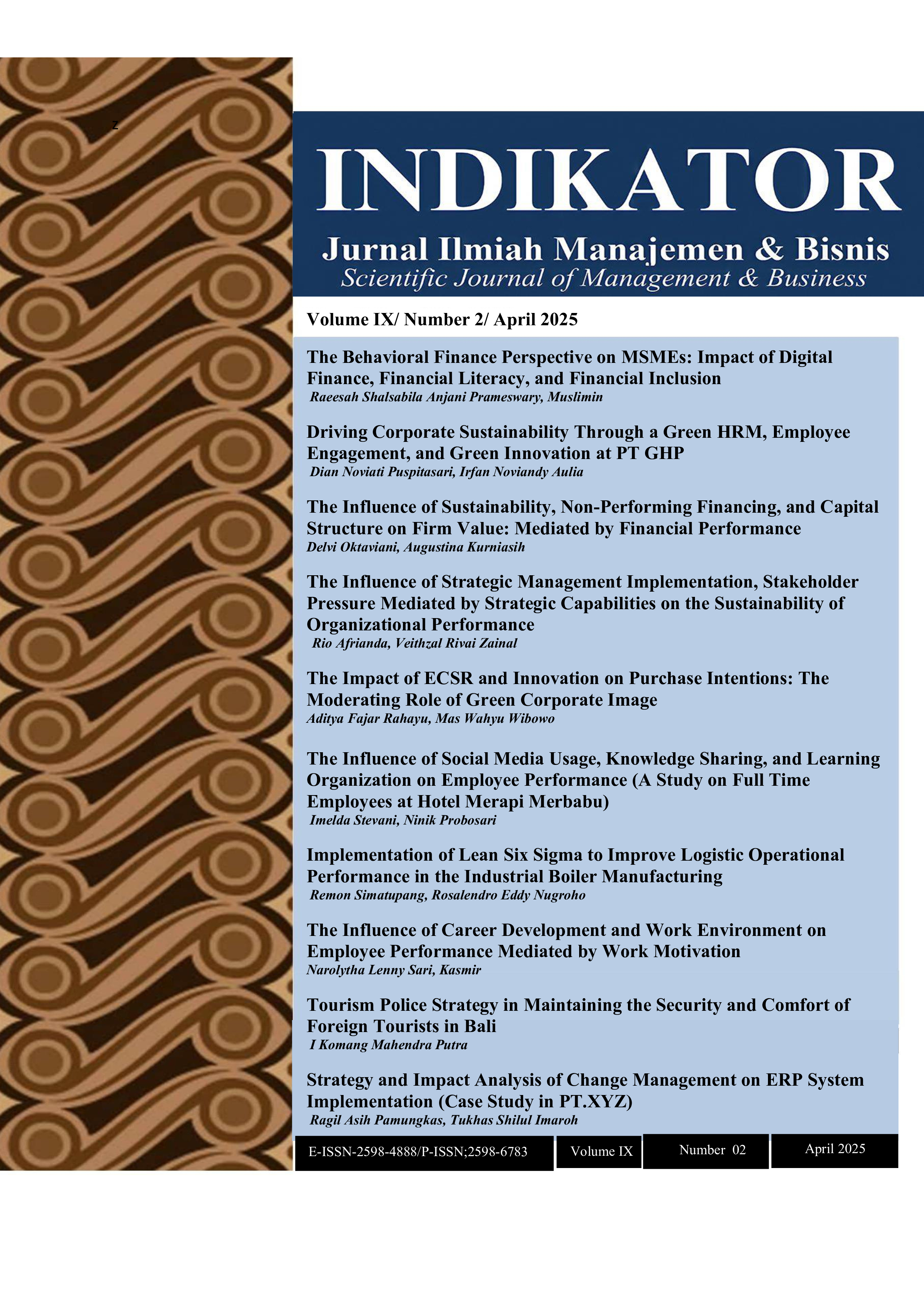
The Impact of ECSR and Innovation on Purchase Intentions: The Moderating Role of Green Corporate Image
DOI:
https://doi.org/10.22441/indikator.v9i2.32917Keywords:
Green Innovation, Environmental Corporate Social Responsibility, Service Innovation, Green Corporate Image, Purchase Intention,Abstract
This research examines how Green Innovation, ECSR, and Service Innovation affect Purchase Intention, utilizing Green Corporate Image as a moderator. Quantitative data from 233 procurement experts was obtained. The research analyzed data using SEM-PLS. Service Innovation strongly affects Purchase Intention, but Green Innovation and ECSR do not. However, Green Corporate Image enhances the link between ECSR and Purchase Intention while weakening Service Innovation. These results show that company image is critical to customer choices in sustainability-driven businesses.
Objectives: Sustainability has become a key concern for businesses, particularly in industries that rely on environmental resources. This study aims to explore how Green Innovation, Environmental Corporate Social Responsibility (ECSR), and Service Innovation influence Purchase Intention, with Green Corporate Image acting as a moderating factor. The goal is to provide insights into how companies in the integrated water supply sector can leverage sustainability-driven strategies to enhance consumer decision-making.
Finding: This study uses quantitative Structural Equation Modeling-Partial Least Squares. 233 procurement experts completed a 7-point Likert scale survey. Using SmartPLS 4, the research investigated variable associations for reliability and validity.
Conclusion: This study provides valuable insights into how businesses in the integrated water supply sector can integrate sustainability and innovation into their marketing strategies. While Service Innovation plays a crucial role, Green Innovation and ECSR require strong corporate branding to influence consumer behavior. Companies should focus on strengthening their environmental image while maintaining service excellence to maximize customer engagement. Future research should explore other moderating factors and examine industry-specific differences to refine sustainability-driven marketing strategies.References
Arachchi, H. A. D. M. (2023). In fl uence of corporate social responsibility and brand attitude on purchase intention. 27(3), 389–406. https://doi.org/10.1108/SJME-12-2021-0224
Bhattacharya, C. B., & Korschun, D. (2008). Stakeholder marketing: Beyond the four Ps and the customer. Journal of Public Policy & Marketing, 27(special issue), 113–116.
Chen, L., Qie, K., Memon, H., & Yesuf, H. M. (2021). The empirical analysis of green innovation for fashion brands, perceived value and green purchase intention-mediating and moderating effects. Sustainability (Switzerland), 13(8). https://doi.org/10.3390/su13084238
Chen, Y. S. (2008). The driver of green innovation and green image - Green core competence. Journal of Business Ethics, 81(3), 531–543. https://doi.org/10.1007/s10551-007-9522-1
Elkington, J. (1997a). Cannibals with forks: The triple bottom line of the 21st-century business. New Society Publishers.
Elkington, J. (1997b). Cannibals with forks: The triple bottom line of the 21st-century business. Capstone.
Elkington, J. (1998). Cannibals with forks: The triple bottom line of 21st-century business. Oxford: Capstone.
Elkington, J. (2006). Governance for sustainability. Corporate Governance: An International Review, 14(6), 522–529.
Freeman, R. E., Harrison, J. S., Wicks, A. C., Parmar, B. L., & De Colle, S. (2010). Stakeholder theory: The state of the art. Cambridge University Press.
García‐Avilés, J. A. (2020). Diffusion of Innovation. In The International Encyclopedia of Media Psychology (pp. 1–8). Wiley. https://doi.org/10.1002/9781119011071.iemp0137
Hair, J. F., Hult, G. T. M., Ringle, C. M., & Sarstedt, M. (2022). A primer on partial least squares structural equation modeling (PLS-SEM) (3rd ed.). SAGE Publications.
Jacobs, B. L. (2024). From CSR and TBL to ESG and the SDGs: Roots from resistance to regularization. Louisiana Law Review, 84(4), 1251–1262.
Ringle, C. M., Wende, S., and Becker, J.-M. 2024. "SmartPLS 4." Bönningstedt: SmartPLS, https://www.smartpls.com.
Rogers, E. M. (2003). Diffusion of innovations (5th ed.). New York, NY: Free Press.
Waris, I., Suki, N. M., Ahmed, A., & Barkat, W. (2024). Environmental corporate social responsibility initiatives and green customer citizenship behavior in tourism industry: the mediating roles of green trust, customer-company identification and green corporate image. Social Responsibility Journal, 20(6), 1138–1156. https://doi.org/10.1108/SRJ-07-2023-0378
Zameer, H., & Yasmeen, H. (2022). Green innovation and environmental awareness driven green purchase intentions. Marketing Intelligence and Planning, 40(5), 624–638. https://doi.org/10.1108/MIP-12-2021-0457.
Downloads
Additional Files
Published
How to Cite
Issue
Section
License
The copyright to this article is transferred to Universitas Mercu Buana (UMB) if and when the article is accepted for publication. The undersigned hereby transfers any and all rights in and to the paper including without limitation all copyrights to UMB. The undersigned hereby represents and warrants that the paper is original and that he/she is the author of the paper, except for material that is clearly identified as to its original source, with permission notices from the copyright owners where required. The undersigned represents that he/she has the power and authority to make and execute this assignment.
We declare that:
1. This paper has not been published in the same form elsewhere.
2. It will not be submitted anywhere else for publication prior to acceptance/rejection by this Journal.
3. A copyright permission is obtained for materials published elsewhere and which require this permission for reproduction.
Furthermore, I/We hereby transfer the unlimited rights of publication of the above mentioned paper in whole to UMB. The copyright transfer covers the exclusive right to reproduce and distribute the article, including reprints, translations, photographic reproductions, microform, electronic form (offline, online) or any other reproductions of similar nature.
The corresponding author signs for and accepts responsibility for releasing this material on behalf of any and all co-authors. This agreement is to be signed by at least one of the authors who have obtained the assent of the co-author(s) where applicable. After submission of this agreement signed by the corresponding author, changes of authorship or in the order of the authors listed will not be accepted.
Retained Rights/Terms and Conditions
1. Authors retain all proprietary rights in any process, procedure, or article of manufacture described in the Work.
2. Authors may reproduce or authorize others to reproduce the Work or derivative works for the authors personal use or for company use, provided that the source and the UMB copyright notice are indicated, the copies are not used in any way that implies UMB endorsement of a product or service of any employer, and the copies themselves are not offered for sale.
3. Although authors are permitted to re-use all or portions of the Work in other works, this does not include granting third-party requests for reprinting, republishing, or other types of re-use.
This work is also licensed under a Creative Commons Attribution-NonCommercial 4.0 International License.









