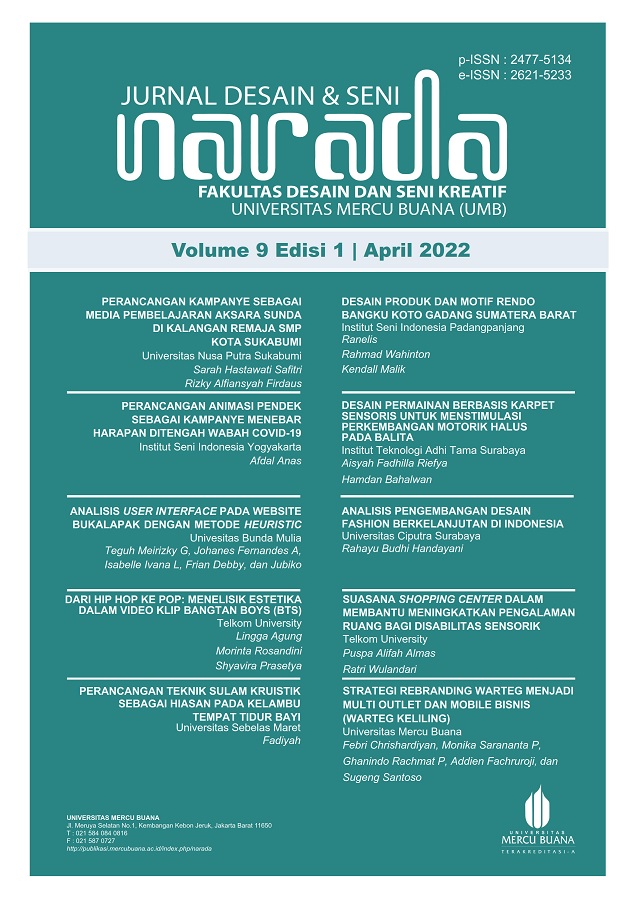
SUASANA SHOPPING CENTER DALAM MEMBANTU MENINGKATKAN PENGALAMAN RUANG BAGI DISABILITAS SENSORIK
DOI:
https://doi.org/10.22441/narada.2022.v9.i1.009Keywords:
Sensory disability, Shopping center, Spatial experienceAbstract
The problem of sensory disability is the ability to stimulate the senses that do not function properly. The shopping center as a public space is a place that can be used for everyone but doesn’t respond to the obstacles experienced by sensory disability. This study aims to provide information and recommendations regarding the design of shopping centers with a sensory approach to create a space experience based on their perspective. The analysis of the qualitative study was conducted by comparing the literature study on the design of a community center for the blind and deaf as a research method. The result of this research is the application of interior elements with a sensory approach can be implemented to improve the spatial experience of people with sensory disabilities in the shopping center. These results can also be accepted and used in a wider community. Based on this research, it can be used as a reference for optimizing shopping centers as public spaces that can answer the problems experienced by sensory disability.
Downloads
References
Agustin, S. (2021). Teknik Dasar Berkomunikasi dengan Penyandang Tunarungu. Dalam Alodokter, 26 November, Jakarta. Diambil dari: https://www.alodokter.com/teknik-dasar-berkomunikasi-dengan-penyandang-tunarungu
Broadbent, G., Ward, A., & Portsmouth College of Technology. School of Architecture. (1969). Design methods in architecture. New York: G. Wittenborn.
Devansari, C. S., & Rachmawati, M. (2017). Pusat Komunitas Tunarungu: Mata yang Mendengar. Jurnal Sains Dan Seni POMITS, 6(2), 53–58.
Ismandari, F. (2018). InfoDATIN: Disabilitas. Jakarta: Kemkes RI.
Lawson, B. (2005). How Designers Think (4th ed.). London: Taylor & Francis Group.
DOI:https://doi.org/10.4324/9780080454979
Lindstrom, M. (2005). Broad sensory branding. Journal of Product & Brand Management, 14(2), 84–87.
Pallasmaa, J. (2005). The Eyes of the Skin: Architecture and The Sense. New Jersey: John Wiley and Sons.
Pausy, M. M., Musyawaroh, & Nugroho, S. P. (2020). Fungsi Rekreatif Shopping Mall di Jakarta. SENTHONG, Vol.3(1).
Pujiono, D. W. (2021). Penyediaan Fasilitas Bagi Narapidana Penyandang Disabilitas Pada Lapas Kelas II A Bekasi. Nusantara : Jurnal Ilmu Pengetahuan Sosial, 8(2), 199–203.
Pratiwi, Y. S., & Rachmawati, M. (2016). Perancangan Pusat Komunitas Tunanetra Indonesia dengan Pendekatan Indera. Jurnal Sains Dan Seni, 5(2), 174–178.
DOI:https://doi.org/10.12962/j23373520.v5i2.18603
Rahmah, F. N. (2018). Problematika Anak Tunarungu dan Cara Mengatasinya. QUALITY: Journal of Empirical Research in Islamic Education, Vol. 6(1), 1-15.
Syafi’ie, M. (2014). Pemenuhan Aksesibilitas Bagi Penyandang Disabilitas. Inklusi 1(2), 269–290.
DOI:https://doi.org/10.14421/ijds.010208
Wulandari, H. (2014). Eksplorasi Pengalaman Panca Indera untuk Perancangan Interior. Dimensi Interior, 12(2), 85–90.
Downloads
Additional Files
Published
How to Cite
Issue
Section
License
A writer who will publish their article in the NARADA Journal of Design and Art agrees to the following conditions:
- The author owns the copyright and grants the rights to NARADA Journal of Design and Art as the party entrusted with publishing the article for the first time simultaneously licensed under the "Creative Commons Attribution-ShareAlike 4.0" License. This makes it possible for other people to share the work with a form of acknowledgment of authorship of the work and initial publication in this journal according to the authorship of the article provided.
- Authors may enter into separate additional contractual agreements for non-exclusive distribution of the published journal version of the work (e.g., posting it to an institutional repository or publishing it in a book) with acknowledgment of initial publication in the NARADA Journal of Design and Art.
- Authors are permitted and asked to post their work online (for example, institutional repositories or on personal websites) after the article publication process. This avoids double publication or multiple submissions which will affect the similarity of writing of the published work.
- In order to maintain the value of originality and similarity of articles sent or submitted. Authors are asked to temporarily remove or hide the original article from other online systems until they receive the results and decisions from the NARADA Journal of Design and Art regarding the decision to publish the article.
- The author, in this case the contributing author (Contributor Author), will be sent a form or letter stating the validity of the scientific work, signed on an IDR 10,000 stamp. Then the author will be asked to send the email to [email protected].
Pemberitahuan Hak Cipta
Seorang penulis yang akan menerbitkan artikelnya dalam NARADA Jurnal Desain dan Seni setuju dengan ketentuan berikut:
- Penulis memiliki hak cipta dan memberikan hak kepada pihak NARADA Jurnal Desain dan Seni sebagai pihak yang diberikan kepercayaan untuk mempublikasi artikelnya pertama kali secara bersamaan dilisensikan di bawah Lisensi "Creative Commons Attribution-ShareAlike 4.0". Hal ini memungkinkan kepada orang lain untuk membagi karya dengan bentuk pengakuan kepengarangan karya dan publikasi awal dalam jurnal ini sesuai dengan penulisan artikel yang diberikan.
- Penulis dapat membuat perjanjian kontrak tambahan yang terpisah untuk distribusi non-eksklusif versi jurnal yang diterbitkan dari karya tersebut (misalnya, mempostingnya ke repositori institusional atau menerbitkannya dalam sebuah buku) dengan pengakuan publikasi awal dalam NARADA Jurnal Desain dan Seni.
- Penulis diizinkan dan diminta untuk mempostingkan karyanya secara online (semisal, repositori institusional atau di situs web pribadi) setelah proses penerbitan artikel, Hal ini menghindari adanya double publikasi atau pengajuan jamak yang akan berpengaruh kepada adanya kesamaan penulisan dari karya yang diterbitkan.
- Demi menjaga nilai orisinalitas dan nilai kesamaan dari artikel yang dikirim atau diajukan. Penulis diminta untuk menghilangkan atau menyembunyikan secara sementara artikel orisinil dari sistem online lain yang sampai mendapatkan hasil nilai dan ketetapan dari pihak NARADA Jurnal Desain dan Seni mengenai keputusan publikasi dari artikel.
- Penulis dalam hal ini penulis kontributor (Contributor Author) akan dikirimkan form atau surat pernyataan keabsahan karya ilmiah, yang ditanda tangani di atas materai 10000. Dan selanjutnya penulis diminta untuk mengirimkan ke email [email protected].









