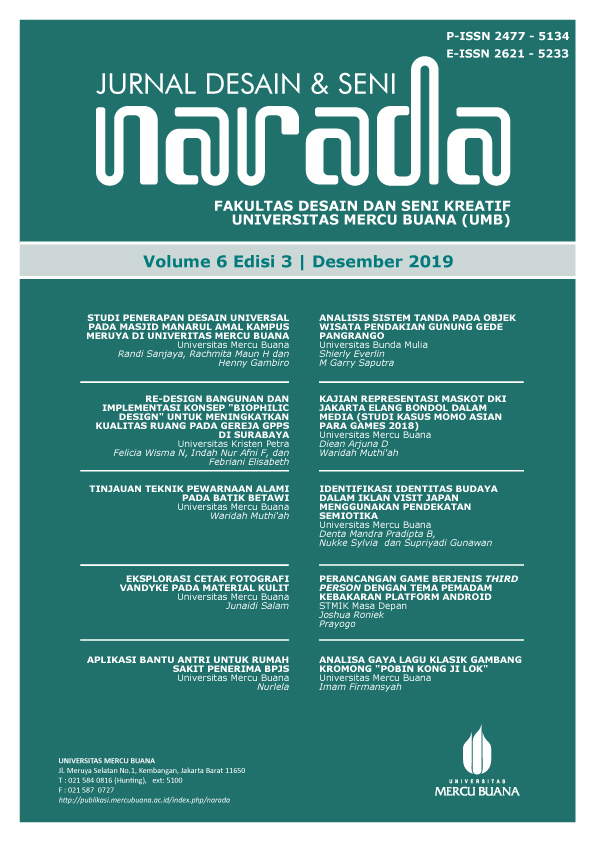
STUDI PENERAPAN DESAIN UNIVERSAL PADA MASJID MANARUL AMAL KAMPUS MERUYA DI UNIVERSITAS MERCU BUANA JAKARTA BARAT
DOI:
https://doi.org/10.22441/narada.2019.v6.i3.001Keywords:
Universal design, mosque, person with disabilities, Manarul AmalAbstract
Mosque design based on the universal design principle is a design concept for a mosque architecture that can be used by a person with disability users. Mosque as the center of religious activities is ‘Allah’s house’ where the congregation conducts praying. Shalat is essential to worship in Islam done at least five times a day and cannot be abandoned unless very specific condition happens (as explained in Al Qur’an). But in fact, hearing disability users still find difficulties in accessing mosques, most mosques are not accessible. This study aims to describe of study of universal design application at the Manarul Amal mosque on the Meruya campus at Mercu Buana University for a person with disabilities. The universal design principle is chosen based on the possibilities it provides to explore each potential tool to reduce or even eliminate the physical barrier for its users. This research method uses a qualitative descriptive method. The instrument of this study was researchers who were assisted with observation guidelines, interview guidelines and documentation guidelines based on the grid Minister of Public Works Regulation No. 14 / PRT / M / 2017. The steps of data analysis carried out include: data reduction, data presentation, and conclusion. The results showed that the interior elements in the Manarul Amal mosque were in form of circulation, guiding paths, ramps, prayer rooms, sermon rooms, ablution rooms, shelves for footwear (shoes and feet) and supporting facilities attributes that didn’t meet the standard. While the walls of a room aren’t equipped with handrail, lighting, and colors are sufficient to meet the standards and audiovisual that is around the prayer room without a TV text, visual alarm (sound calling when praying).
Downloads
References
_ .(2018). Data Gedung Masjid Kampus Meruya. Jakarta: BMGS Universitas Mercu Buana
Chiambretto, A & Asta K, T. (2016). DeafSpace individuality + integration in Gallaudet university by asta kronborg triilingsgaard . Washington DC: Gallaudet University
Harahap, R, M. (2019). Interiority of Public Spacei in The Deaf Exhibition Center in Bekasi. Sinergi Journal. Vol 23(3)
DOI: http://dx.doi.org/10.22441/sinergi.2019.3.009
Harahap, R, M. (2019). Through of Beach Space Design for Person with Disabilities Based on Universal Design Principles. Indonesian Journal of Disability Studies (IJDS). Vol. 6(1). Hal 7-1
Keumala, C, R, N. (2016). Pengaruh Konsep Desain Universal pada Mesjid bagi Difabel (Studi Kasus Masjid UIN Sunan Kalijaga dan Masjid Kampus Universitas Gadjah Mada. INKLUSI: Jurnal Disability Studies. Vol. 3(1).
Kurniawan, H. (2011): Familiarity in designing a mosque: a practice of universal design. Conference: UIA 2011 Tokyo World Congress Programme Work Programme - Architecture for All Regions I, II, III & IV - Oral Presentations at: Tokyo, Japan. September 2011.
DOI: 10.13140/RG.2.2.28069.19687
Laurens, J, M. (2005). Arsitektur dan Perilaku Manusia. Tangerang: PT. Grasindo
Mace, R, L. (1991). Accessible Environments: Toward Universal Design. New York: Van Nostrand Reinhold.
Mace, R. (2000). Universal Design: Housing for the Lifespan of All People. North Carolina: North Carolina State University.
Moleong, L. (2006). Metodologi Penelitian Kualitatif. Bandung: Remaja Rosdakarya.
Terok. F. (2015). Persepsi masyarakat terhadap elemen street furniture pedestrian koridor Jalan. Piere Tendean. Thesis Magister Arsitektur Universitas Sam Ratulangi, Manado.
Arch Daily: Taller The Arquitectura-Mauricio Rocha. (2001). Center for The Blind and Visually Impaired Taller de Arquitectura Mauricio Rocha. Diambil dari https://www.archdaily.com/158301/center-for-the-blind-and-visually-impaired-taller-de-arquitectura-mauricio-rocha
Downloads
Published
How to Cite
Issue
Section
License
A writer who will publish their article in the NARADA Journal of Design and Art agrees to the following conditions:
- The author owns the copyright and grants the rights to NARADA Journal of Design and Art as the party entrusted with publishing the article for the first time simultaneously licensed under the "Creative Commons Attribution-ShareAlike 4.0" License. This makes it possible for other people to share the work with a form of acknowledgment of authorship of the work and initial publication in this journal according to the authorship of the article provided.
- Authors may enter into separate additional contractual agreements for non-exclusive distribution of the published journal version of the work (e.g., posting it to an institutional repository or publishing it in a book) with acknowledgment of initial publication in the NARADA Journal of Design and Art.
- Authors are permitted and asked to post their work online (for example, institutional repositories or on personal websites) after the article publication process. This avoids double publication or multiple submissions which will affect the similarity of writing of the published work.
- In order to maintain the value of originality and similarity of articles sent or submitted. Authors are asked to temporarily remove or hide the original article from other online systems until they receive the results and decisions from the NARADA Journal of Design and Art regarding the decision to publish the article.
- The author, in this case the contributing author (Contributor Author), will be sent a form or letter stating the validity of the scientific work, signed on an IDR 10,000 stamp. Then the author will be asked to send the email to [email protected].
Pemberitahuan Hak Cipta
Seorang penulis yang akan menerbitkan artikelnya dalam NARADA Jurnal Desain dan Seni setuju dengan ketentuan berikut:
- Penulis memiliki hak cipta dan memberikan hak kepada pihak NARADA Jurnal Desain dan Seni sebagai pihak yang diberikan kepercayaan untuk mempublikasi artikelnya pertama kali secara bersamaan dilisensikan di bawah Lisensi "Creative Commons Attribution-ShareAlike 4.0". Hal ini memungkinkan kepada orang lain untuk membagi karya dengan bentuk pengakuan kepengarangan karya dan publikasi awal dalam jurnal ini sesuai dengan penulisan artikel yang diberikan.
- Penulis dapat membuat perjanjian kontrak tambahan yang terpisah untuk distribusi non-eksklusif versi jurnal yang diterbitkan dari karya tersebut (misalnya, mempostingnya ke repositori institusional atau menerbitkannya dalam sebuah buku) dengan pengakuan publikasi awal dalam NARADA Jurnal Desain dan Seni.
- Penulis diizinkan dan diminta untuk mempostingkan karyanya secara online (semisal, repositori institusional atau di situs web pribadi) setelah proses penerbitan artikel, Hal ini menghindari adanya double publikasi atau pengajuan jamak yang akan berpengaruh kepada adanya kesamaan penulisan dari karya yang diterbitkan.
- Demi menjaga nilai orisinalitas dan nilai kesamaan dari artikel yang dikirim atau diajukan. Penulis diminta untuk menghilangkan atau menyembunyikan secara sementara artikel orisinil dari sistem online lain yang sampai mendapatkan hasil nilai dan ketetapan dari pihak NARADA Jurnal Desain dan Seni mengenai keputusan publikasi dari artikel.
- Penulis dalam hal ini penulis kontributor (Contributor Author) akan dikirimkan form atau surat pernyataan keabsahan karya ilmiah, yang ditanda tangani di atas materai 10000. Dan selanjutnya penulis diminta untuk mengirimkan ke email [email protected].









