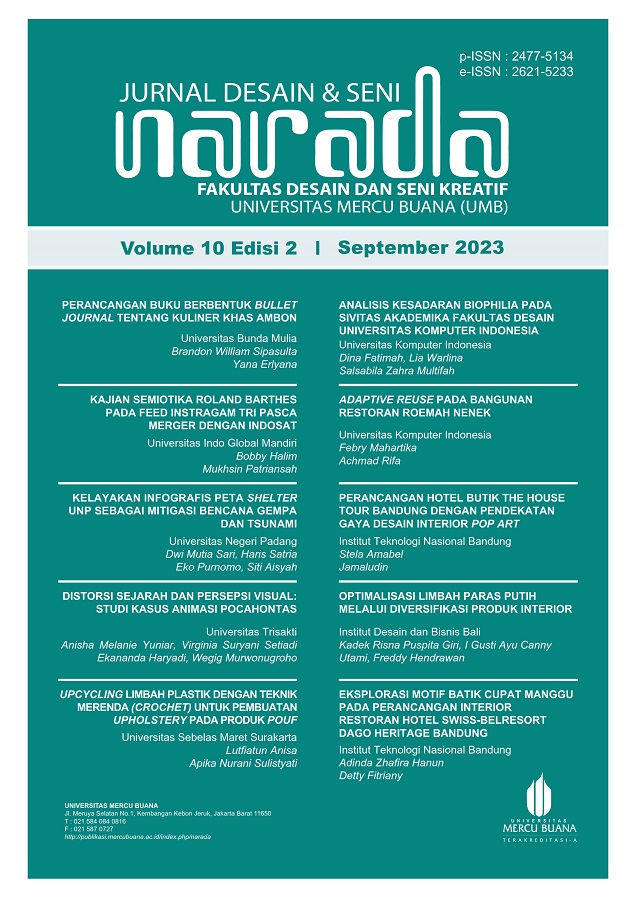
DISTORSI SEJARAH DAN PERSEPSI VISUAL: STUDI KASUS ANIMASI POCAHONTAS
DOI:
https://doi.org/10.22441/narada.2023.v10.i2.004Keywords:
Animation of Pocahontas, children's literature, historical perception in literature, story reconstructionAbstract
As a form of children's literature, animated films are reflective illustrations of real life whose consumers are segmented as children. However, children's literary production is often ambivalent. The reason is that children's literature must arouse the imagination (in order to fulfill the elements of literature) while depicting real life that represents facts (in order to fulfill the requirements for reflection and representation of life). If animation is used to retell past history, then the major premise narrated by the animation must be representative of actual events (valid in terms of the information source). This research seeks to achieve two things, namely: discussing the extent of historical distortion in the Pocahontas animation as literature, and revealing the audience's meaning of the message content in the Pocahontas animation. This research was carried out qualitatively using the structuralism semiotic analysis method introduced by Ferdinand de Saussure. The results of this research reveal that the historical reconstruction in the Pocahontas animation is indeed distorted. However, this deviation is still at a normal stage as children's literature. The Pocahontas animation does not qualify as a historical reconstruction. It only qualifies as children's literature intended for entertainment purposes. Moreover, there is the addition of the wrong romantic element. According to a semiotic analysis of audience perception, this distortion is not a serious problem for viewers in Indonesia (who incidentally do not know the historical events behind the character Pocahontas). Meanwhile, for Americans, especially native Americans, this distortion is an ethical problem that literary producers and critics need to pay attention to.
Downloads
References
Adzani, F., & Murwonugroho, W. (2021). Pentingnya kesesuaian visual karakter tokoh dalam film animasi “My little pony: The movie.” Jurnal Penelitian Dan Karya Ilmiah Lembaga Penelitian Universitas Trisakti, 6(1), 68–84.
DOI:https://doi.org/10.25105/pdk.v6i1.8630
Andelina, I. R. (2020). Analisis elemen dalam penciptaan karakter desain di dalam Ip Hypnosis Mic - Seiyuu X Rapper Project. Narada Jurnal Desain Dan Seni, 7(2), 137.
DOI:https://doi.org/10.22441/narada.2020.v7.i2.001
Buescher, D. T., & Ono, K. A. (2015). Civilized colonialism: Pocahontas as neocolonial rhetoric. Women’s Studies in Communication, 19(2), 127–153.
DOI:https://doi.org/10.1080/07491409.1996.11089810
Byrskog, S. (2002). Story as history - history as story. Boston, Leiden: Brill Academic Publishers.
Clément, T. (2020). The art of Walt Disney animation studios: Movement by nature. InMedia: The French Journal of Media Studies, 6.
DOI:https://doi.org/10.4000/inmedia.877
Feest, C. F. (2007). Native Americans, history and the environment. In U. Lehmkuhl & H. Wellenreuther (Eds.), Historians and nature (Issue March). Berg.
Feest, C. F., & Mossiker, F. (1977). Pocahontas: The life and the legend. Ethnohistory, 24(3), 272.
DOI:https://doi.org/10.2307/481702
Huber, M. W. (2013). Pocahontas and Rebecca : Two tales of a captive. Proceedings of the Annual Meeting of the Southern Anthropological Society, 42(1), 75–102.
Kartodirdjo, S. (1992). Pendekatan ilmu sosial dalam metodologi sejarah. Jakarta: Gramedia Pustaka Utama.
Kuntowijoyo. (2013). Pengantar ilmu sejarah. Yogyakarta: Tiara Wacana.
Kupperman, K. O. (2019). Pocahontas and the English boys: Caught between cultures in early Virginia. New York University Press.
M. Wardaya, AI Saidi, W.Murwonugroho. Karakteristik Buku Anak yang Memorable dalam Membangun Karakter Anak. Jurnal Seni & Reka Rancang. 2(2), April 2020, pp 199-206.
DOI:https://doi.org/10.25105/jsrr.v2i2.8233
Miftakhuddin, M. (2020). Kolonialisme: Eksploitasi dan pembangunan menuju hegemoni. Sukabumi: Jejak.
Miles, M. B., Huberman, A. M., & Saldana, J. (2014). Qualitative data analysis: A methods sourcebook (3rd ed.). United State: Sage Publication.
Mitchell, D., Waterbury, P., & Casement, R. (2002). Children’s literature: An invitation to the world. Boston: Allyn and Bacon.
Montón, L. S. J. (2020). "Pocahontas: A Study of Disney’s Approach to English Colonialism". [Thesis]. Spanyol: Filología Inglesa y Alemana y Traducción e Interpretación, Universidad Del País Vasco.
NABS Research Center Online Exhibits. (2010). The true story of Pocahontas. United State: Salisbury University Libraries.https://libapps.salisbury.edu/nabb-online/exhibits/show/native-americans-then-and-now/introduction/how-is-indigenous-history-port/the-true-story-of-pocahontas#:~:text=Pocahontas is one story that,portray or represent historical events.
Nurgiyantoro, B. (2016). Sastra anak: Pengantar pemahaman dunia anak. Yogyakarta: Gadjah Mada University Press.
Ocasio, G. (2012). Matoaka, one who kindles (Also known as Pocahontas). InTensions, 5(5), 1–5.
DOI:https://doi.org/10.25071/1913-5874/37375
Price, D. A. (2023). "Pocahontas: Powhatan princess". Britannica.Com, 2023, July. Chicago. Diambil dari: https://www.britannica.com/biography/Pocahontas-Powhatan-princess
Ranang, B. A. (2010). Animasi kartun dari analog sampai digital. Jakarta: Indeks.
Smith, E. B. (2008). The story of Pocahontas and captain John Smith. Project Gutenberg.
Stebbins, S. J. (2010). "Historic Jamestowne: Part of colonial national historical park virginia". National Park Service, 2010 August. Virginia. Diambil dari: https://www.nps.gov/jame/learn/historyculture/pocahontas-her-life-and-legend.htm
Stewig, J. W. (2013). Children’s preference in picture book illustration. Education Leadership Journal, 31(2), 273–279.
Swatriani, R. (2020a). Konstruksi karakter Jabo dalam animasi Binekon. Narada : Jurnal Desain Dan Seni, 7(1), 31-44
DOI:https://doi.org/10.22441/narada.2020.v7.i1.003
Swatriani, R. (2020b). Representasi budaya nusantara dalam animasi Binekon. Jurnal Narada, 7(3), 287–306.
DOI:https://doi.org/10.2241/narada.2020.v7.i3.001
Taberham, P. (2020). Defining experimental animation: A follow-up. Animation Practice, Process & Production, 8(1), 11–31.
Downloads
Published
How to Cite
Issue
Section
License
A writer who will publish their article in the NARADA Journal of Design and Art agrees to the following conditions:
- The author owns the copyright and grants the rights to NARADA Journal of Design and Art as the party entrusted with publishing the article for the first time simultaneously licensed under the "Creative Commons Attribution-ShareAlike 4.0" License. This makes it possible for other people to share the work with a form of acknowledgment of authorship of the work and initial publication in this journal according to the authorship of the article provided.
- Authors may enter into separate additional contractual agreements for non-exclusive distribution of the published journal version of the work (e.g., posting it to an institutional repository or publishing it in a book) with acknowledgment of initial publication in the NARADA Journal of Design and Art.
- Authors are permitted and asked to post their work online (for example, institutional repositories or on personal websites) after the article publication process. This avoids double publication or multiple submissions which will affect the similarity of writing of the published work.
- In order to maintain the value of originality and similarity of articles sent or submitted. Authors are asked to temporarily remove or hide the original article from other online systems until they receive the results and decisions from the NARADA Journal of Design and Art regarding the decision to publish the article.
- The author, in this case the contributing author (Contributor Author), will be sent a form or letter stating the validity of the scientific work, signed on an IDR 10,000 stamp. Then the author will be asked to send the email to [email protected].
Pemberitahuan Hak Cipta
Seorang penulis yang akan menerbitkan artikelnya dalam NARADA Jurnal Desain dan Seni setuju dengan ketentuan berikut:
- Penulis memiliki hak cipta dan memberikan hak kepada pihak NARADA Jurnal Desain dan Seni sebagai pihak yang diberikan kepercayaan untuk mempublikasi artikelnya pertama kali secara bersamaan dilisensikan di bawah Lisensi "Creative Commons Attribution-ShareAlike 4.0". Hal ini memungkinkan kepada orang lain untuk membagi karya dengan bentuk pengakuan kepengarangan karya dan publikasi awal dalam jurnal ini sesuai dengan penulisan artikel yang diberikan.
- Penulis dapat membuat perjanjian kontrak tambahan yang terpisah untuk distribusi non-eksklusif versi jurnal yang diterbitkan dari karya tersebut (misalnya, mempostingnya ke repositori institusional atau menerbitkannya dalam sebuah buku) dengan pengakuan publikasi awal dalam NARADA Jurnal Desain dan Seni.
- Penulis diizinkan dan diminta untuk mempostingkan karyanya secara online (semisal, repositori institusional atau di situs web pribadi) setelah proses penerbitan artikel, Hal ini menghindari adanya double publikasi atau pengajuan jamak yang akan berpengaruh kepada adanya kesamaan penulisan dari karya yang diterbitkan.
- Demi menjaga nilai orisinalitas dan nilai kesamaan dari artikel yang dikirim atau diajukan. Penulis diminta untuk menghilangkan atau menyembunyikan secara sementara artikel orisinil dari sistem online lain yang sampai mendapatkan hasil nilai dan ketetapan dari pihak NARADA Jurnal Desain dan Seni mengenai keputusan publikasi dari artikel.
- Penulis dalam hal ini penulis kontributor (Contributor Author) akan dikirimkan form atau surat pernyataan keabsahan karya ilmiah, yang ditanda tangani di atas materai 10000. Dan selanjutnya penulis diminta untuk mengirimkan ke email [email protected].









