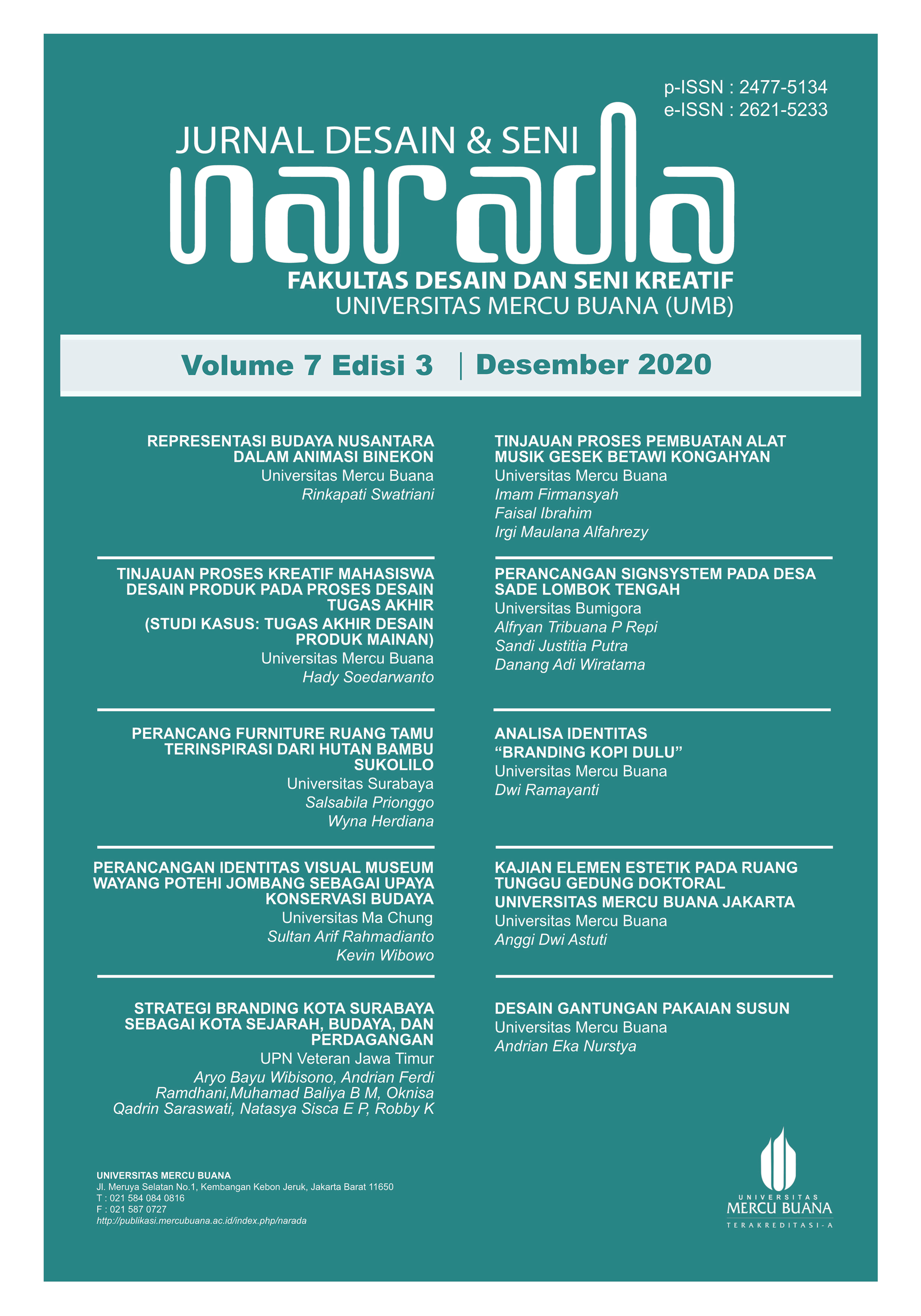
REPRESENTASI BUDAYA NUSANTARA DALAM ANIMASI BINEKON
DOI:
https://doi.org/10.22441/narada.2020.v7.i3.001Keywords:
Animation, Semiotic, RepresentationAbstract
The characters contained in the Binekon animation are "representatives" of the culture that exists in Indonesia. Similar to a film, animation also has elements of construction and social representation that want to be built by giving meaning in the reality that occurs in society. Researchers will focus on discussing how the portrayal of binekon animated characters is represented from the social reality of the ethnic / racial communities of the Archipelago with the Pierce semiotic method. The triadic sign model proposed by Pierce, is depicted simply with three points, namely the sign, object, and interpreter. The hallmarks of this study are the characters found in the animations, with the visuals present in each character, then the intepretant is the archipelago culture. And the results of the study showed every character contained in the Binekon animation by Belantara Studio is a cultural representation of the archipelago that represents the major islands in Indonesia, namely Sumi from Sumatra, Jabo from Java, Kale from Kalimantan Island, Sula from Sulawesi Island, and Papu from Papua Island.
Downloads
References
Aqli, W. (2011). Anatomi Bubungan Tinggi SEbagai Rumah TRadisional Utama Dalam Kelompok Rumah Banjar. Jakarta: UMJ.
Carter, D. E. (2003). The Big Book of Color in Design. New York: HDI.
Djono., Utomo, T. P., & Subiyantoro, S. (2012). Nilai Kearifan Lokal Rumah Tradisional Jawa. Jurnal Humaniora, Vol.24 (3) Oktober 2012. Surakarta: Universitas Sebelas Maret.
Eco, U. (2011). Teori Semiotika: Signifikasi Komunikasi, Teori Kode, serta Teori Produksi Tanda. Yogyakarta: Kreasi Wacana.
Fiske, J. (2011). Cultural and Communication Studies: Sebuah Pengantar Paling Komprehensif. Yogyakarta: Jalasutra.
Giles, J., & Middleton, T. (1999). Studying Culture: A Practical Introduction. United Kingdom: Blackwell Publisher.
Habibi, G. (2018). Rumah Gadang yang Tahan Gempa. Jakarta: Badan Pengembangan dan Pembinaan Bahasa.
Juliastuti, N. (2000). Teori Sosiologi Modern. Jakarta: Kencana.
Leonaldy, I, Fretisari, I. (2014). Motif Dayak. Pontianak: Program Studi Pendidikan Seni dan Tari Musik Untan.
Madsen, R. (1996). Animation Film Concepts, Methods, and Uses. United Kingdom: Interland Pub.
Ranang, B, Asmoro. (2010). Animasi Kartun Dari Analog Sampai Digital. Jakarta: Indeks.
Rumansara, E, H. (2014). Seni Ukir Asmat. Yogyakarta: Kepel Press.
Shekelle, M. (2008). Distribution of Tarsier Acoustic Froms North and Central Sulawesi: With Notes on The Priary Taxonomy of Sulawesi’s Tarsiers. Jakarta: LIPI Press. 35-50.
Sultan, St. H., Mayasari, K. (2014). Teknologi dan Konstruksi Rumah Tradisional Toraja (Tongkonan). Balai Pengembangan Teknologi Perumahan Tradisional Makassar. Jurnal Masalah Bangunan Vol.49(1), 40-45.
Suprayitno., & Ariesta, I. (2014). Makna Simbolik Dibalik Lurik Solo-Yogyakarta. Jurnal Humaniora, Vol. 5(2), 842-851.
DOI: https://doi.org/10.21512/humaniora.v5i2.3150
Syahbani, M. S. (2020). Talawang. Jurnal Canthing, Vol.6 (1), 51-74.
Windhiari, W. D. (2018). Bimo Profesor Honai. Jakarta: Badan Pengembangan dan Pembinaan Bahasa.
Zusneli, Z. (2002). Pempek Palembang. Padang: Balai Pelestarian Nilai Budaya Padang.
Downloads
Published
How to Cite
Issue
Section
License
A writer who will publish their article in the NARADA Journal of Design and Art agrees to the following conditions:
- The author owns the copyright and grants the rights to NARADA Journal of Design and Art as the party entrusted with publishing the article for the first time simultaneously licensed under the "Creative Commons Attribution-ShareAlike 4.0" License. This makes it possible for other people to share the work with a form of acknowledgment of authorship of the work and initial publication in this journal according to the authorship of the article provided.
- Authors may enter into separate additional contractual agreements for non-exclusive distribution of the published journal version of the work (e.g., posting it to an institutional repository or publishing it in a book) with acknowledgment of initial publication in the NARADA Journal of Design and Art.
- Authors are permitted and asked to post their work online (for example, institutional repositories or on personal websites) after the article publication process. This avoids double publication or multiple submissions which will affect the similarity of writing of the published work.
- In order to maintain the value of originality and similarity of articles sent or submitted. Authors are asked to temporarily remove or hide the original article from other online systems until they receive the results and decisions from the NARADA Journal of Design and Art regarding the decision to publish the article.
- The author, in this case the contributing author (Contributor Author), will be sent a form or letter stating the validity of the scientific work, signed on an IDR 10,000 stamp. Then the author will be asked to send the email to [email protected].
Pemberitahuan Hak Cipta
Seorang penulis yang akan menerbitkan artikelnya dalam NARADA Jurnal Desain dan Seni setuju dengan ketentuan berikut:
- Penulis memiliki hak cipta dan memberikan hak kepada pihak NARADA Jurnal Desain dan Seni sebagai pihak yang diberikan kepercayaan untuk mempublikasi artikelnya pertama kali secara bersamaan dilisensikan di bawah Lisensi "Creative Commons Attribution-ShareAlike 4.0". Hal ini memungkinkan kepada orang lain untuk membagi karya dengan bentuk pengakuan kepengarangan karya dan publikasi awal dalam jurnal ini sesuai dengan penulisan artikel yang diberikan.
- Penulis dapat membuat perjanjian kontrak tambahan yang terpisah untuk distribusi non-eksklusif versi jurnal yang diterbitkan dari karya tersebut (misalnya, mempostingnya ke repositori institusional atau menerbitkannya dalam sebuah buku) dengan pengakuan publikasi awal dalam NARADA Jurnal Desain dan Seni.
- Penulis diizinkan dan diminta untuk mempostingkan karyanya secara online (semisal, repositori institusional atau di situs web pribadi) setelah proses penerbitan artikel, Hal ini menghindari adanya double publikasi atau pengajuan jamak yang akan berpengaruh kepada adanya kesamaan penulisan dari karya yang diterbitkan.
- Demi menjaga nilai orisinalitas dan nilai kesamaan dari artikel yang dikirim atau diajukan. Penulis diminta untuk menghilangkan atau menyembunyikan secara sementara artikel orisinil dari sistem online lain yang sampai mendapatkan hasil nilai dan ketetapan dari pihak NARADA Jurnal Desain dan Seni mengenai keputusan publikasi dari artikel.
- Penulis dalam hal ini penulis kontributor (Contributor Author) akan dikirimkan form atau surat pernyataan keabsahan karya ilmiah, yang ditanda tangani di atas materai 10000. Dan selanjutnya penulis diminta untuk mengirimkan ke email [email protected].









