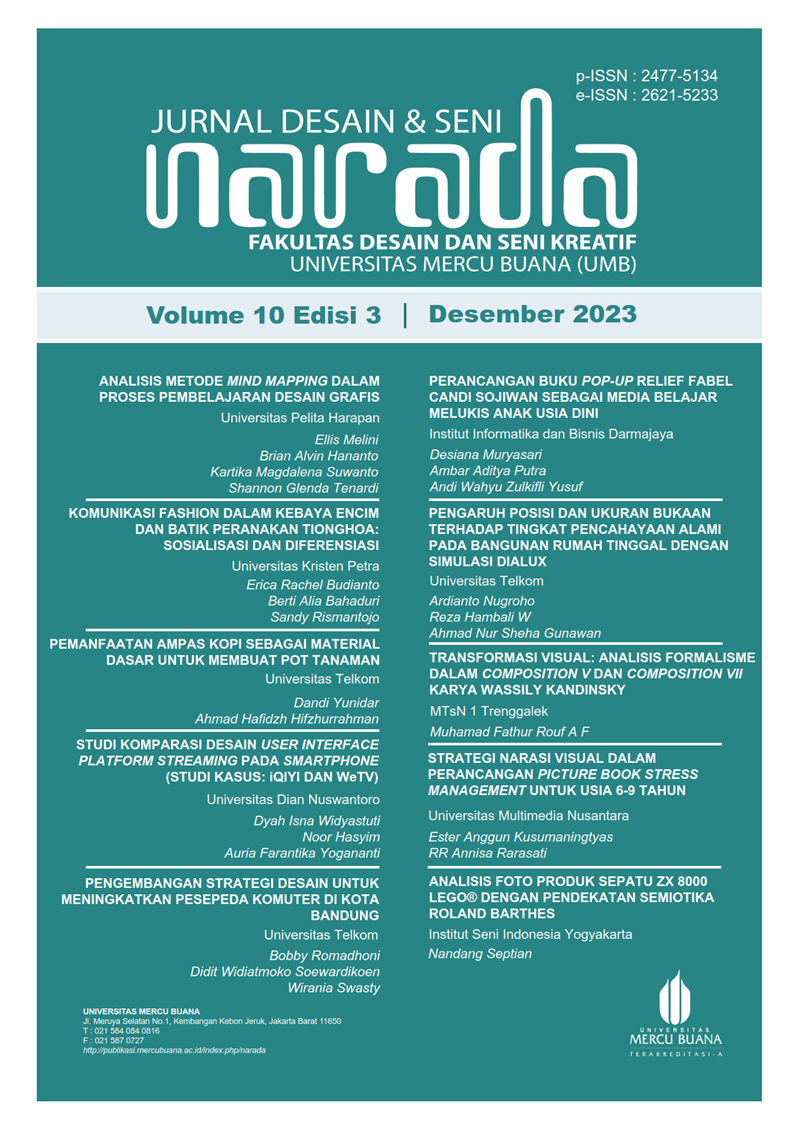
STRATEGI NARASI VISUAL DALAM PERANCANGAN PICTURE BOOK STRESS MANAGEMENT UNTUK USIA 6-9 TAHUN
DOI:
https://doi.org/10.22441/narada.2023/v10.i3.009Keywords:
Picture Book, Visual Literacy, Visual Narration, Psychology, StressAbstract
The stress experience in the childhood poses significant and enduring risks to both physical and psychological development. Stress not only adversely affects physical health but also correlates with serious issues such as suicide, psychological symptoms, depression, and school dropout rates. The age of 6-9 years is a period of transition in exploratory learning and playing to formal schooling with exams so that this age is vulnerable to early stress. The activity of reading books that children and parents do can provide a sense of comfort, thereby reducing children's stress. Picture books are believed to be related to the formation of children's character, introduce concepts, and have a positive impact on the world of children. The visual narrative implied in the picture book can be a visual approach that attracts children. Until now, there has not been much research discussing visual narrative stress management for children aged 6-9 years. Research on book design using a visual narrative approach to introducing stress management as an alternative solution to problems needs to be carried out and studied. This study aims to design a visual narrative strategy that is implemented in a picture book illustration with the theme of stress management. This study uses a qualitative approach with literature studies, document studies, observations, and interviews to design the visual narrative’s strategy. The finding is that a visual narrative approach of contradiction, metaphor, and humor in children's books can be a illustration approach that provides comfort and a relaxing effect with easy-to-see illustrations.
Downloads
References
Afifi, T. D., Harrison, K., Zamanzadeh, N., & Callejas, M. A. (2020). Testing the Theory of Resilience and Relational Load in Dual Career Families: Relationship Maintenance as Stress Management. Journal of Applied Communication Research, 48(1), 5–25.
DOI:https://doi.org/10.1080/00909882.2019.1706097
Aqiela, H. S., & Sihombing, R. M. (2023). Analisis Ilustrasi Buku Anak sebagai Media Edukasi Stress dan Depresi kepada Anak. Imatype: Journal of Graphic Design Studies, 2(2), 79–88.
DOI:https://doi.org/10.37312/imatype.v2i2.7457
Beckman, R. (2018). Lucy Takes the Stage: a Story for Children with Anxiety. Bank Street. https://educate.bankstreet.edu/independent-studies/202
Bhargava, D., & Trivedi, H. (2018). A Study of Causes of Stress and Stress Management among Youth. IRA-International Journal of Management & Social Sciences, 11(3), 108–117.
DOI:https://doi.org/10.21013/jmss.v11.n3.p1
Franke, H. A. (2014). Toxic Stress: Effects, Prevention and Treatment. Children, 1(3), 390–402.
DOI:https://doi.org/10.3390/children1030390
Garner, P. W., & Parker, T. S. (2018). Young Children’s Picture-Books as a Forum for the Socialization of Emotion. Journal of Early Childhood Research, 16(3), 291–304.
DOI:https://doi.org/10.1177/1476718X18775760
Ghozalli, E. (2020). Panduan Mengilustrasi dan Mendesain Cerita Anak untuk Tenaga Profesional. Pusat Pembinaan Bahasa dan Sastra, Badan Pengembangan dan Pembinaan Bahasa, Kementerian Pendidikan dan Kebudayaan, Republik Indonesia.
Harini, N. (2013). Terapi Warna untuk Megurangi Kecemasan. Jurnal Ilmiah Psikologi Terapan, 1(2), 291–303.
DOI:https://doi.org/10.22219/jipt.v1i2.1584
Hasibuan, I. S., Anggraini, S., Hasibuan, Q., & Hasibuan, I. W. (2022). Implementasi Desain Ruang Kelas dalam Meningkatkan Kenyamanan Belajar Anak di RA AL-Ihsan. Pema: Jurnal Pendidikan Dan Pengabdian Kepada Masyarakat, 2(3), 200–207.
DOI:https://doi.org/10.56832/pema.v2i3.307
Lori, L. (2013). Stress Free Kids: a Parent’s Guide to Helping Build Self-Esteem, Manage Stress, and Reduce Anxiety in Children. Adams Media.
Moruzi, K., Chen, S.-W. S., & Venzo, P. (2021). Public Health, Polio, and Pandemics: Fear and Anxiety about Health in Children’s Literature. Children’s Literature in Education, 53, 97–111.
DOI:https://doi.org/10.1007/s10583-021-09439-8
Mufdi T, A., Ernawati, D., & Tranggono, T. (2020). Perancangan Produk Multifunction Box yang Ergonomis dengan menggunakan Metode Pahl & Beitz. Juminten: Jurnal Manajemen Industri Dan Teknologi, 1(5), 1–12.
Mulyati, M. I. (2022). Studi Pemilihan Warna terhadap Interior Kamar Praktek Dokter dan Ruang Tunggunya Anak Berkaitan terhadap Tingkat Stres Pasien. Jurnal Pendidikan Dan Konseling, 4(6), 7464–7468.
DOI:https://doi.org/10.31004/jpdk.v4i6.9519
Paramarta, F. N. (2021). Konsep Interior Ruang Fisioterapi Anak Berkebutuhan Khusus pada Klinik Anak Usia 1-5 Tahun. Akselerasi: Jurnal Ilmiah Nasional, 3(1), 42–49.
DOI:https://doi.org/10.54783/jin.v3i1.358
Rohmiyati, Y. (2019). Proses Pelaksanaan Biblioterapi sebagai Alternatif Penyembuhan Individu melalui Membaca Buku. Anuva Jurnal Kajian Budaya, Perpustakaan, Dan Informasi, 3(1), 11–17.
DOI:https://doi.org/10.14710/anuva.3.1.11-17
Sari, A. S. P., Lestari, N. E., & Istiani, H. G. (2021). Storytelling using Picture Books Reduces Anxiety in Hospitalized Preschool Children. Jurnal Ilmiah Ilmu Keperawatan Indonesia, 11(3), 142.
DOI:145. https://doi.org/10.33221/jiiki.v11i03.1350
Sekhavatpour, Z., Khanjani, N., Reyhani, T., Ghaffari, S., & Dastoorpoor, M. (2019). The Effect of Storytelling on Anxiety and Behavioral Disorders in Children Undergoing Surgery: a Randomized Controlled Trial. Pediatric Health, Medicine and Therapeutics, 2019:10, 61–68.
DOI:https://doi.org/10.2147/PHMT.S201653
Serafini, F., & Coles, R. (2015). Humor in Children’s Picture Books. Reading Teacher, 68(8), 636–638.
DOI:https://doi.org/10.1002/trtr.1361
Templeton, T. (2020). Picture Perfect: the Role of Picture Books in a Secondary Classroom. Scan: The Journal for Educators, 39(6), 17–20.
Utami, D. P., Melliani, D., Maolana, F. N., Marliyanti, F., & Hidayat, A. (2021). Iklim Organisasi Kelurahan dalam Perspektif Ekologi. JIP: Jurnal Inovasi Penelitian, 1(12), 2735–2742.
Downloads
Published
How to Cite
Issue
Section
License
A writer who will publish their article in the NARADA Journal of Design and Art agrees to the following conditions:
- The author owns the copyright and grants the rights to NARADA Journal of Design and Art as the party entrusted with publishing the article for the first time simultaneously licensed under the "Creative Commons Attribution-ShareAlike 4.0" License. This makes it possible for other people to share the work with a form of acknowledgment of authorship of the work and initial publication in this journal according to the authorship of the article provided.
- Authors may enter into separate additional contractual agreements for non-exclusive distribution of the published journal version of the work (e.g., posting it to an institutional repository or publishing it in a book) with acknowledgment of initial publication in the NARADA Journal of Design and Art.
- Authors are permitted and asked to post their work online (for example, institutional repositories or on personal websites) after the article publication process. This avoids double publication or multiple submissions which will affect the similarity of writing of the published work.
- In order to maintain the value of originality and similarity of articles sent or submitted. Authors are asked to temporarily remove or hide the original article from other online systems until they receive the results and decisions from the NARADA Journal of Design and Art regarding the decision to publish the article.
- The author, in this case the contributing author (Contributor Author), will be sent a form or letter stating the validity of the scientific work, signed on an IDR 10,000 stamp. Then the author will be asked to send the email to [email protected].
Pemberitahuan Hak Cipta
Seorang penulis yang akan menerbitkan artikelnya dalam NARADA Jurnal Desain dan Seni setuju dengan ketentuan berikut:
- Penulis memiliki hak cipta dan memberikan hak kepada pihak NARADA Jurnal Desain dan Seni sebagai pihak yang diberikan kepercayaan untuk mempublikasi artikelnya pertama kali secara bersamaan dilisensikan di bawah Lisensi "Creative Commons Attribution-ShareAlike 4.0". Hal ini memungkinkan kepada orang lain untuk membagi karya dengan bentuk pengakuan kepengarangan karya dan publikasi awal dalam jurnal ini sesuai dengan penulisan artikel yang diberikan.
- Penulis dapat membuat perjanjian kontrak tambahan yang terpisah untuk distribusi non-eksklusif versi jurnal yang diterbitkan dari karya tersebut (misalnya, mempostingnya ke repositori institusional atau menerbitkannya dalam sebuah buku) dengan pengakuan publikasi awal dalam NARADA Jurnal Desain dan Seni.
- Penulis diizinkan dan diminta untuk mempostingkan karyanya secara online (semisal, repositori institusional atau di situs web pribadi) setelah proses penerbitan artikel, Hal ini menghindari adanya double publikasi atau pengajuan jamak yang akan berpengaruh kepada adanya kesamaan penulisan dari karya yang diterbitkan.
- Demi menjaga nilai orisinalitas dan nilai kesamaan dari artikel yang dikirim atau diajukan. Penulis diminta untuk menghilangkan atau menyembunyikan secara sementara artikel orisinil dari sistem online lain yang sampai mendapatkan hasil nilai dan ketetapan dari pihak NARADA Jurnal Desain dan Seni mengenai keputusan publikasi dari artikel.
- Penulis dalam hal ini penulis kontributor (Contributor Author) akan dikirimkan form atau surat pernyataan keabsahan karya ilmiah, yang ditanda tangani di atas materai 10000. Dan selanjutnya penulis diminta untuk mengirimkan ke email [email protected].









