
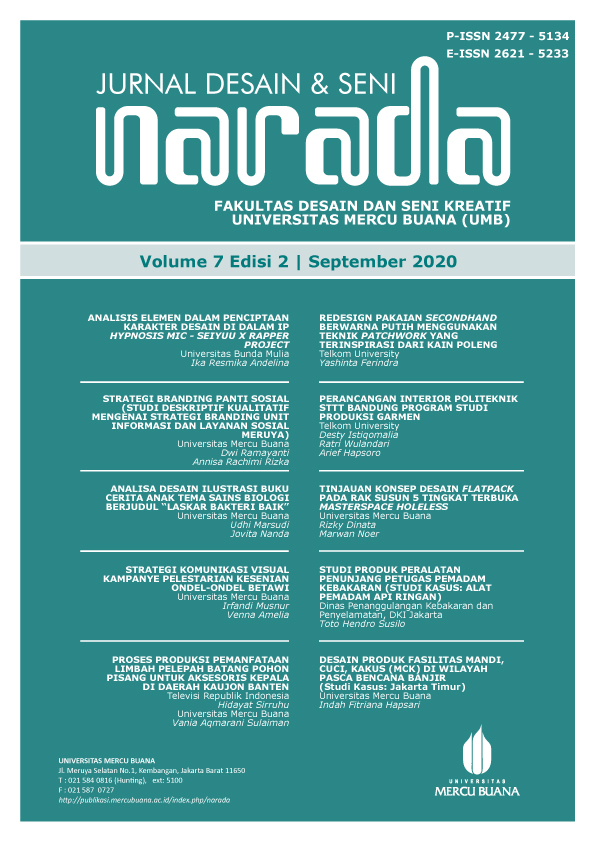
DESAIN PRODUK MANDI, CUCI, KAKUS (MCK) DI WILAYAH PASCA BENCANA BANJIR (Studi Kasus: Jakarta Timur)
DOI:
https://doi.org/10.22441/narada.2020.v7.i2.010Keywords:
Tough, Reliable, Easy to useAbstract
Activities inside the bathroom have already been a part of human activities every day. Because of that bathroom became one of the most visited places. From the function point of view, a bathroom is a place to cleaning ourselves self (clean up), so the most crucial requirement for the bathroom is to serve clean and freshwater. Regarding its function as a place to cleaning ourself, room arrangement needs to be associated with bathroom need. Inside a bathroom, there is a need for space for human movements, such as to rub the body, pour, and dry ourselves. So, to design a qualified bathroom, have to be concerned about all the needs, then the excellent bathroom can be developed and useful for everyone.
Downloads
References
Anshel, J. (2005). Visual Ergonomics Handbook. New York: Taylor and Francis Group.
Bowers, J. (1999). Introduction to Two – Dimensional Design: Understanding Form and Function. Canada: John Wiley and Sons, Inc.
Byars, M. (1998). 50 Products Innovations in Design and Materials. Switzerland: RotoVision SA.
Day, D. (1973). Construction Equipment Guide. New York: John Wiley & Sons.
Gill, W, R. (1991). Basic Rendering. London: Thames and Hudson Ltd.
Gill, W, Robert. (1973). Rendering with Pen and Ink. London: thames and Hudson Ltd.
Gower. (1999). On Design and Innovation. Aldershot: Gower Publishing Limited.
Heskett, J. (1980). Industrial Design. London: Thames and Hudson Ltd.
Felice, F. (1994). Japanese Design – A Survey Since 1950. Philadelphia: Museum of Art and Harry N. Abrams, Inc.
Jordan, W, P. (2000). Designing Pleasurable Products. London: Taylor and Francis Group.
Kern, D. (2002). Design for Impact. United Kingdom: Laurence King Publishing Ltd.
Kemnitzer, R, B. (1983). Rendering With Marker. London: VNU Business Media, Inc.
Lefteri, C & Rashid, K. (2006). Plastics 2 – Materials for Inspirational Design. Switzerland: RotoVision SA.
Noblet, D, J. (1993). Industrial Design – Reflection of A Century. Paris Flammaron.
Panero, J & Zelnik, M. (1979). Dimensi Manusia Dan Ruang Interior. Jakarta: Erlangga.
Tabrani, P. (2000). Proses Kreasi, Apresiasi Belajar. Bandung: Ganesha ITB.
Read, Herbert. (1953). Art and Industry. New York: Horizon Press.
Rochmanhadi. (1983). Kapasitas dan Produksi Alat-alat Berat. Jakarta: Departemen Pekerjaan Umum.
Tilley, R, A. (1959). The Measure Of Man And Woman. USA: BPI Communication Inc.
Viemeister, T. (1993). Product Design 6. New York: PBC International, Inc.
Woodson, E, W. (1981). Human Factors Design Handbook. USA: McGraw Hill, Inc.
Downloads
Published
How to Cite
Issue
Section
License
A writer who will publish their article in the NARADA Journal of Design and Art agrees to the following conditions:
- The author owns the copyright and grants the rights to NARADA Journal of Design and Art as the party entrusted with publishing the article for the first time simultaneously licensed under the "Creative Commons Attribution-ShareAlike 4.0" License. This makes it possible for other people to share the work with a form of acknowledgment of authorship of the work and initial publication in this journal according to the authorship of the article provided.
- Authors may enter into separate additional contractual agreements for non-exclusive distribution of the published journal version of the work (e.g., posting it to an institutional repository or publishing it in a book) with acknowledgment of initial publication in the NARADA Journal of Design and Art.
- Authors are permitted and asked to post their work online (for example, institutional repositories or on personal websites) after the article publication process. This avoids double publication or multiple submissions which will affect the similarity of writing of the published work.
- In order to maintain the value of originality and similarity of articles sent or submitted. Authors are asked to temporarily remove or hide the original article from other online systems until they receive the results and decisions from the NARADA Journal of Design and Art regarding the decision to publish the article.
- The author, in this case the contributing author (Contributor Author), will be sent a form or letter stating the validity of the scientific work, signed on an IDR 10,000 stamp. Then the author will be asked to send the email to [email protected].
Pemberitahuan Hak Cipta
Seorang penulis yang akan menerbitkan artikelnya dalam NARADA Jurnal Desain dan Seni setuju dengan ketentuan berikut:
- Penulis memiliki hak cipta dan memberikan hak kepada pihak NARADA Jurnal Desain dan Seni sebagai pihak yang diberikan kepercayaan untuk mempublikasi artikelnya pertama kali secara bersamaan dilisensikan di bawah Lisensi "Creative Commons Attribution-ShareAlike 4.0". Hal ini memungkinkan kepada orang lain untuk membagi karya dengan bentuk pengakuan kepengarangan karya dan publikasi awal dalam jurnal ini sesuai dengan penulisan artikel yang diberikan.
- Penulis dapat membuat perjanjian kontrak tambahan yang terpisah untuk distribusi non-eksklusif versi jurnal yang diterbitkan dari karya tersebut (misalnya, mempostingnya ke repositori institusional atau menerbitkannya dalam sebuah buku) dengan pengakuan publikasi awal dalam NARADA Jurnal Desain dan Seni.
- Penulis diizinkan dan diminta untuk mempostingkan karyanya secara online (semisal, repositori institusional atau di situs web pribadi) setelah proses penerbitan artikel, Hal ini menghindari adanya double publikasi atau pengajuan jamak yang akan berpengaruh kepada adanya kesamaan penulisan dari karya yang diterbitkan.
- Demi menjaga nilai orisinalitas dan nilai kesamaan dari artikel yang dikirim atau diajukan. Penulis diminta untuk menghilangkan atau menyembunyikan secara sementara artikel orisinil dari sistem online lain yang sampai mendapatkan hasil nilai dan ketetapan dari pihak NARADA Jurnal Desain dan Seni mengenai keputusan publikasi dari artikel.
- Penulis dalam hal ini penulis kontributor (Contributor Author) akan dikirimkan form atau surat pernyataan keabsahan karya ilmiah, yang ditanda tangani di atas materai 10000. Dan selanjutnya penulis diminta untuk mengirimkan ke email [email protected].









