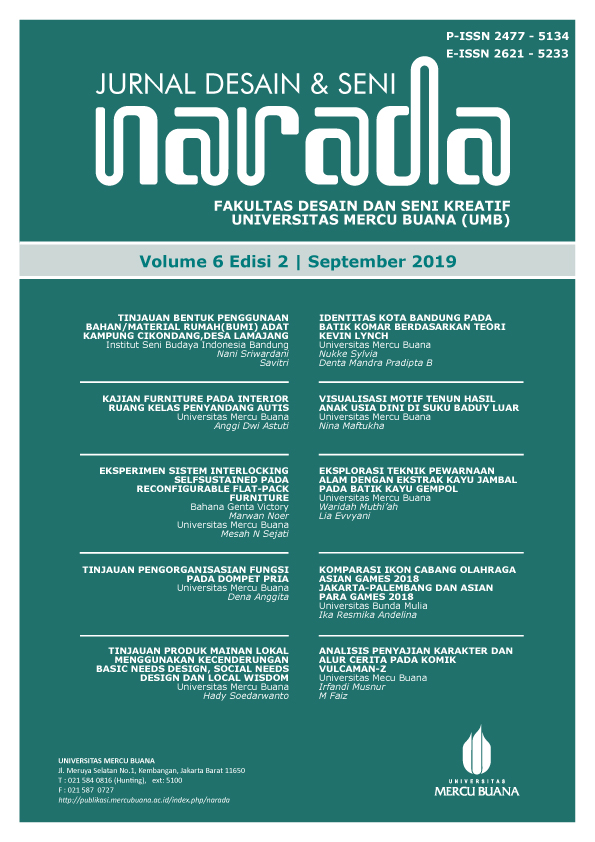
EKSPLORASI TEKNIK PEWARNAAN ALAM DENGAN EKSTRAK KAYU JAMBAL PADA BATIK KAYU GEMPOL
DOI:
https://doi.org/10.22441/narada.2019.v6.i2.008Keywords:
pewarna alam, batik kayu, gempol, jambal, merbau, mordanAbstract
Gempol is a type of wood that is widely used as a craft material. Because the nature of the material is not too hard, easy to form, easy to absorb the liquid dye, and not greasy, this wood is suitable to be processed with various techniques, including wooden batik. Because of its uniqueness, wooden batik has good potential to be developed in the craft industry. However, the technique used in the process of making wooden batik tends to be harmful to the environment, because it uses synthetic dyes. Natural dyes are rarely developed for wood batik because they are considered not good in terms of color quality and time efficiency. This study seeks to explore the use of natural dyes extract of jambal wood on gempol wood, through various types of mordants, coloring and mordanting methods, and coloring times. The research was carried out using an experimental method with the AHP method to obtain the ideal coloring method and material formulation.
Downloads
References
Djufri, R. (1976). Teknologi Pengelantangan, Pencelupan, dan Pencapan. Bandung: Institut Teknologi Tekstil.
Farida, F., Atika, V., & Haerudin, A. (2015). Pengaruh Variasi Bahan Pra Mordan pada Pewarnaan Batik Menggunakan Akar Mengkudu (Morinda citrifolia). Dinamika Kerajinan Dan Batik, 32(1), 1-8.
Khasbullah, K. (2013). Finishing Pengolahan/Penyempurnaan Tekstil. Jakarta: Yayasan Alkhairiyah.
Kurniawati, D. Y. (2014). Eksistensi Kerajinan Batik Kayu di Dusun Krebet, Desa Sendangsari, Kecamatan Pajangan, Kabupaten Bantul, Yogyakarta (Kajian Historis dan Estetika) (Doctoral Dissertation, Institut Seni Indonesia Surakarta).
Muflihati. (2013). Ekstraktif Kulit Kayu Samak (Syzygium inophyllum DC) Sebagai Pewarna Alami Kayu [Tesis]. Bogor : Institut Pertanian Bogor.
Murwati, E. S., Pristiwati, E., & Nugroho, L. P. A. (2011). Teknik Pewarnaan Agel Dengan Zat Warna Alam dari Daun Jati. Dinamika Kerajinan Dan Batik, 28(1), 31-36.
Priyanto, S. (2013). Pengetahuan Proses Pretreatment Produksi Textile Dyeing & Printing. Jakarta.
Santosa, E. K., & Kusumastuti, A. (2014). Pemanfaatan Daun Tembakau untuk Pewarnaan Kain Sutera dengan Mordan Jeruk Nipis. Teknobuga, 1(1).
Suprapto, Agus dkk. (2005). Teknologi Persiapan Penyempurnaan. Bandung: Sekolah Tinggi Teknologi Tekstil.
Wardyani, Y., & Diba, F. (2017). Pewarnaan Kayu Sengon (Paraserianthes falcataria Linn) dari Ekstrak Limbah Kulit Kayu Bakau (Rhizophora apiculata Blume): Uji Ketahanan Warna Dan Keawetan Kayu. Jurnal Hutan Lestari, 5(3), 618-628.
Downloads
Published
How to Cite
Issue
Section
License
A writer who will publish their article in the NARADA Journal of Design and Art agrees to the following conditions:
- The author owns the copyright and grants the rights to NARADA Journal of Design and Art as the party entrusted with publishing the article for the first time simultaneously licensed under the "Creative Commons Attribution-ShareAlike 4.0" License. This makes it possible for other people to share the work with a form of acknowledgment of authorship of the work and initial publication in this journal according to the authorship of the article provided.
- Authors may enter into separate additional contractual agreements for non-exclusive distribution of the published journal version of the work (e.g., posting it to an institutional repository or publishing it in a book) with acknowledgment of initial publication in the NARADA Journal of Design and Art.
- Authors are permitted and asked to post their work online (for example, institutional repositories or on personal websites) after the article publication process. This avoids double publication or multiple submissions which will affect the similarity of writing of the published work.
- In order to maintain the value of originality and similarity of articles sent or submitted. Authors are asked to temporarily remove or hide the original article from other online systems until they receive the results and decisions from the NARADA Journal of Design and Art regarding the decision to publish the article.
- The author, in this case the contributing author (Contributor Author), will be sent a form or letter stating the validity of the scientific work, signed on an IDR 10,000 stamp. Then the author will be asked to send the email to [email protected].
Pemberitahuan Hak Cipta
Seorang penulis yang akan menerbitkan artikelnya dalam NARADA Jurnal Desain dan Seni setuju dengan ketentuan berikut:
- Penulis memiliki hak cipta dan memberikan hak kepada pihak NARADA Jurnal Desain dan Seni sebagai pihak yang diberikan kepercayaan untuk mempublikasi artikelnya pertama kali secara bersamaan dilisensikan di bawah Lisensi "Creative Commons Attribution-ShareAlike 4.0". Hal ini memungkinkan kepada orang lain untuk membagi karya dengan bentuk pengakuan kepengarangan karya dan publikasi awal dalam jurnal ini sesuai dengan penulisan artikel yang diberikan.
- Penulis dapat membuat perjanjian kontrak tambahan yang terpisah untuk distribusi non-eksklusif versi jurnal yang diterbitkan dari karya tersebut (misalnya, mempostingnya ke repositori institusional atau menerbitkannya dalam sebuah buku) dengan pengakuan publikasi awal dalam NARADA Jurnal Desain dan Seni.
- Penulis diizinkan dan diminta untuk mempostingkan karyanya secara online (semisal, repositori institusional atau di situs web pribadi) setelah proses penerbitan artikel, Hal ini menghindari adanya double publikasi atau pengajuan jamak yang akan berpengaruh kepada adanya kesamaan penulisan dari karya yang diterbitkan.
- Demi menjaga nilai orisinalitas dan nilai kesamaan dari artikel yang dikirim atau diajukan. Penulis diminta untuk menghilangkan atau menyembunyikan secara sementara artikel orisinil dari sistem online lain yang sampai mendapatkan hasil nilai dan ketetapan dari pihak NARADA Jurnal Desain dan Seni mengenai keputusan publikasi dari artikel.
- Penulis dalam hal ini penulis kontributor (Contributor Author) akan dikirimkan form atau surat pernyataan keabsahan karya ilmiah, yang ditanda tangani di atas materai 10000. Dan selanjutnya penulis diminta untuk mengirimkan ke email [email protected].









