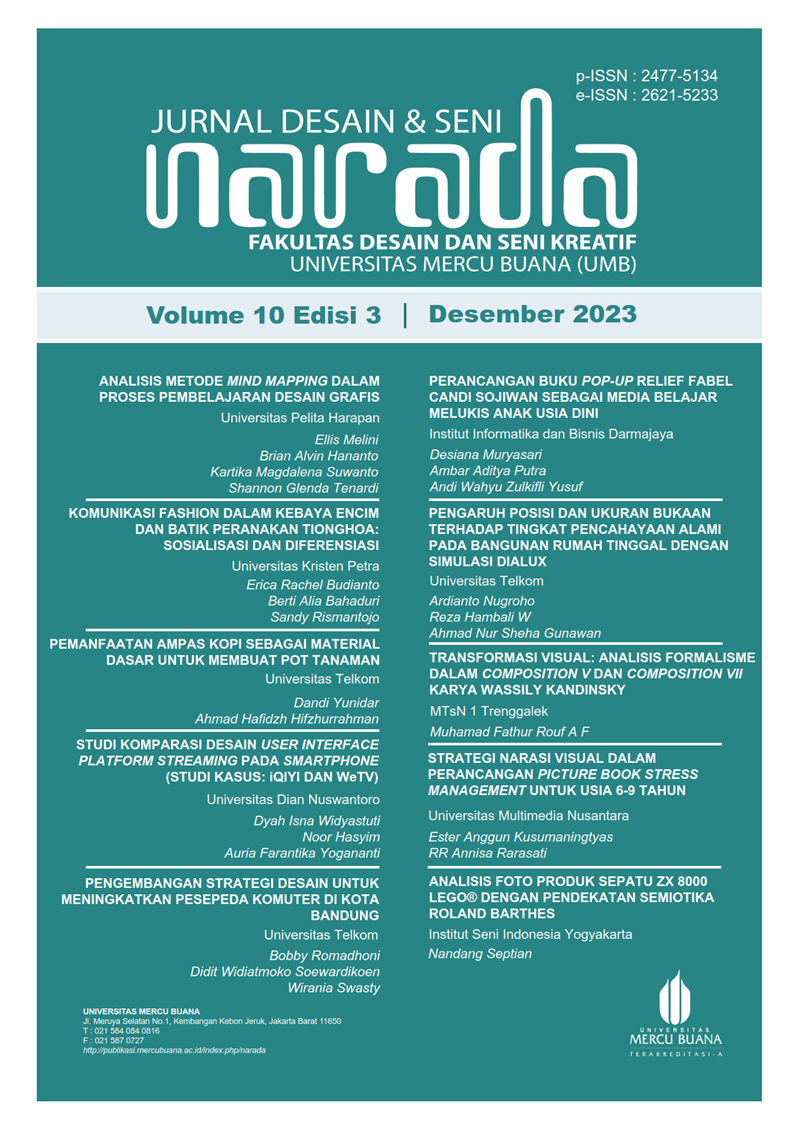
KOMUNIKASI FASHION DALAM KEBAYA ENCIM DAN BATIK PERANAKAN TIONGHOA: SOSIALISASI DAN DIFERENSIASI
DOI:
https://doi.org/10.22441/narada.2023/v10.i3.002Keywords:
Batik, Kebaya encim, Fashion communication, Chinese PeranakanAbstract
Fashion, clothing and culture are communication and cultural phenomenon, in which fashion communication has both socialization and differentiation function. In the realm of fashion and clothing, the forming of social groups and personal identities are established through continuous communication process. This phenomenon occurred in the development of kebaya encim and Chinese Peranakan batik at Java in the 19th century. Kebaya encim was a type of kebaya worn by Peranakan Chinese women, therefore it had visual characteristics which were eminently influenced by Chinese culture. The Chinese Peranakan women used to wear kebaya as upper clothes, combined with Peranakan Chinese batik cloth as skirt At the beginning, kebaya encim and Peranakan Chinese batik emulated the kebaya and batik characteristics worn by Dutch women in Java. This was due to the desire of Peranakans to acquire equal privilidge with the Dutch in the society.This research aims to define the role of fashion communication in the development of kebaya encim and Peranakan Chinese batik in the 19th century at Java Island. Therefore, this research utilises descriptive qualitative approach. Theories which are used in this research are Barnard's fashion communication theory and Lukman's mimicry and hibridity theory. This research confirms that there is fashion communication process that can be emphasized from socialization and differentiation function with mimicry and hybridity phenomenon in kebaya encim and Peranakan Chinese batik. Socialization can be seen from mimicry of Dutch's kebaya and batik style to obtain social equality. Moreover there is also differentiation function, since the Chinese Peranakans made some special adjustments toward their own kebaya and batik characteristics in order to be more suitable with their culture.
Downloads
References
Barnard, M. (2016). Fashion Sebagai Komunikasi: Cara Mengomunkasikan Identitas Sosial, Seksual, Kelas dan Gender. Yogyakarta: Jalasutra.
Bhabha, H. (2004). Location of Culture. London: Routledge.
Budianto, E.R. (2019). Identitas Elemen Estetik Batik Peranakan Tionghoa 'Oey Soe Tjoen' Generasi Pertama. Tesis Program Magister Institut Teknologi Bandung, Bandung.
Calosa, M. (2014). Teknik Mendesain Kebaya Sendiri. Jakarta: Prima.
Chavalit, K.M, Phromsuthirak, M. (2000). Costumes in ASEAN. Bangkok: ASEAN Committee on Culture and Information of Thailand.
Forshee, J. (2006). Culture and Customs of Indonesia. London: Greenwood Publishing Group.
Gillow, J. (1992). Traditional Indonesian Textilles. London: Thames and Hudson Ltd.
Knapp, R.G. (2012). The Peranakan Chinese Home: Arts and Culture in Daily Life. Singapura: Tuttle Publishing.
Knight-Achjadi, J., Damais, A. (2006). Butterflies and Phoenixes: Chinese Inspirations in Indonesian Textile Arts. Singapura: Marshall Cavendish Editions.
Lee, P. (2014). Sarong Kebaya: Peranakan Fashion in an Interconnected World 1500-1950. Singapura: Asian Civilizations Museum.
Lee, T. (2016). Defining the Aesthetics of the Nyonyas’ Batik Sarongs in the Straits Settlements, Late Nineteenth to Early Twentieth Century. Asian Studies Review, 40(2), 173–191. https://doi.org/10.1080/10357823.2016.1162137.
Lukman, C.C., Piliang, Y.A., Sunarto, P. (2013). Kebaya Encim as the Phenomenon of Mimicry in East Indies Dutch Colonial's Culture. Art and Design Studies, 13, 15-22.
Mahmood, D.S.E. (2012). The Nyonya Kebaya: A Century of Straits Chinese Costume. Singapore: Tuttle Publishing.
Moleong, L.J. (2001). Metodologi Penelitian Kualitatif. Bandung: PT Remaja Rosdakarya.
Neo, C.O.K. (2011). Kebaya Nyonya. Singapura: Forst Printers Pte Ltd.
Roojen, P.V. (2001). Batik Design. Amsterdam: Pepin Press.
Setiawan, F. (2011). 50 Galeri Kebaya Eksotik nan Cantik. Jakarta: Penebar Plus.
Simmel, G. (1997). The Philosophy of Fashion. Chicago: University of Chicago Press.
Sumarsono, H., Ishwara, H., Yahya, L.R.S., dan Moeis, X. (2018). Batik Pesisir Pusaka Indonesia: Koleksi Hartono Sumarsono. Jakarta: Lintas Persada Anugerah.
Suryadinata, L. (1984). Dilema Minoritas Tionghoa. Jakarta: PT Grafiti Pers.
Tan, C.B. (1988). Structure and Change: Cultural Identity of the Baba of Melaka, Bijdragen tot de Taal-, Land- en Volkenkunde (Journal of the Humanitites and Social Sciences of Southeast Asia), 144(2),297-314. https://doi.org/10.1163/22134379-90003298.
Veldhuisen, H.C. (2007). Batik Belanda 1840-1940: Pengaruh Belanda pada Batik dari Jawa, Sejarah dan Kisah-kisah di Sekitarnya. Jakarta: PT Gaya Favorit Press.
Wang, Y. (2023). Fashion: An essential factor influencing the development of 19th to 20th centuries Peranakan decorative motifs, Cogent Arts & Humanities, 10(1), 2198321. 10.1080/23311983.2023.2198321.
Yarwood, D. (1978). Illustrated Encyclopedia of World Costume. New York: Dover Publications Inc.
Zwain, A., Bahauddin, A. (2021). Malacca’s “Straits Chinese traditional courtyard eclectic style shophouses”: facades’architectural design elements through place identity. Journal of Cultural Heritage Management and Sustainable Development, ISSN 2044-1266,https://doi.org/10.1108/JCHMSD-02-2021-0014
Downloads
Published
How to Cite
Issue
Section
License
A writer who will publish their article in the NARADA Journal of Design and Art agrees to the following conditions:
- The author owns the copyright and grants the rights to NARADA Journal of Design and Art as the party entrusted with publishing the article for the first time simultaneously licensed under the "Creative Commons Attribution-ShareAlike 4.0" License. This makes it possible for other people to share the work with a form of acknowledgment of authorship of the work and initial publication in this journal according to the authorship of the article provided.
- Authors may enter into separate additional contractual agreements for non-exclusive distribution of the published journal version of the work (e.g., posting it to an institutional repository or publishing it in a book) with acknowledgment of initial publication in the NARADA Journal of Design and Art.
- Authors are permitted and asked to post their work online (for example, institutional repositories or on personal websites) after the article publication process. This avoids double publication or multiple submissions which will affect the similarity of writing of the published work.
- In order to maintain the value of originality and similarity of articles sent or submitted. Authors are asked to temporarily remove or hide the original article from other online systems until they receive the results and decisions from the NARADA Journal of Design and Art regarding the decision to publish the article.
- The author, in this case the contributing author (Contributor Author), will be sent a form or letter stating the validity of the scientific work, signed on an IDR 10,000 stamp. Then the author will be asked to send the email to [email protected].
Pemberitahuan Hak Cipta
Seorang penulis yang akan menerbitkan artikelnya dalam NARADA Jurnal Desain dan Seni setuju dengan ketentuan berikut:
- Penulis memiliki hak cipta dan memberikan hak kepada pihak NARADA Jurnal Desain dan Seni sebagai pihak yang diberikan kepercayaan untuk mempublikasi artikelnya pertama kali secara bersamaan dilisensikan di bawah Lisensi "Creative Commons Attribution-ShareAlike 4.0". Hal ini memungkinkan kepada orang lain untuk membagi karya dengan bentuk pengakuan kepengarangan karya dan publikasi awal dalam jurnal ini sesuai dengan penulisan artikel yang diberikan.
- Penulis dapat membuat perjanjian kontrak tambahan yang terpisah untuk distribusi non-eksklusif versi jurnal yang diterbitkan dari karya tersebut (misalnya, mempostingnya ke repositori institusional atau menerbitkannya dalam sebuah buku) dengan pengakuan publikasi awal dalam NARADA Jurnal Desain dan Seni.
- Penulis diizinkan dan diminta untuk mempostingkan karyanya secara online (semisal, repositori institusional atau di situs web pribadi) setelah proses penerbitan artikel, Hal ini menghindari adanya double publikasi atau pengajuan jamak yang akan berpengaruh kepada adanya kesamaan penulisan dari karya yang diterbitkan.
- Demi menjaga nilai orisinalitas dan nilai kesamaan dari artikel yang dikirim atau diajukan. Penulis diminta untuk menghilangkan atau menyembunyikan secara sementara artikel orisinil dari sistem online lain yang sampai mendapatkan hasil nilai dan ketetapan dari pihak NARADA Jurnal Desain dan Seni mengenai keputusan publikasi dari artikel.
- Penulis dalam hal ini penulis kontributor (Contributor Author) akan dikirimkan form atau surat pernyataan keabsahan karya ilmiah, yang ditanda tangani di atas materai 10000. Dan selanjutnya penulis diminta untuk mengirimkan ke email [email protected].









