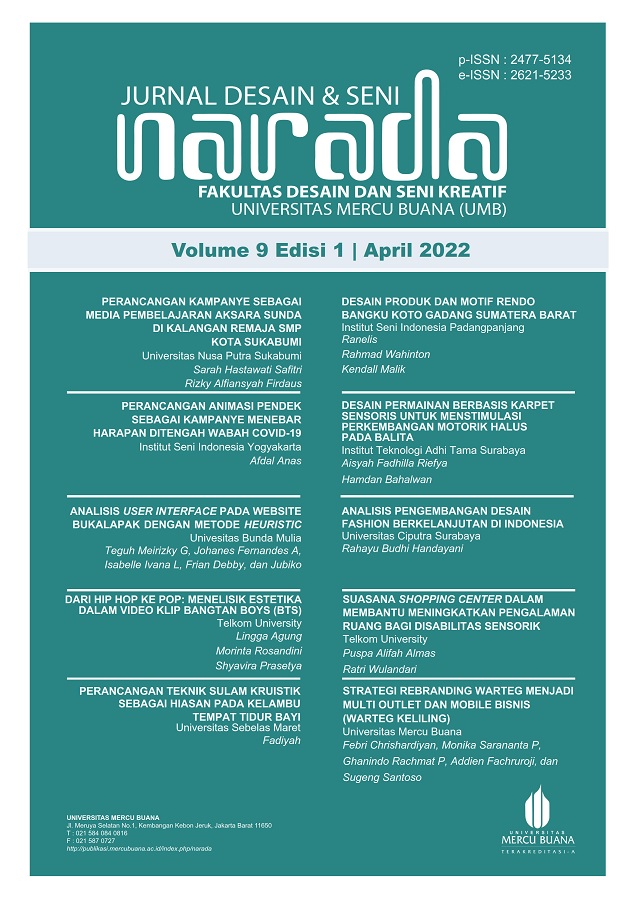
ANALISIS PENGEMBANGAN DESAIN FASHION BERKELANJUTAN DI INDONESIA
DOI:
https://doi.org/10.22441/narada.2022.v9.i1.008Keywords:
Design Development, Fashion, SustainabilityAbstract
Analysis of Sustainable Fashion Design Development in Indonesia describes how a design approach strategy can be put into practice to contribute to the development of sustainable fashion. Fashion is an industry that has great potential for Indonesia's creative economy and employment, but on the other hand it has negative social and environmental impacts. Sustainable fashion is a new trend and aesthetic that is developing in urban society. There are various strategies to develop sustainable fashion, one of which is through a design approach. Using a qualitative descriptive approach, this paper further analyzes the implementation of this strategy through purposive sampling of the brand, Sejauh Mata Memandang, as one of the pioneers of sustainable fashion brand in Indonesia. Based on the results of virtual observations and data analysis, it is concluded that there are six sustainable design strategies carried out by Sejauh Mata Memandang that can be used as references as best practices for developing sustainable fashion design in Indonesia.
Downloads
References
Brooks, A., Fletcher, K., Francis, R. A., Rigby, E. D., & Roberts, T. (2017). Fashion, sustainability, and the anthropocene. Utopian Studies. Vol. 28(3).
DOI:https://doi.org/10.5325/utopianstudies.28.3.0482
Dean, C. (2020). Waste - Is It Really in Fashion? Https://Www.Fashionrevolution.Org/Waste-Is-It-Really-in-Fashion/ .
Fletcher, K. (2012). Sustainable fashion and textiles: Design journeys. In Sustainable Fashion and Textiles: Design Journeys.
DOI:https://doi.org/10.4324/9781849772778
Győr, A. F. (2017). Digital ethnography: Principles and practice by Sarah Pink, Heather Horst, John Postill, Larissa Hjorth, Tania Lewis, Jo Tacchi (1st edition. London, Sage, 2016). In Corvinus Journal of Sociology and Social Policy. Vol. 8(1).
DOI:https://doi.org/10.14267/CJSSP.2017.01.08
Handayani, R. B., Hutama, K., & Sunarya, Y. Y. (2020). Matriks Strategi Implementasi Perancangan Fashion Berkelanjutan. Jurnal Seni Dan Reka Rancang: Jurnal Ilmiah Magister Desain, 3(1).
DOI:https://doi.org/10.25105/jsrr.v3i1.8291
Holmes, E. (2014). Fashion Brands’ Message for Fall Shoppers: Buy Less, Spend More. Https://Www.Wsj.Com/Articles/Fashion-Brands-Message-for-Fall-Shoppers-Buy-Less-Spend-More-1409786240.
Jung, S., & Jin, B. (2014). A theoretical investigation of slow fashion: Sustainable future of the apparel industry. International Journal of Consumer Studies. Vol. 38(5).
DOI:https://doi.org/10.1111/ijcs.12127
Laitala, K., Boks, C., & Klepp, I. G. (2015). Making Clothing Last : A Design Approach for Reducing the Environmental Impacts. Vol. 9(2), 93–107.
Nijman, S. (2019). UN Alliance For Sustainable Fashion addresses damage of ‘fast fashion.’ (n.d.). Diambil dari: https://www.unep.org/news-and-stories/press-release/un-alliance-sustainable-fashion-addresses-damage-fast-fashion (Diakses pada tanggal September 5, 2021)
Wild, B. (2016). Imitation in fashion: Further reflections on the work of Thorstein Veblen and Georg Simmel. Fashion, Style & Popular Culture. Vol.3(3).
DOI:https://doi.org/10.1386/fspc.3.3.281_1
Young, S. (2020). “Fashion Revolution Week: What Was the Rana Plaza Disaster and Why Did it Happen?”. Dalam INDEPENDENT Dimabil dari: Https://Www.Independent.Co.Uk/Life-Style/Fashion/Rana-Plaza-Factory-Disaster-Anniversary-What-Happened-Fashion-A9478126.Html.
Downloads
Published
How to Cite
Issue
Section
License
A writer who will publish their article in the NARADA Journal of Design and Art agrees to the following conditions:
- The author owns the copyright and grants the rights to NARADA Journal of Design and Art as the party entrusted with publishing the article for the first time simultaneously licensed under the "Creative Commons Attribution-ShareAlike 4.0" License. This makes it possible for other people to share the work with a form of acknowledgment of authorship of the work and initial publication in this journal according to the authorship of the article provided.
- Authors may enter into separate additional contractual agreements for non-exclusive distribution of the published journal version of the work (e.g., posting it to an institutional repository or publishing it in a book) with acknowledgment of initial publication in the NARADA Journal of Design and Art.
- Authors are permitted and asked to post their work online (for example, institutional repositories or on personal websites) after the article publication process. This avoids double publication or multiple submissions which will affect the similarity of writing of the published work.
- In order to maintain the value of originality and similarity of articles sent or submitted. Authors are asked to temporarily remove or hide the original article from other online systems until they receive the results and decisions from the NARADA Journal of Design and Art regarding the decision to publish the article.
- The author, in this case the contributing author (Contributor Author), will be sent a form or letter stating the validity of the scientific work, signed on an IDR 10,000 stamp. Then the author will be asked to send the email to [email protected].
Pemberitahuan Hak Cipta
Seorang penulis yang akan menerbitkan artikelnya dalam NARADA Jurnal Desain dan Seni setuju dengan ketentuan berikut:
- Penulis memiliki hak cipta dan memberikan hak kepada pihak NARADA Jurnal Desain dan Seni sebagai pihak yang diberikan kepercayaan untuk mempublikasi artikelnya pertama kali secara bersamaan dilisensikan di bawah Lisensi "Creative Commons Attribution-ShareAlike 4.0". Hal ini memungkinkan kepada orang lain untuk membagi karya dengan bentuk pengakuan kepengarangan karya dan publikasi awal dalam jurnal ini sesuai dengan penulisan artikel yang diberikan.
- Penulis dapat membuat perjanjian kontrak tambahan yang terpisah untuk distribusi non-eksklusif versi jurnal yang diterbitkan dari karya tersebut (misalnya, mempostingnya ke repositori institusional atau menerbitkannya dalam sebuah buku) dengan pengakuan publikasi awal dalam NARADA Jurnal Desain dan Seni.
- Penulis diizinkan dan diminta untuk mempostingkan karyanya secara online (semisal, repositori institusional atau di situs web pribadi) setelah proses penerbitan artikel, Hal ini menghindari adanya double publikasi atau pengajuan jamak yang akan berpengaruh kepada adanya kesamaan penulisan dari karya yang diterbitkan.
- Demi menjaga nilai orisinalitas dan nilai kesamaan dari artikel yang dikirim atau diajukan. Penulis diminta untuk menghilangkan atau menyembunyikan secara sementara artikel orisinil dari sistem online lain yang sampai mendapatkan hasil nilai dan ketetapan dari pihak NARADA Jurnal Desain dan Seni mengenai keputusan publikasi dari artikel.
- Penulis dalam hal ini penulis kontributor (Contributor Author) akan dikirimkan form atau surat pernyataan keabsahan karya ilmiah, yang ditanda tangani di atas materai 10000. Dan selanjutnya penulis diminta untuk mengirimkan ke email [email protected].









